Featured post

The Scottish Islanders

  Get your copy from  www.shop.yachtarchive.scot  !

Showing posts with label fish farm salmon ardmaddy cuan sound seil crown estate. Show all posts

Tuesday, 16 August 2011

Daring (maybe not so) Young Men in their Flying Canoes

Canoe men, all images courtesy Jeff Broome
One blustery day at the end of May I was amazed to see a fleet of little sailing machines travelling down our loch at great speed before a Westerly breeze. Soon after they were hauling out in front of the house and we were able to offer them a little shelter in our humble abode.

Their visit gave Anne and me an insight into the crusing sailing canoe, pioneered by some great Victorians and now taken to a fine modern art by these latter-day McGregors. They've now written up their exploits in Argyll in their Canoe Gossip and have allowed me to publish them as a guest posting.

"Waiting for the Tide (and Wind) - Jeff Broome
A select band of five congregated in Oban on the last Saturday in May for a cruise, initially intended to be a circumnavigation of Mull. These were myself, the two Daves, Gavin and Keith. There were no spouses in attendance as other activities, such as growing vegetables, seem to have been more attractive, although the underlying concern was that us lads want to sail too far and for too long. As things turned out this would not have been a problem. The forecast was dire for Sunday and so we weren't in any great hurry to get away. Besides, the prospect of camping for at least one night on Kerrera could not compete with the comforts of the campsite and bright lights of Oban.
Sunday turned out to be as grim as predicted, so we walked into Oban for lunch. I can recommend the freshly cooked mussels from the stall behind the ferry terminal and also the cafe found by the others. In the pub, ambitions were reined in and the plan was now for a cruise down the Firth of Lorn and to play it by ear as the weather was clearly going to be unpredictable; this option would give us both sheltered water and convenient opportunities for escape, if necessary.

Monday morning was still windy, but manageable, and the weather forecast was for it to improve, although a serious low was predicted to hit us later in the week. By the time we had packed up the tents and loaded up the boats, things were looking a lot better and we set off down the Sound of Kerrera into lumpy seas. The five boats varied in size from Dave P's ocean going trimaran down to Dave S's Fulmar. We called in at Barrnacarry Bay on the south shore at the entrance to Loch Feochan for a leisurely lunch.
The west coast of Seil promised to be rather uncomfortable and so the plan was to sail through Clachan Sound and we were in no hurry. Even so we set off knowing that the tide would still be against us in the sound, but this gave us the opportunity to explore the Puilladobhrain anchorage before going through. This is a deservedly very popular stop for yotties, it is very sheltered and has beautiful views across the Firth of Lorn to the mountains of Mull.
Clachan Sound is remarkable. It is a narrow and very straight channel between the island of Seil and the mainland which is spanned by the 'Bridge over the Atlantic', a single arch stone bridge completed in 1793. Next to it is Tigh an Truish Inn (the house of trousers!), allegedly where islanders stopped to change out of their banned tartan and kilts on their way to the mainland. Fortunately the Sound was sheltered from the wind because I found that sailing into the wind and with the tide can produce some very disconcerting effects. We had a very enjoyabl sail down Seil Sound as the wind had veered to the west a little and we made good time down to Degnish Point. The beach suggested by Keith was rejected as an unsuitable place to camp as it is rather exposed to the south and so we set off to Bagh Lachlainn on the east coast of Luing. which turned out to be a lovely sheltered location to weather a storm.

In the morning we set off for an exploration of Loch Melfort where none of us had sailed before. This took us down the Sound of Shuna and back north again where we encountered a Wayfarer being sailed by two OCSG members, Charlie and Bernie. We parted company and then had exhilarating sail up to Kilmelford in search of a café. We gathered on the road above the beach where we had landed to be greeted by Ewan Kennedy who had watched us sail in and come out to meet us. He gave us a choice: walk a mile or so to a cafe in Kilmelford Village; or accept his hospitality. Naturally we accepted his offer and spent a very enjoyable time drinking tea and coffee and eating a magnificent fruitcake that his wife produced from a cupboard. It would seem she keeps one in reserve for occasions like this when her husband invites in bands of hungry strangers. We had a fascinating conversation that ranged over the recent gales and the number of stranded yachts (four in Loch Melfort and we saw another two near Oban) and the fact that the tide didn't go out that day, Islander class boats, such as his own, mutual acquaintance with Richard Pierce, who it turns out was in the Lake District and not at home on Luing, his blog and more besides. We also could not leave without inspecting his dinghy and the restoration project in his garage.
We finally tore ourselves away and set off beating back up the loch. The weather had started to deteriorate by the time we got back to our campsite where Charlie and Bernie joined us and we had a very convivial evening around their campfire. Wednesday was as miserable as predicted and we all decided to go for a walk to Cullipool to check out the attractions of the post office, which boasts a machine dispensing Nescafe and stocks bird seed and wallpaper paste in addition to the usual very basic selection of groceries. I posted a postcard to my mum that took a mere 22 days to reach London! Charlie, Bernie and I walked around the north end of the island past the slate quarries and along the Cuan Sound to watch the tide racing through the Sound and the confused seas where the stream hits the open water.
We had a leisurely start the following morning because we had decided to head out through the Cuan Sound with a vague ambition to visit the Garvellachs. Reaching them was unlikely because we would have to wait for the tide to change in the Cuan Sound and this would not really leave enough time to get there without meeting foul tides. In the event we snuck through the sound against the last of the ebb and decided to head for the island of Belnahua. We set a cut off time of midday due to the light winds and the need to get to somewhere we could camp that night. In the event we made it within our time limit and landed with some difficulty, there still being a lazy swell and a rather steep beach. In fact Dave S nearly came a cropper as the backwash pulled his boat from his grasp. We had a very brief stay, as we were nervous about the safety of the boats on the beach. Belnahua is a bleak place, one of the 'slate islands' that supported a population of more than a hundred quarry men at the peak of activity. The quarry workings in the centre of the island are now flooded leaving a narrow strip of land around the edge with ruined buildings and rusting machinery scattered around. Our chosen destination for the night was Port Donain on Mull, about ten miles to the north. We had the tide with us and light winds and so it was a relaxing sail. Keith decided part way that his back, which had started to ache that morning, would prefer sleeping in his van to another night camping, so he headed straight back to Oban. The sun came out as we approached Port Donain and we spent a very pleasant time setting up camp and drying out.
Friday morning was sunny and warm too and we eventually set sail towards Loch Spelve. I say sail, but drifting and paddling were more the order of the day. As we approached a light breeze sprang up, just sufficient for us to be able to make progress against the ebbing tide and we made it about a mile up the entrance of the loch and stopped for lunch. We couldn't stay long because the tide was due to turn and having made a note to return and explore the loch further, we departed. The wind picked up a bit as we got back out into the Firth of Lorn and made for our starting point at the Puffin Dive Centre at Gallanach. Keith was there to greet us as we approached and to warn us of the divers in the water just off the slipway.
All in all a very enjoyable trip with some excellent sailing, some fairly unpleasant weather, good company and a new friend in Ewan Kennedy."
You can find out more about the canoe men (and women) on their website Open Canoe Sailing Group

It is most timely that the canoe men have supplied this account, in view of the threat to one of the stretches of water they sailed over from a fish farm. To read about our campaign to stop this click here:- http://www.saveseilsound.org.uk

Monday, 15 August 2011

Setting up a Website

image courtesy David Ainsley
Regular visitors to this blog will realise that my efforts recently have been largely taken up with campaigning to save Seil Sound and its wildlife from an enormous salmon farm development, which a company largely owned from Poland intend to install in this precious part of Scotland's scenic coastal heritage.

I've already posted extensively about the threat on this blog, but that isn't what the blog was intended to be about. Our campaign group, consisting of a number of local residents and others with varying backgrounds but a shared interest in preserving our ecology, local economy and quality of life, decided that we should set up a dedicated website for the campaign.

We quickly discovered that setting up a website requires a great deal more expertise than blogging and our group were delighted to recruit Garry Milligan, a computer expert and website whizzkid with a great interest in the ecology and heritage, to our ranks.

A weekend of frantic activity resulted in many days work being compressed into the time available. From a standing start on Saturday morning http://www.saveseilsound.org.uk went live last night.
Please join our campaign and enjoy the new site, which will contain lots of useful and sometimes disturbing information about the effects of factory marine farming on our delicate eco-systems.

Meantime, I've got a mass of materials gathered over the Summer on more gentle matters, which will enable this blog to return to its usual business of random musings, historical information and nice images of our West coast and its denizens.

image courtesy of David Ainsley

Sunday, 7 August 2011

Ardmaddy Fish Farm - Briefing Notes

View of the threatened site
Update as at 18 August 2011

Since these notes were prepared the campaign group has set up http://www.saveseilsound.org.uk where there are now comprehensive pages incorporating everything in the notes and much more besides. Also the group has received more information about the proposal and a number of points have been cleared up.

In particular the applicants have confirmed that when they referred to the "existing" installation in their application they were referring not to their existing operation further North but to a proposed mussel farm for which a local fisherman got a licence from the Crown Estate many years ago, but never actually constructed. Accordingly what they described as existing didn't exist and what did exist wasn't described.
 
The applicants have now provided details of their existing farm, in the sense of the one that really, actually does exist in the real world, which can be read about on the new website. What follows is the text of my original post. Please follow http://www.saveseilsound.org.uk for developments and updates.
 
I have prepared these notes for the assistance of those who are just joining the 400 or so people who have already made their views known to Argyll & Bute Council and also as an aide memoire for the rest of us.
The proposal

The operators of an existing salmon farm at Ardmaddy Bay in the Seil Sound, Argyll propose to close down that facility and open a new one further South in the Sound. They describe this as a proposed "relocation" but arguably this is misleading, because:-

1 Although not far distant the new site is much more prominent and conspicuous. It is in the centre of one of Argyll's finest visual panoramas, much visited by tourists and close to the Cuan Sound, which is believed to form a major run for the local wild fish population and is much used by passing commercial vessels and yachts.
2 The existing farm is said by the applicants to consist of six square fish cages, each ten metres by ten metres The new farm would contain two rows, each of six circular cages, described as 100 metres circumference, that is about 32 metres diameter, increasing the area involved from 55,803 square metres to 179,800 square metres. I'm not a great expert on football pitches, Olympic swimming pools or the size of Wales, but this seems a massive increase, by a factor of 3.2.
3 The existing operation is serviced by boats from Craobh Haven and the applicant's base in Loch Craignish. The new one would involve a concrete feeder and servicing barge of which the dimensions are given in one of the applicant's supporting documents. The proposed barge is rectangular and has a deck area of 26 metres by 18 metres. On top there are a number of units, including a feed silo and a personnel room with on top of this a further deck area surrounded by railings, giving a total height of about 3 metres. The structure would be built from grey concrete and surrounded by tyre fenders.
4 The existing unit has a maximum permitted biomass of 1,350 tonnes, whereas the new one would be 2,500 tonnes.
5 The proposed new unit would involve underwater lighting between the months of December and May, consisting of 2 x 1,000 watt lamps per cage powered by a diesel-fuelled generator on the barge.
6 To scare off wild-life "approved acoustic deterrents may be used if and when required."

I suggest that these features sufficiently distinguish the new proposal from the existing one to make this effectively a new proposal and not a relocation.

Further misleading statements.

The applicants state that the site has an "existing use" as a mussel farm. It is true that a local fisherman got a lease from the Crown Estate many years ago for this site (and two others) for this purpose, but he never operated the site as such. This statement may be calculated to make anyone unfamiliar with the locus think there is an operation there already. I am unable to see why else it was made.

What is relevant, but the applicants don't refer to it, is that many years ago Pan Fish Scotland were scoping this site for salmon farming and rejected it after local objections, some based on the fact that the adjacent bay was seen as a "harbour of refuge."
The applicants state:- "A Farm Management Agreement has been defined for this area and has been signed by Lakeland Marine Farm and Kames Limited." This is no doubt true but is not the whole story. There was a "Lower Lorn Area Management Agreement" in place between 2006 and the end of 2010, but it collapsed, per the Atlantic Salmon Trust:-
"Now the Lower Lorn AMA has collapsed, after wild fish interests in Argyll decided they could no longer support it. The Association of Salmon Fishery Boards (ASFB) says that this calls into question the viability of the entire policy.
The collapse is blamed on the 'serial failure of one side to the agreement to honour its commitments.' "
While the agreement between the two companies is better than nothing this history does nothing to inspire confidence. Area Management Agreements are a key part of the Scottish Government's strategy for controlling the spread of infection and sea lice and the lack of one in a largely contained stretch of water such as Loch Melfort is highly disturbing.

Nor for that matter does it inspire confidence that Lakeland Marine Farm Limited were in 2006 fined for the criminal offence of over-stocking their unit at Shuna.

Full details of the proposal and the comments received by Argyll & Bute Council can be found online here:- 


 The benefits of the proposal.
Farmed fish are by far the largest export from the Scottish economy by value at the present time, bringing in great sums to local economies not just in terms of direct employment but in the supporting industries and the spin-off multiplier effect beloved by economists. One consequence of this is that there is undoubtedly pressure on government bodies to downplay the side effects.

In the present case the applicants claim that the proposal will support "3 to 4 full-time and two part-time employees." Even in terms of the micro-economy in this part of Argyll this does not seem a lot. The automatic feeding system makes the unit less labour-intensive than a traditional unit.

One thing that will not happen is for any of the profit to stay in Scotland, or indeed in the UK. Lakeland Marine Farm Limited is owned by Morpol, an operation with numerous foreign shareholders, but mainly owned from Poland. You can inspect the list of shareholders here:-
The Grounds of Objection
The Science
As with many scientific issues where money is involved there is a furious debate about why our native fish stocks on the West coast are in proven, serious decline. Wild salmon are apparently plentiful in our great Northern and Eastern rivers where, surprise, surprise, there are no fish farms.

Marine biologists are providing convincing evidence of cross-infection between caged fish and wild stocks not just when the former escape but with the spread of the deadly sea-lice.

Many experts are worried that our waters could experience catastrophic increases of lice, one describing our sea-lochs as "bombing alleys."

The routine anti-biotic treatment of caged fish leads to the development of super-viruses.

The quantity of salmon faeces produced by 2,500 tonnes of salmon (about 400,000 fish) is equivalent to that produced by a town many times the size of Oban. Richard Pierce has calculated that the total human population of Seil has a weight of about fifteen tonnes. And the government spent eleven (or was it eighteen) million Pounds on a sewage system for them to keep our seas clean!

Very little is known about the behaviour patterns of our native sea-trout. There still are some in Loch Melfort and it is known that they run in Seil Sound.

How much pollution can the site in Ardmaddy take? I am informed that the bottom is rocky and so less able to take the constant dumping of waste food and faeces. By contrast, with a sediment bottom marine borers come to the surface and diligently clear up the mess left by human enterprise.

Finally to those who say we must eat something and why not salmon we must respond with the question "what do the salmon feed on?"

The most widely-accepted opinion seems to be that it takes three tonnes of fish-meal to produce one tonne of salmon. The fish-meal consists of sand-eels and similar fish that have been hoovered from the sea-bed, dried and processed. As fish are themselves mainly water it must take several tonnes of fish to create one tonne of meal. The industry itself claims a conversion ration of about 1.5 to 1, which seems improbable but is still inefficient.

Incidentally the destruction of sand-eels impacts on the populations of sea-birds and marine mammals too.

There is a helpful and highly readable article about all this available online here:-

Last, but I hope not least, some may spare a thought for the wretched salmon thrashing about in the cages. A very senior former government adviser in these matters considers "farming" a misnomer and told me that caged feeding would be a better term.

To all of this the industry will say, either that its methods are perfectly safe and there are other reasons for the loss of our wild fauna, or that these having already been destroyed there is nothing left to damage.

I am frankly astonished that Argyll & Bute Council appear to have decided that an Environmental Impact Assessment is not required in this case and have asked the planning officer in charge to explain the reasoning behind this. Others with better scientific knowledge than I have are also asking more detailed questions about this.

We can't expect too much from our national politicians, but local ones should be very concerned indeed about our ecology and the impact its destruction would have on our main local industry, tourism.

Tourism
While salmon-farming is important nationally tourism is the main driver of our local economy in Argyll. Including its supporting industries it employs by far the greatest number of our private sector workers.

Increasingly foreign visitors are coming to see Scotland's unique ecosystems, often bringing with them canoes and bicycles to explore her remote corners. Those of us lucky enough to be here year-round perhaps become used to the scenery, but to visitors from, say, the industrial heartland of Germany or the intensively-farmed flatlands of the Netherlands it presents breathtaking views of the unspoilt fringe of Europe.

Yachting has a traditionally elitist image, but water sport in all its forms, be it small boating, canoeing, diving or indeed yachting has always been one of the major pastimes of our island nation. Increasingly people are trailer-sailing, bringing small relatively inexpensive craft with them. There are also our excellent facilities for sea trips to see seals, dolphins, birds and other wild-life.

Bluntly, fish-farming and tourism don't mix. The sites are ugly and industrial and you won't see a lot of seals near them, because operators shoot them. (The present applicants have declared their intention to seek a shooting licence.)

In the present recession parts of our tourism industry are struggling and it's vitally important not to damage them further. This should be the main focus of our objections, as the threat to the local economy should be pretty obvious to both the planning officials and members of the planning committee.

Public Health and Safety

Seil Sound and Cuan Sound are in constant use by commercial fishermen, pleasure boats and yachts and excursion boats. Ardmaddy is a favourite spot for the Hebridean Princess and the Waverley occasionally passes near.

The proposal would make the only bay nearby effectively inaccessible, denying the harbour of refuge that was the basis for then Scottish-owned Pan Fish withdrawing years ago.

More than one half of the navigable part of the Seil Sound would be out of bounds. Just beyond the site the apparently clear part contains dangerous unmarked rocks. Richard Pierce has contributed the following:-

"This is the only sheltered safe beach landing / anchorage/ refuge in many miles of otherwise hostile coastline.  Its orientation, and position provide an unusually well protected refuge in all wind directions and tide conditions, particularly for the ever increasing number of cruising yachts and small cruise ships visiting the area....
I am concerned that by omission, the application does not fully illustrate the impact that the proposed development would have on safe navigation. For instance the submitted chart is cropped in such a way that anyone unfamiliar with the area will see no potential hazards. Reading the chart in the way a mariner does, to plot his course or safe refuge, requires a more extensive view....[which shows]... that no other vessel can anchor not only in the black zone, but in a significant region beyond, for fear of fouling anchor warps on mooring lines.                                                                 
This mooring area will thus preclude other vessels from anchoring in the shelter of Torsa from the prevailing SW and NE gales.
...from the scans it is difficult to appreciate the hazards to navigation to the North East Torsa at the entrance to the fiercely tidal Cuan Sound."
In the online version of this Richard has posted some images that clearly illustrate his point. He has also posted a photograph of a stranded yacht with the words:-

"This recent RNLI rescue was effected just a few hundred metres to the NW of the proposed cages. The unmarked submerged rocks are in what would appear to be the centre of the 'new' fairway. Thankfully these visitors made their mistake in calm weather."
You can read Richard's full posting and see the photographs here:-

This is not just posturing by demented yachties. Visitors to our waters, even from as near as the Firth of Clyde, often don't appreciate the hazards presented by Argyll's unmarked reefs and isolated rocks. The public have the right to use the sea for the purposes of both navigation and leisure. This is inalienable, that is to say the Crown Estate Commissioners do not have the power to take it away, although in the past they have come close to doing so.
Quality of Life

I have left this to the end, because I suspect a decision will be made on economic rather than on the unquantifiable effect of forcing local residents to endure constant noise, artificial light and water pollution. For local residents the effects of the development, apart from the obvious visual one, would be:-
1 The constant background noise from the day-round operation of diesel generators. The existing one at the North end of Shuna can be heard thumping all day from miles away. On Luing recently I heard locals remarking that the noise had actually stopped for a short period!
2 Periodic noise from the helicopters and supply vessels. Those of us already experiencing these know how intense the disturbance can be.
3 Lack of access to a beautiful stretch of water and shore for fishing and pleasure boating.
4 Light pollution from the underwater installations. A major joy of country living is the darkness of our winter nights.
5 Loss of wild life, resulting form the shooting of seals and the acoustic scaring devices.
6 Pollution of the sea caused by food debris and faeces.
The Irony

What is depressing about this application is that the interests of fish-farmers and others such as tourists and local residents only come into conflict when one intrudes on the territory of another. By locating farms in remote locations far away from centres of tourism and population the problems seen with this application would largely be avoided. Further the most modern and enlightened methods of fish farming incorporate:-
1 Locations on the open sea, where sea-lice is less of a problem.
2 The use of double-netting, which minimises the risk of escapes and makes it unnecessary to shoot seals.
3 Locating the units on land, or developing enclosed sea-based units where the environment can be totally contained. This puts the farmer in total control of the nurture and health of his product.
Postscript
I owe a great debt of gratitude to numerous people who have helped me to put these notes together. I have taken a lot of care with the text and have tried to make it as accurate as possible, but if you spot anything that should be questioned or corrected please let me know.
I'm posting the notes up on www.scottishboating.blogspot.com, where comments can be made, anonymously if people wish (although that is obviously not my preferred option) or I can be emailed on ewangkennedy@gmail,com.
As comments come in I will edit the text as appropriate, so that it remains up to date and accurate.
Notes prepared by Ewan G Kennedy, Kilmelford, 7 August 2011

Friday, 5 August 2011

Ardmaddy Fish Farm - The Latest

Yacht aground in centre of what would be left of the channel

The closing date for formal submissions closed yesterday with over 400 comments, mostly objections. This must be close to a record for a single application.

Despite the closing date there is still time for anyone to post a comment. Argyll & Bute Council have confirmed that they will have regard to all material submitted up to the date the actual decision is made. 

To post a comment please click here: - Argyll & Bute Council website for the Ardmaddy Fish Farm 

We have an excellent, experienced team working on all aspects of this matter, the ecological, the biological, the economic, the navigational, as well as the threat to the quality of life for local residents, who will be subjected to  round-the-clock noise from the diesel generators that power the automatic feeding systems.

One of our team, Richard Pierce of Luing, has permitted me to publish in full the text of his letter to the planning officer in charge:-

"It seems to me that this is not an application to move an existing facility. It is an application to establish a new facility,  and therefore I understand it should be considered by an entirely different planning process. Please tell me if I am right or wrong in this assumption bearing in mind the following:


1        Being at least twice the size of the existing facility, the proposed installation will require many new cages, and a service barge that the present facility does not have.  From the submitted documents it is not easy to see that the barge is 26m x 18m, with a building  approx.18m x 15m on top, which rises at least 3m above deck level. The submitted documents do not enable an informed comparison to be made. In addition there is no indication of the plant that will be installed, or the sound pressure levels thereof , and judging by the North Shuna installation this could be a very serious consideration.
Existing Fish Farm 2011


2.        The proposed new site is in an unspoiled, non-industrial, wild environment. Such areas are easily irreversibly destroyed and are increasingly rare. The following pictures may help those who may not be able to visit the site in the near future.
The proposed site is in the middle of this panorama taken from Torsa.  To the left is Seil Sound, to the right is Loch Melfort.
Looking South over the proposed site from Port na Morachd
 ...and  looking North


This is the only sheltered safe beach landing / anchorage/ refuge in many miles of otherwise hostile coastline.  Its orientation, and position provide an unusually well protected refuge in all wind directions and tide conditions, particularly for the ever increasing number of cruising yachts and small cruise ships visiting the area.


3.    I am concerned that by omission, the application does not fully illustrate the impact that the proposed development would have on safe navigation. For instance the submitted chart is cropped in such a way that anyone unfamiliar with the area will see no potential hazards. Reading the chart in the way a mariner does, to plot his course or safe refuge, requires a more extensive view: 
 

This shows the Proposed Extent of Moorings... meaning that no other vessel can anchor not only in the black zone, but in a significant region beyond, for fear of fouling anchor warps on mooring lines.
                                                                  
This mooring area will thus preclude other vessels from anchoring in the shelter of Torsa from the prevailing SW and NE gales.
        
Even from the above scans it is difficult to appreciate the hazards to navigation to the North East Torsa at the entrance to the fiercely tidal Cuan Sound.   So to illustrate:

Summer 2010   RNLI in attendance to rock-bound yacht. Not a rare occurrence.
 This recent RNLI rescue was effected just a few hundred metres to the NW of the proposed cages. The unmarked submerged rocks are in what would appear to be the centre of the 'new' fairway.

Thankfully these visitors made their mistake in calm weather."

Saturday, 30 July 2011

Ardmaddy Fish Farm - Still time to object


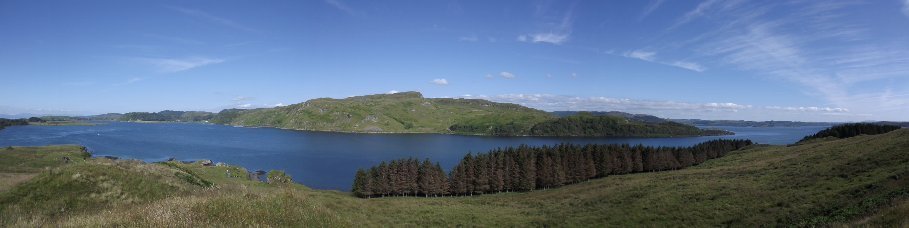
The above is a panoramic view of the area under threat.

For those just coming on board our campaign the site in the middle of Seil Sound has great environmental and scenic value and historical importance. The threat comes from a proposed 2500 tonne biomass salmon farm with a substantial grey concrete feeding and servicing barge, interfering with a run much used by sea trout and other wild fish and blocking more than half of the navigable channel, as the part of the Sound left open contains extremely hazardous unmarked rocks.

The good news is that to date about 350 people have found the time to register their objections on the Argyll & Bute Council website and THERE'S STILL TIME. It's been confirmed that the official time limit for comments on the proposal is 4 August and comments can be registered by clicking here:-

Argyll & Bute Council public access for comments

In practice in a matter of great importance the Council will have regard to new matters raised in comments made right up to the date of the decision, but that is no reason to delay.

Not everyone has computer access and as I write this leaflets are being delivered by hand to every house on the islands of Seil and Luing. They will be most immediately affected by the noise of generators running 24 hours per day and the visual impact, but it's terribly important that everyone who is concerned about our environment, our wild-life and the health and safety of residents and visitors alike should register their views. The address for written comments is:-

Argyll and Bute Council, Kilmory, Lochgilphead, Argyll, PA31 8RT, quoting planning ref: 11/01066/MFF

Friday, 22 July 2011

Red Alert - Another fish farm threatens the environment - Less then one week to object

Castle of the Dogs
In February, by good chance, I received a copy of a pre-application consultation in connection with a proposal to site a salmon farm at Ardmaddy in the Seil Sound, an area of outstanding landscape beauty and historical significance and lying within both the Knapdale/Melfort Regional Scenic Area and the Firth of Lorn Marine Conservation Area. The above image shows the view across the location, with the medieval hunting lodge the Castle of the Dogs in the foreground and just out of view across the Sound the prehistoric fortress of Dun Fadha.

I posted on this back in February and my efforts can be read here:- Proposed salmon farm at Ardmaddy and here:- Bad Neighbours

I promised to let people know if and when a formal application was lodged. In Argyll public notification is made through that august publication the Oban Times and it seems that a minute notice appeared, buried near the end of the paper, on 7 July, asking for any objections to be lodged within 21 days, making a deadline of 27 July to be on the safe side.

It is of course notorious for contentious applications to be made just after the start of the holiday period, when many are away and others have children at home and I confess that I missed it until last night, so there's less than a week before the period for comments closes. Argyll & Bute planners sent out letters to various statutory consultees on 6 July with the same deadline, stating that failure to reply would be taken to mean the bodies concerned had no objection. Their staff will also be affected by holidays and anyone working in the tourist industry is going flat-out at this time of year, so it won't be surprising if many of them miss out.

If you feel as strongly as I do about the destruction of our major asset, the environment with its unique beauty and wild-life please take the time to register your view. You can do so by clicking here:- Argyll & Bute Council website link for comments

In case it assists here is what I posted on the site:-


"I object most strongly to this application. My grounds of objection are:-

1                    The siting of this massive development in a much-used stretch of water presents a serious hazard to the life and safety of all who navigate on or otherwise use these waters, be they small boat enthusiasts, canoeists, yachtsmen, divers or whatever. Blocking one half of a passage which forms a main route North comes close to infringing the public’s inalienable right to navigate.

2                    The development will present a shocking eyesore in an area of panoramic beauty, which currently presents a major attraction to visitors.

3                    The development will cause major pollution to Loch Melfort, already burdened by a significant number of other fish farms.

4                    The presence of large numbers of captive salmon will threaten the health and welfare of the wild sea trout, shellfish and other wild-life in the area.

5                    The proposal by the applicants to apply for a licence to shoot the local seal population is abhorrent."
I have received an email from David Ainsley, a Seil resident and marine biologist, who runs Sea Life Adventures, a business bringing our countryside to life for visitors. Here is what he wrote:-


"Save Argyll seals, wild salmon and help tourism

Summary

A planning application has been lodged to double the peak biomass of salmon (to 2500 tonnes) and slightly relocate the salmon farm at Ardmaddy, near Oban and close to the Firth of Lorn Special Area of Conservation. This farm is in a narrow channel used by migratory salmon and sea trout which have no choice but to pass so close to the farm that up to 80% may be killed by sea lice (Ref.3). There is an important seal pupping haulout close by in Cuan Sound. The farm proposes not to use environmentally friendly double nets but instead to shoot seals. When mother seals are shot the pups are left to starve. The farm will also use seal scarers - a known threat to bottlenose dolphins and porpoise which regularly use the Sound and are important to local tourism jobs. One report [ref. 1] estimates that the farm will produce pollution equivalent to the untreated sewage of a town of 50,000 people (Oban population is 8,120). There will be a feed barge, generator running at night and 24,000 watts of underwater lighting. The area within the buoyage will take up half Seil Sound in this beautiful scenic area.

Please spare 2 minutes to object to this application in order to save seals, wild salmon and the natural beauty of the area.

To object, copy the skeleton letter (or write your own)
then click on the link below and follow the simple instructions


Skeleton Letter. Copy the text from between the lines:
_______________________________________________________

I object to the proposal. The doubling of biomass will increase problems caused by the existing farm, which would be better relocated offshore where there is the potential to expand with lesser impacts on wild salmon and sea trout, seals, bottlenose dolphins and porpoise. The proposal will also damage an important dive site (with a priority marine feature), the Firth of Lorn Special Area of Conservation, designated shellfish waters & wildlife tourism.

I request that an EIA and Appropriate Assessment be carried out and that the same legislation which required spending £11 million on Seil sewerage be applied.

This is a sensitive area of natural beauty. The concrete feed-barge, underwater lighting with generator at night and mooring buoys halfway across the channel will impair views.

If consent is granted, I request that conditions include: the fitting of double nets (outer and inner mesh identical), no seal shooting or use of seal scarers and no increase of biomass from existing farm.
_______________________________________________________

Click the link below to see a video of a polluted seabed near a salmon farm in Argyll:


Thank you for helping. Please feel free to forward this e-mail to others.


For those who want more information David has also supplied the following:-


Further Details

The technology now exists for the salmon farming industry to situate new farms offshore in areas less damaging to wildlife and tourism jobs. To operate in a more environmentally friendly way, the applicant (a large multi-national company) could relocate offshore, away from areas important to conservation and use double underwater netting (with the outer net mesh the same type and size as the inner net to prevent entanglement of wildlife). There would then be no need to shoot seals, and the double nets would also reduce the problem of farmed salmon escaping and damaging wild stocks. Instead, the applicant has chosen the cheaper option of applying for a site in a sensitive area important to wildlife, using single nets and shooting seals.

The farm is close to an important seal pupping ground around Cleit Rock in Cuan Sound. When mothers are shot, orphaned pups are left to starve. Under the Marine (Scotland) Act 2010, guidelines state that seals should only be shot as a "last resort". This application does not propose to fit double nets and therefore will not employ the most efficient non-lethal means of keeping salmon and seals separated. Accordingly seal shooting by this farm is not a "last resort" and the farm should not be granted a license to shoot seals.

The farm will also use seal-scarers, which are known to disturb dolphins and porpoise which regularly use the Sound. This may well change their migration patterns and impact on wildlife tourism jobs not to mention the good effect that seeing dolphins regularly has on the local community.

The application is for an inshore location in Seil Sound, which is a narrow channel used by migrating salmonids where sea lice and disease from the farm will continue to damage local salmon and sea trout stocks (Ref.3). There is no excuse for expanding without regard to local wildlife and tourist interests as these companies are currently highly profitable - one company reporting first quarter profits this year of over £1 million per 1000 tonnes of salmon farmed.

Historically, local rivers had healthy runs of salmon and sea trout. There used to be a bag-netting station at Easdale and the coble at Loch Feochan. The Rivers and Fisheries Trusts of Scotland (RAFTS) blame sea lice infestations from salmon farms for infecting migrating wild salmon and sea trout. They report that wild salmon rod catches between 1970  and 2009 in the West Highlands and Islands (the aquaculture area) have declined by 42%, whereas catches in the East, where there are no salmon farms, have risen by 24% [ref. 2]. Studies show that as many as 80% of juvenile salmon and sea trout are killed by sea lice from salmon farms [ref. 3].

The visual impact of the farm will detract from an area of great scenic beauty. Should consent be granted, the area within the moorings would be greater than the existing farm by a factor of 3.2 and the buoys would be halfway across the channel. There would be a large concrete feed-barge and 24,000 watts of underwater lighting with a generator running all night.

One report [ref. 1] estimates that the farm will produce pollution equivalent to the untreated sewage of a town of 50,000 people (Oban population is 8,120). Although salmon farms may not look particularly large, a huge biomass of fish is crammed into them. The proposed peak stocking density of 17.4 Kg / cubic metre exceeds the RSPCA "freedom foods" standards. On the 26th of April 2006, the applicant pleaded guilty to over-stocking fish cages and polluting the environment on their neighbouring site in Loch Shuna, and was fined £1000. Inevitably, pollution from the proposed site will reach both the local designated shellfish waters and the Firth of Lorn Special Area of Conservation yet no Appropriate Assessment (as required by the Habitats Directive) or Environmental Impact Assessment has been carried out. It was deemed necessary to spend £11 million to improve the sewerage of around 150 houses to comply with legislation - should the same legislation apply here?

The farm will be located very close to an important dive-site, which contains a "Priority Marine Feature" - an area of white cluster anemones (Parazoanthus anguicomus).

All public bodies have statutory duty under the Nature Conservation Act (Scotland) 2004, to 'further the conservation of biodiversity' as they carry out their work. There is a great deal of environmental legislation designed to protect biodiversity, seals, wild salmon, porpoises and dolphins, and the Firth of Lorn SAC. To this date, this legislation has not been correctly applied. It is important to note that the normal burden of proof in planning is reversed under the Habitats Directive. It is the responsibility of the appropriate authority of the member state to demonstrate that a "plan or project" will not adversely affect a Special Area of Conservation.

The Crown Estate owns the seabed. The views and the wildlife, which will be damaged should this application be approved, belong to the people of Scotland. If the application is approved, the planning consent alone will be worth perhaps £ millions to the applicant. People have a right to expect that the salmon farming industry will work to reduce its impacts on landscape and wildlife. This is not an environmentally responsible application. Please object to it.


References:

[ref. 1] The One That Got Away (June 2001) by Friends of the Earth Scotland
[ref. 2] Comparison of the decline of Scottish East and West Coast Salmon Fisheries (June 2011) by RAFTS
[ref. 3] Year Zero For Wild Scottish Salmon (2010) by Salmon and Trout Association

Don't forget, there's less than a week to comment. Register your comment by clicking here:- Argyll & Bute Council website address for comments

Wednesday, 9 February 2011

Proposed Salmon Farm at Ardmaddy


The above map shows the location of the latest threat to the enjoyment of our local waters and the health and safety of navigators and our beautiful landscape. Lakeland Marine are proposing to relocate an existing salmon farm further North in Seil Sound to a position off the entrance to the Cuan Sound. The reason for the relocation is that "hydrographic conditions are more favourable" at the new site, which I assume means in other words that the tidal flows at the existing site are insufficient to remove the enormous quantities of waste food and debris produced by this form of industrial production. 

Once again fish farming, the sacred cow of the Scottish economy, threatens the one asset we truly have in Scotland, our lovely landscape, and the tourist and leisure industries that are our major employers. Far more serious however  is the threat to personal safety, as the proposal presents a major hazard to navigation.

When I first looked at the pre-application proposal I couldn't believe the figures. The farm is to contain twelve circular fish cages, each 100 metres in diameter, in two rows of six, tethered to twentyone  mooring buoys positioned in a rectangle in excess of 300 metres wide by 510 metres long, making a total area, per the application form, of 179,800 square metres, or about 45 acres in old money. There is to be in addition a concrete feed barge, presumably similar to the grey monster off the North end of Shuna.


Above is the layout plan, showing the disposition of the cages and moorings. Effectively the area within the red boundaries becomes an exclusion zone for small craft.


And this is a large scale location plan, showing that the exclusion zone extends about half way across the Sound. This is an area well known for strong tidal streams and wind shifts. It's not as if the Cuan Sound is a backwater, in Summer it's one of the major routes North for visitors. Legally the power of the Crown Estate to grant leases of the seabed is subject to the rights of the public to navigate safely. This application is in flagrant disregard of those rights and must be resisted by all those who value our waters and the safety of those who venture out on them.

I will be looking out for formal notification of the application in the press and trust that those who care will be ready to object to it.

The Wherrymen

The Wherrymen
Two old friends on the water