Featured post

The Scottish Islanders

  Get your copy from  www.shop.yachtarchive.scot  !

Showing posts with label spar making. Show all posts

Tuesday, 13 March 2018

Building the Mast - Chapter Three


That's the mast basically finished. It's now stored in the Great Hut with the plastic bag to stop people poking their eyes out on it, not ideal but better than this. 


The Great Hut started out in life as a boatbuilding workshop, then later we lived in it for two years while the house was built, by which time there was also a garage, which of course became the workshop and then the GH was suddenly taken over as a sort of women's retreat, complete with fridge, ashtrays, television, heater, seating and even a sewing machine. The spars will have to live here on suffrage, but I fear it won't be popular.

I'm quite pleased with the stage it's now at. It's a bit heavier than it could have been, but pretty strong and the glue joint is perfect.


I've now also made the boom, which is a rectangular hollow section, solid at the ends, and much easier to put together than the mast was. Here is the sequence:

First, strips about 5/8th inch put together, with a straight batten to keep them in order. Note cling film keeps the glue off the hands and clamps


Gluing done, ready to clean off and plane.


Flat top face, 1/2 inch thick, added. Another ten clamps borrowed for this.


Turned over the bottom face added.


Cleaned off, ends trimmed, corners rounded, preliminary sanding.
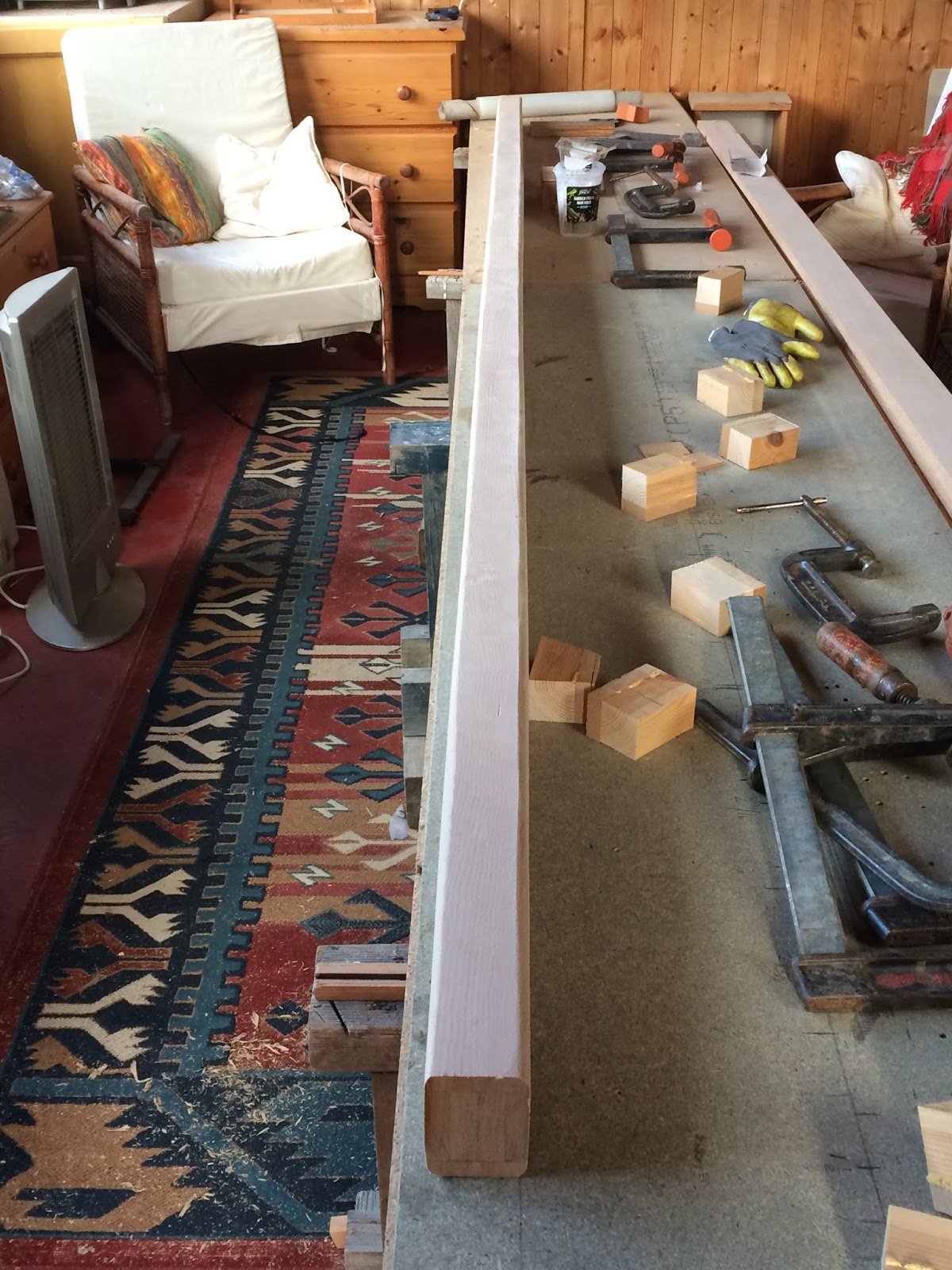

To finish off, the mast and boom will both need external blocks for strops and fittings, then outboard ends will get painted white and the finished spars varnished.

Like the mast, the boom is overweight, probably stronger than it needs to be by a huge margin, but I don't think that's too bad a thing. What now requires a lot of thought is how light I dare make the gunter yard/gaff/call it what you will, because weight aloft is a very bad thing. But of course so is a broken spar...

Wednesday, 21 February 2018

Building the Mast - Chapter Two - Planing and Bevelling


This is a brief report on four days in the workshop. There's a lot of work involved in planing down a spar, but it doesn't take long to write about it.

The two halves were trued up on the thickness planer, then a slight hollow put in the middle to ensure that the outside edges would be a very tight fit when glued. It's thinner than the photo suggests!


Having scooped out the hollow section, which I decided to expand to eleven feet while doing it, the next step was to saturate it with clear epoxy, in the hope that this will avoid rot developing in what could be a nice warm incubation chamber later. I contemplated a layer of woven roving as well, but decided that that would be a step too far. Time will tell.

This enabled the sections to be put together, using all available clamps.


Then we discussed cutting the bevels on the table saw, using a tapered infill for the top section, but soon discovered that this could be at the expense of a nice new blade and stopped. A bigger machine would have coped, but it would still be a risky operation.


There followed a few days of planing, first power planer, then hand planes. For the tapered section at the top a good trick for measuring off is to place a twelve inch ruler diagonally across the workpiece and run it along marking off the 3 1/2 inch and 8 1/2 inch positions. But basically this is just careful, hard work until it's as close to the lines.

The bottom section was redesigned during the operation, as the transition from square to round can be easily done without a intervening octagonal section.


Sunday, 18 February 2018

Building the Mast - Chapter One - Workshop Porn


One of the great delights in my boatbuilding activities is visiting my ancient friend in his Dragon's Workshop half way up a mountain a few miles from my house. Forget your dinky clamps when you can dog your stick down with one of these fellows, hand-forged in Sheffield. A whack on top with the heavy hammer secures it, a whack on the side and it's free.

I'm well past the stage of wondering whether to rig the Kotik as sloop or yawl, as discussed briefly, here: Hull Coming Along

I'm sure that the decision to go with the sloop is correct, as at 21 feet overall the Kotik is still a very small boat. Upwards of 24 feet and with a built-in trunk for the rudder stock would be a different story, because you would have positive steering and a more workable stern deck. That would of course entail a complete redesign, or going with Albert Strange.

The next step was to decide how to build the mast.

By far the strongest and simplest mast would be a rectangular box section, as described by L Francs Herreshoff in Sensible Cruising Designs, but of course it's not suitable for gaff/gunter rig. This left the birds mouth method, akin to making a staved barrel with extra bits, or back to basics with a solid single piece or a hollow two piece spar. 

Over the years I've read a lot about the birds mouth method and the drawings received from Iain Oughtred included detailed dimensions for the smaller Wee Seal design, which could have been scaled up. I can see the attraction if one has to use a lot of small sectioned stock, but less appealing if you are able to source some good stock. After a lot of thought the simplicity and certainty in the hollow two part method won the day and the following sketch resulted:


Some months ago a nice piece of Sitka Spruce arrived from the South of England and with the weather too cold and wet for working on the hull it's time for spar making. With a good fire in the stove conditions were ideal.


The first task was to split the stick, twenty feet by eight inches by two inches, lengthwise. There wasn't sufficient space to use the big machine, seen behind the stove in the above image, so we had to use the table saw, which was just possible when John cut a hole in the wall.


There followed an hour or so of thicknessing, again using a small portable machine.


This all goes to show that with care you can handle large sections and lengths with smaller machines.

Afternoon on day one involved starting the hollowing out process. By this time I'd decided to extend the hollow section through the foot length marked "solid" on the sketch, as I don't think pressure from the gaff jaws will be all that great.

We both hate routers and John drew the short straw, on the basis that a litre of the Grouse would restore him later.


There followed a couple of hours of work with one of those ancient planes that people find in antique shops and hang on their cottage walls, this one once the property of the man who trained the man who trained John's grandfather, or something like that. (I find it difficult to keep up with the prehistory of Derbyshire.)

First, having sharpened the blade on a stone that arrived here shortly after the American War of Independence Mr H applied principles developed by Isaac Newton to assemble and adjust it (hitting it with a hammer.)


To my astonishment I found that even an old office worker could make a passable job of cleaning out the ridges left behind by the router.


The Wherrymen

The Wherrymen
Two old friends on the water