Featured post

The Scottish Islanders

  Get your copy from  www.shop.yachtarchive.scot  !

Wednesday, 18 July 2012

The smallest Gallery in the World, a very small Island and an Abundance of Progue

Today Easdale Island with its strange scenery and lovely wee cottages is a haven for artists and craftspeople and it's where the enterprising picture-framer Jan Fraser has just opened The Bothy, which may qualify for the title of the smallest art gallery in the world. Nephews Paul and Adam were among various well-known artists represented at the first show.

One of Adam's ship pictures has pride of place

The Editor and the Brother in 1954
Thomas the Lifeguard, serene in his perch
 Prints of the above and many more are available from The Bothy.

Easdale is so tiny that Hamish Haswell-Smith doesn't really rate it as an island, describing it in his book as a "broken-off outlier" from Seil, which in turn he doesn't see as a proper island, since the old ferry at the Tigh-an Truish inn was replaced by a bridge 220 years ago. As everyone probably knows already the inn got its name, which translates as "The House of the Trousers", because after the second Jacobite rising wearing the kilt became illegal, so islanders would stop there to borrow a pair of trousers for their visit to the mainland.


Easdale is smaller today than it was originally, as for several centuries it was populated by squads of diligent miners who blasted and chopped huge holes, hundreds of feet deep, bringing out millions of tons of slate that at one time roofed the World. 

 At its peak there were about five hundred residents on Easdale alone, with many more on the neighbouring islands. It's hard to imagine what life must have been like in these places, particularly on tiny outcrops like Belnahua, where bad weather could cut the workers off for months in winter. They lived in  slate cottages built by themselves and grew their own vegetables in miniature walled gardens, the very earth created by the workers by harvesting seaweed, bracken and dung, identifiable today from the lush weeds that flourish on what's left.
In such a slatey, tree-less environment it must have been seen as a gift from the gods when the sailing ship Norval, laden with a cargo of Canadian timber struck rocks on nearby uninhabited Insch Island in thick fog on the shortest day, 20 December 1870. A few weeks earlier she had left Montreal bound for Glasgow and would have been heading for the Mull of Kintyre, about thirty miles South of where she struck. Captain Taylor would have known from soundings and the fog that he was near land and may have been trying to give Ireland a wide berth. The entire crew got safely off and rowed the short distance to Easdale. Two days later the owner, Walter Grieve of Greenock, sent the steam tug Flying Meteor to attempt a rescue, but the Norval was found to be badly holed on a rock and on 5 January 1871 she broke up.

I've written before about the ancient art of The Progue. We can assume that the Lorn proguers were out in force as thousands of deal boards floated North past Oban and into the Sound of Mull, while Grieve's men tried to salvage as much as they could. By February the Glasgow Herald was carrying advertisements for the contract to transport the salvage to Glasgow for auction.

Walter Grieve was one of a family of diligent Scots, from Perthshire originally, who established themselves around 1837 in the cod fishery in St Johns, Newfoundland, then moved from 1855 into sealing and whaling. He commissioned numerous ships, the Norval being a large three-master being built by A McMillan & Sons at Dumbarton, on the site latterly occupied by the distillery, in 1864. His brother James Johnston Grieve was the resident partner at Greenock. He was prominent in promoting the development of the harbour and various public works in the town, was Provost four times and represented the town in Parliament from 1868 to 1877. In common with most incomers he found that his efforts weren't entirely welcomed in some quarters, but the effects remain and Grieve Road is named after him.

These mid-Victorian Scots were an astonishingly resilient, enterprising tribe of risk-takers as one can see from Walter Grieve's quick response to the wreck. Later his family suffered a financial ship-wreck as the records show that they were all sequestrated at Greenock Sheriff Court in 1895. Incredibly for the times they clawed their way out of bankruptcy in little over two years.

Back to our story, on Easdale the islanders seized the chance to acquire the main mast of the Norval, together with sufficient timber to construct a new hall for the training of the local militia. For the same purpose part of the old harbour was filled in with quarry waste to create a level drill field, the present-day village green.  .

Ten years after the wreck a storm burst through the thin curtain walls and the quarries flooded, drowning the machinery. The men survived but their livelihood was largely gone. Industry limped on with slate being chopped out of the accessible areas until the 1950s. By 1961 the population was down to 16, but it has gradually recovered and today stands at about 60, with many of the cottages also in use as holiday homes. The story can be found on www.easdale.org.

Today visiting Easdale, accessed by a two minute ride on a little ferry crewed by a three-legged dog, is a unique experience. Apart from the artists the island now has its own local history museum, the Puffer pub and restaurant and numerous curious relics of our industrial past. The old proguing habit survives too, as the recycled telephone box shows.


Friday, 29 June 2012

Authenticity versus Modernity

People often say, with reference to their favourite designer (Watson, Mylne, Fife ...) if he'd only heard of carbon fibre he'd have used it. It's rather trite, like saying the Vikings would have used epoxy instead of moss to caulk their seams and the Picts would have been far happier with fibreglass coracles than skin ones. Readers of the Jack Aubrey stories will know that only under something like the post system, which placed senility at the top level within the Lords of the Admiralty, would one deliberately hold out against progress. Even they gave out in the end when it stared them in the face, or rather the stern, as happened when HMS Rattler won her tug of war against the Alecto in March 1843, finally demonstrating to even the most afflicted of their Lordships that propellers are better than paddles.

I had the chance to spend a weekend reflecting on the issues of mixing modern materials and old boats just after September Eleven at a conference in Monaco, attended by many from throughout Europe but virtually none from the States, for obvious reasons, apart from Olin Stephens, who had spent a good bit of that Summer in the Mediterranean.

We had found the invitation from the Principality a few months earlier behind the door of our retreat in a remote corner of Argyll, addressing me as the President of the Scottish Classic Yachts, an organisation that I had not heard of until then, but that I was pleased to establish immediately.

Anne and I will always remember the wonderful hospitality we enjoyed that weekend and the sights that we saw. We had not previously seen the sea being hoovered by floating vacuum cleaners to remove all traces of late night revelry, nor hills with lifts inside them to save the weary feet (how many Munros could visitors bag with such devices, were the Scottish Government only to fit them here). There were extreme contrasts of style and naffness, at one end the Clubhouse with its glittering crystal gantry and elegant, solicitous, tuxedo-clad bartender, at the other a harbour parade of Rivas chauffeured by dark-suited Italian industrialists, their, usually somewhat younger, ladies taking part in a "Princess Grace Look-alike Competition".

The conference had a serious purpose, however, to consider and vote on proposed  new racing rules for adoption by the CIM (Comite Internationale de la Mediterranee) introducing a "co-efficient of authenticity" in terms of which yachts would be handicapped for racing on the basis of the extent to which "inauthentic" materials had been used in construction or restoration. This followed a number of races in which the fifteen-metre The Lady Anne, with carbon fibre in her top-mast had trounced the Tuiga, the club yacht of the Yacht Club de Monaco. (The thought did occur that the latter's crack English crew disciplined by a certain Mr Goss had had something to do with vanquishing a slightly more laid-back local team.)

Simply stated, the new rules required a yacht that contained certain materials, whether or not critical to her speed (formica in the galley perhaps an example of the latter) to carry a penalty of a percentage of a varying amount dependent on significance.

In the course of the discussions, which I attended while Anne marvelled at the wonders of the harbour and its denizens, it seemed that there was a clear divide between the Northern Europeans and those from the Mediterranean. (Perhaps some of us felt that we wouldn't be invited back anyway.) Our Swedish friends pointed out that many old square-metre boats were maintained by youngsters who could not afford authenticity. I felt greatly in sympathy, as I was then in my sixth year of the restoration of Stroma, using the best materials I could afford. (I've already written about that project, here Reflections on the Scottish Islanders) Their and my mild reservations were supported by a charismatic senior yachtsman from Britanny, whose considerable personal wealth gave him the credibility in that company to point out forcefully that prohibiting the only materials that many enthusiasts could afford would render the sport ridiculously exclusive and kill it off in the longer term.

At the end of the weekend there was a delightful dinner in the clubhouse and the next morning we were driven back to the airport by one of the royal bodyguards in a Lincoln with tinted-glass windows. We were also informed that the measures had been duly passed.

A problem may have been resolved for those competing in races along the South of France but for the rest of us it remains. So far I've highlighted the question of money and for me affordability wins hands-down. A generation or so ago yachting was truly the sport of the super-rich and we must avoid going back there, or the sport will stifle itself with exclusivity. What are the other issues?

Authenticity has a number of facets. In its purest form perhaps it should be confined to museums, although the treatment of the Cutty Sark shows another way forward, preserving the artifact while enhancing the visitor experience with proper access by use of modern technology. At least one hopes so, but of course only time will tell.

Elsewhere these competing aims, conservation and visitor experience have conflicted disastrously. The old City of Adelaide, latterly Carrick, sat more or less happily afloat in Glasgow until after a few sinkings, from which she always recovered, and some complicated political intrigues, the details of which have never been disclosed to the tax-payer who ultimately paid for them, she found herself in the lower Clyde where, contrary to much professional advice, she suffered the fate of being hauled on a slipway to dry out for the first time since her launch in 1864. A dubious visitor magnet was created at the cost of the ship herself, which proceeded to destroy herself over the following years.


The lesson is that in pure conservation terms some things should be left where they are, perhaps even if that is on the bed of the sea in some cases.

People are very emotional about pedigree too and will value something that is demonstrably old even in the face of evidence that perhaps most of it isn't. It may be true that a hundred or so years ago a client presented William Fife III with a hatch picked up from the shore after a storm and simply said "please repair my yacht". More recently it's certainly true that after the Barnato Bentley known as "Old Number One" sold for £10 million the purchasers, a company financed by a Mr Kohji Nakauchi refused to pay for it on the grounds that the car had been rebuilt so many times it was no longer the original. The purchaser lost and the case report is a splendid piece of judicial writing by Mr Justice Otton, worth reading, here The Case of Old Bentley Number One

The sad thing in all this is that the value in the works of our great designers should be precisely in the designs that they produced, rather than the original manifestations thereof, but the marketplace says that it isn't. Until it does many of those fantastic designs will be destined to remain on the page rather than on the water.

Saturday, 16 June 2012

Surrinduppity


Juni is a masterwork of Swedish boat carpentry, her hull planked close-seam from a hard close-grained mahogany, no caulking, no splines and, I suspect no glue either. This has its problems in a little ship that’s forty years old and has obviously been through a few escapades.

Doing the repairs was rather nerve-wracking, as I am no cabinet-maker. There were some strategic decisions to be made, as I wanted to respect the skills with which the boat had been made while ending up with a seaworthy, useable vessel. That the construction was so fine ruled out some of the more robust approaches which would have guaranteed keeping the water out. Among other things I’ve had to fix some nasty splits in a few of her bottom planks, clinkering between some of the others and quite a few broken timbers, all as unobtrusively as possible.

As a result of this approach it was no surprise, just a bit upsetting, to find Juni weeping rather badly on being returned to her element after about ten years ashore, the last seven inside a shed.

This is where the surrinduppity (I’ve adopted the Brother’s spelling) comes in. If we were dealing with an old loch boat, her boat-skin planked in good Scottish larch, we’d just secure her with some stones and leave her sunk for a few days. With a close-planked hull of fine hardwood and a ballast keel this is not a good idea. The ideal would be a nice soft mud-berth, but Argyll isn’t Essex and the shores here are sharp and rocky.

Salvation was found literally round the corner from where we launched, at the Melfort Pier, a luxury holiday complex whose houses circle a calm private dock and whose owners love boats, or at least lovely little ones like Juni. Under one of the houses we found the ideal sick bay, a secluded berth just wide enough and with fixing points for the long diagonal warps that are necessary to cope with the rise and fall of the tide.


For the first couple of days I was pumping every six hours or so, but six days after launching things are getting better. I’m down to pumping every twelve hours and it will be interesting to see if and when there is any further improvement, or if she has to come out again for further treatment. That the hull is from a hard, close-grained timber is not helping, nor is the fact that she is now so well protected by all the paint I have put on, so I’m living in hope. 

Monday, 11 June 2012

Stroma is for sale (Correction, see below, was for sale)


I am posting this to let my friends know, in advance of formal marketing, that I have decided with huge regret to sell my beloved yacht Stroma, number four of the historic Scottish Islands Class, built in 1929 by McGruers to a design by Alfred Mylne. There is a full history of the class on my website, www.scottishislandsclass.blogspot.com.

Scottish Islanders are absolutely lovely boats, well behaved in virtually all normal conditions, fast and elegant. The compromise is the limited accommodation, which I have always considered a small price to pay for such a wonderful sailing experience.

Stroma was extensively rebuilt by me, with help from a few friends, and her spars, rigging and sails were all renewed before she was relaunched in 2003.

I decided not to instal an engine, so that would be for a new owner to decide.

I bought Stroma in 1976 when I was 28 years old and have had numerous adventures on her with my friends over the years. It’s only advancing age and the lack of regular sailing companions that are causing me to sell her.

Stroma is lying ashore at Kilmelford, in order that her topsides can be repainted, just to freshen her appearance as there are no cracks showing. I’m also doing a number of small jobs to ensure that she’s in fine condition for a new custodian.

Update Spring 2013

Stroma didn't sell, to my great relief as it would have broken my heart. I'm sharing her with Adam Way, talented master boat builder, who is keeping her at Crinan and will look after here there. He's one of the very few people to whom I'd entrust such an artifact and it's great that he's fallen in love with her.


Just about afloat at last


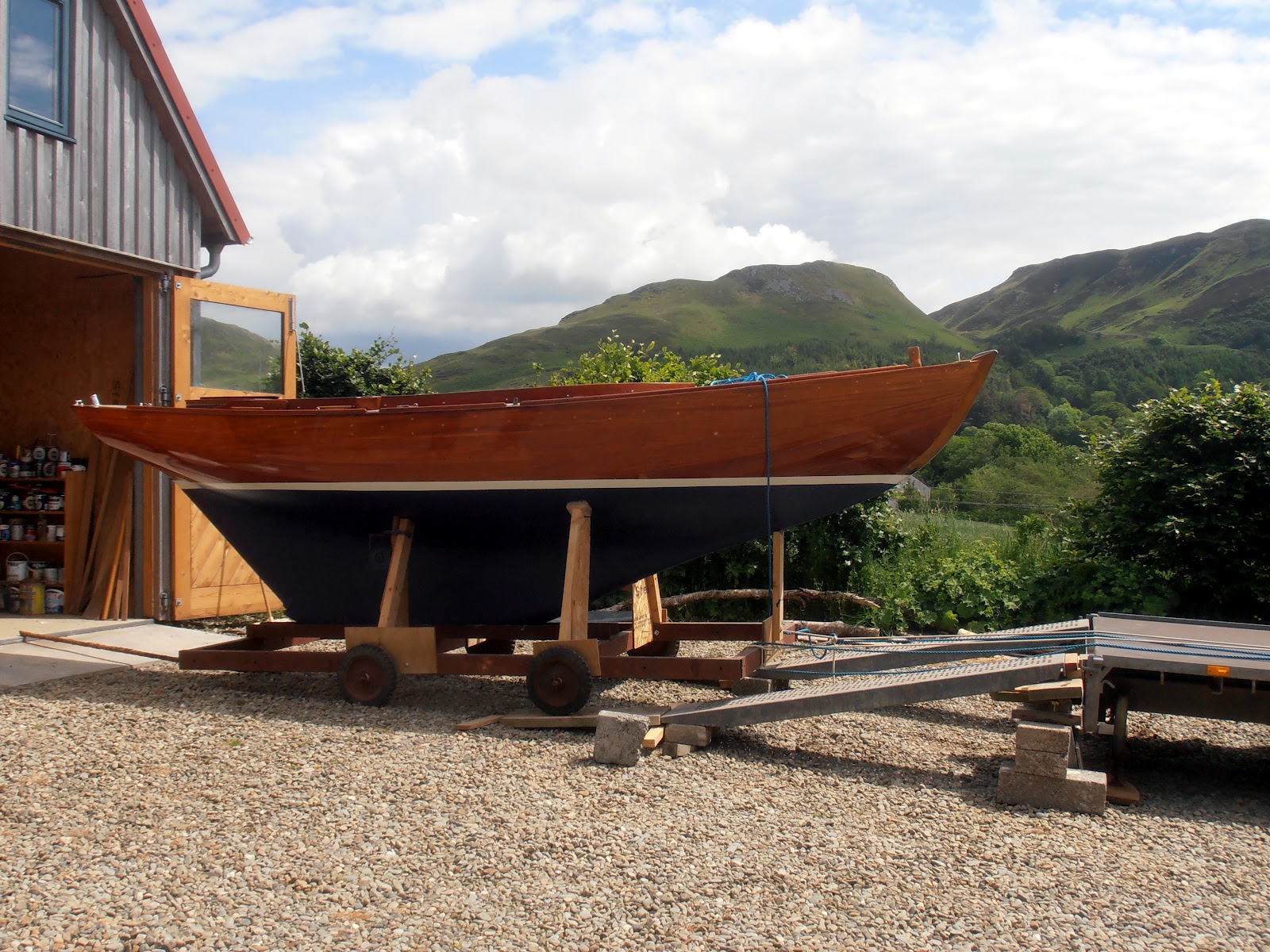
The last week has seen Juni out of her workshed and along to our friends’ slipway where she was returned to her element after about ten years ashore. Predictably a lot of water came in and I’ve been pumping her every few hours, but this morning’s session at 5.30am suggested the inflow is going down a little. The following pictures tell the story better than words.

blinking in the daylight
very tight fit on flatbed

nearly ready to go
tricky slip with dogleg
the launching team, combined age (minus wagon) just over 200

Friday, 18 May 2012

Spencer RIP 1980 (approx) to 2012


For over thirty years he patrolled his watery domain, a languid fin-flip enough to propel him gently from one muddy little corner to another. Sometimes he'd be difficult to spot, perhaps lurking under the floating umbrella of the waterlilies or maybe hiding in the chinaclay chimney pot that Peter had so thoughtfully chucked into the pond and he'd adopted as his own. He'd spend hours in this private space, sometimes re-emerging backwards by the way he went in, sometimes shooting out forwards. It would be pointless to try to work out what goes in the mind of a carp.

When we first met him in 1984 he had a number of chums, but gradually they went, some saying they'd becoming victims of the visiting herons, others hinting darkly that Spencer had got bored with them, or perhaps just hungry, and had eaten them. Regarding this latter possibility I'm afraid he had some form. Each Spring his peace would be disturbed by a crowd of totally amoral frogs, who would cavort in the most unseemly ways, quite naked, right in front of his pink old eyes. He would get his revenge by devouring as many of their progeny as he could snaffle down and those were among the rare occasions when he showed much of a turn of speed.

In the early years he wasn't called Spencer, that name arrived with his current custodians, but he never answered to it anyway unless the call was accompanied by a scattering of fish feed on the surface.

All thought that with age he had acquired a capacity to survive almost anything. In the prolongued freeze in early 2011 he lay immobile for weeks under several inches of ice, astonishing all with the first tentative flickers of a fin when the thaw eventually arrived. His end came while his carers were off steeping themselves in the cultural delights of Iowa and only a few scales were left as clues. He had grown far too big for the herons and it seems likely that some crafty otters spotted him and carried him off for their tea. I like otters but rather hope that tough old Spencer gave them a nasty case of indigestion.

Saturday, 12 May 2012

Cold return to Normality


The forecast on the Sunday evening was dire, offering a strong cold North-easterly building up during the day with rain arriving from mid-day. I considered hitching a lift back by road, but that would have left a sense of incompleteness and lack of achievement. Also it's a good old rule that if conditions look possible and you have an escape route you should always go.

My mates for the trip were going back on the sturdy Blue Sky, so the Kelpie's now solitary crew departed just before nine, with a couple of hours of favourable tide left.

 
Once I had rowed out far enough to get an offing the main was set. 


At that stage there wasn't a lot of wind, so the jib went up as well, but a few minutes later this effort was rewarded when a squall came over and we shipped a bathful of water. Thereafter for most of the day the jib stayed firmly lashed to the bowsprit.

 
Despite the strongish wind progress was slow, with Kelpie's flat bottom slamming a lot in the nasty short chop, then the waves gradually got bigger and she really got into her groove, charging along with her rail a couple of inches clear, luffing in the puffs and eating up the distance to windward. Operating the new pump was a bit like wrestling with an eel, however.

After a couple of hours Kelpie and I were well into Loch Melfort when a short line forming part of the snotter burst during a squall and the sprit fell down, leaving the rig accidentally scandalised and flapping like mad, quite useless for further windward progress. As it continued to blow very hard I couldn't see exactly what had happened, so stowed the main and got the jib up to see if any progress could be made against the wind. The answer was a resounding no.

I could have reached across to the South shore of the loch, except for the fact that the route to the only stretch with any shelter was totally barred by the lines of black buoys of the mussel farm, fastened with steel wires along the surface stretching for several hundred metres. This is exactly the sort of problem some of us have tried time and again to bring to the attention of the authorities who license these things, to absolutely no avail. The general public have the inalienable right to use the surface of the sea for the purposes inter alia of navigation and recreation, but the Crown Estate, who hold the seabed in trust for us, ignore these rights and make money by granting leases of the seabed. The farm in question, owned by some Swiss investors, was badly damaged in the storm a year ago, turning the lines of ropes into a tangled confused mess and a real hazard to everyone. It's been rumoured that they even got a cash grant from our government to start their operations here, which sometimes makes me wonder what kind of reply we would get if a group of Scots asked one of the Swiss cantons for finance to spoil one of their lovely mountainsides with a similar intensive farm. Surely the Swiss, with no seas of their own, should stick to tax dodging, cuckoo clocks and occasional sorties into the America's Cup?

Downwind from the mussel farm was a nasty lee shore with waves breaking on sharp  boulders. The only course was to run under the jib to the shelter of the point at Arduaine where I got the oars out and had a brisk row round the corner, passing close between the reef and the shore (there's a deep passage there, I discovered) before beaching on a nice sheltered sandy bay. I discovered that one tiny piece of line had let the whole show down, a real reminder of the old adage for the want of a nail .... After some lunch and a walk on shore I quickly got the rig repaired and the Kelpie relaunched.

There now followed a hard beat of about three hours into a really cold North-easterly with occasional squalls of sleet and a real sense of achievement on getting safely moored in time for tea. Once again Walt Simmons' wherry showed her seaworthiness.

The Wherrymen

The Wherrymen
Two old friends on the water