Featured post

The Scottish Islanders

  Get your copy from  www.shop.yachtarchive.scot  !

Showing posts with label toberonochy. Show all posts

Wednesday, 9 August 2023

A very short Trip


This summer has been utterly dreadful here in mid Argyll. As we head into the second half of the season I'm wondering if I should believe optimistic locals here assuring us that there will be an Indian Summer, starting any day now.

After another couple of weeks of extremely unsettled conditions, the forecasts a few days ago promised a couple of days of sunshine and light westerlies, so I headed off on Monday with three plastic boxes containing lunch, dinner and breakfast. 

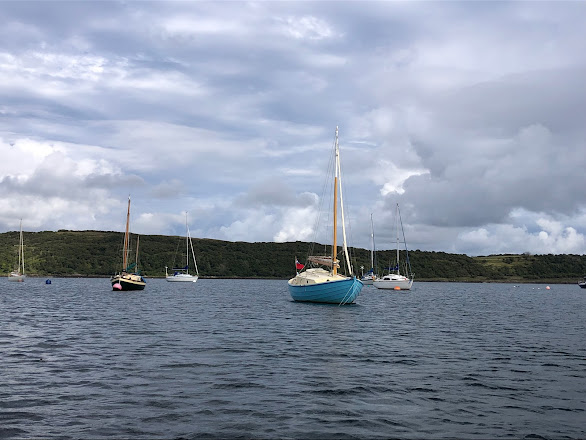
Long term readers of this blog will know that Toberonochy is one of my favourite places, sheltered from anything with west in it and excellent holding ground. So, off I went in the late morning, tacking into a light westerly, but there was not too much of the promised sun. By the time I was half way down the loch the wind was really getting up, with some dirty black clouds bringing nasty puffs, but I figured that as I got closer to Shuna and then Luing there would be a bit of a lee, so decided not to reef and pressed on. Mariota is actually a much tougher wee boat than she might appear and there were no scary moments. 

Outside the bay I hove too and got anchor, chain, warp and tripping line nicely rigged and flaked, then sheeted in and tacked up inshore of Mariota's older sister Minna. When I started sailing I tended not to use a tripping line and was perhaps lucky never to lose an anchor, although fifty years ago the seabed wasn't littered so much with discarded fishing gear and debris from abandoned fish farms. Another problem in recent years is the growth of kelp, which seems to be taking over everywhere, perhaps also a bi-product of fish farming, via the excess nutrients dumped in the water column. This can mean that the anchor never actually reaches the seabed, an issue if you're using a wee Bruce or similar type of hook. Even if it makes its way through, it will likely come up with a load of heavy material, giving the foredeck hand a nasty job and maybe rendering the boat difficult to steer until it's cleared. And working alone, it's essential to get back to the helm sharpish, once you're clear. A problem with a tripping line can arise when some lazy fellow comes in after you and mistakes it for a mooring, which traditionally caused some to paint some strong language on the float. With a long line it's possible to keep it on the foredeck.
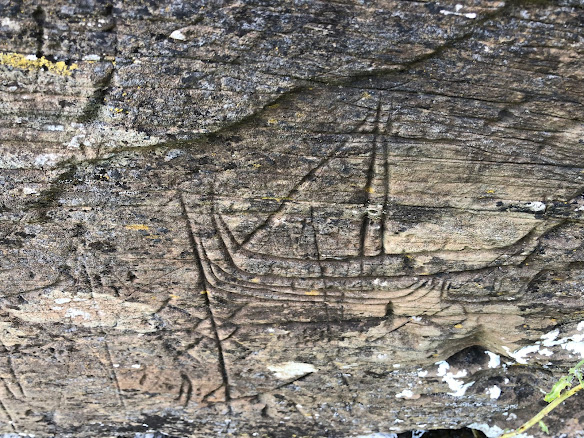
        

There was no real reason to go ashore, but having brought the tender I went for a walk up to the old Kilchattan church. Over the years I've tried unsuccessfully to get a good photograph of the ancient graffiti, which is as interesting as the church itself. This time the light was perfect and it worked!


You can read more about the history behind this here: From Toberonochy to the Battle of Largs

And since writing that earlier post a kind friend has donated an authentic image of the battle.


When I turned in, the forecast was for a day of beautiful sunshine and a gentle westerly breeze, so it was a surprise when, just after I had taken down the cockpit tent, black clouds came over with quarter of an hour of a strong, very cold northwesterly and a downpour. Then, all was calm. The anchor came up loaded with mud, no kelp at all. I rigged the electric outboard and used about 0.5% of the battery storage travelling at about two knots across to the mouth of Loch Melfort.


Off Kilchoan, the wind arrived, providing a dead run back to base. I was lucky to be hooked up before it strengthened to a fierce, cold blow that lasted until night time.  

Sunday, 17 May 2020

Cold Return to Normality


Today the weather is absolutely dire, low visibility, constant rain, strong wind. Although I’m glad the boat is ashore I’m reminded that such conditions have resulted in some of the most memorable trips.
This is the first time this Century when a group of small boat lunatics hasn’t assembled at Toberonochy on the Isle of Luing, thanks to the Johnson Plague. That weekend is incredibly special, with overtones of return to childhood, challenging trips in small open boats, most of which we have built ourselves, and most of all an extraordinary bunch of people from incredibly diverse backgrounds united by an interest in traditional boat types.
My yellow boat, the Kelpie, was built by me in 2006 specifically for the muster. I wanted something primarily seaworthy that could carry up to four but also be easy to single hand, with an interesting, safe rig and lots of bits of string to keep the crew busy. She’s an open boat, fifteen feet long, with a lot of displacement which makes her stable but a hard pull if you have to row her.
The design is based on an old New England salmon wherry, drawn by Walt Simmonds of Duck Trap Boatworks in Maine. I’ve changed quite a lot, including the rig, which is a sprit sail cut for me in 1988 by the late Gayle Heard of Tollesbury, one of very few with the ability to do it. He’d made it for another New England boat I’d built before, a Swampscott racing dory that had proved to be just too racy. Here's a photo of her under her original rig; the sprit sail tamed her but when the boat went to Angus, seen here, I kept the sail.


Decades later it still sets perfectly. At first the wherry wouldn’t sail properly to windward, something my designer friend Richard Pierce sorted by advising me to move the centreboard forward. Perhaps New Englanders usually sail in reaching winds. Richard also donated a jib, which helps greatly going into the wind.
At the end of the event in 2012 my crew had to go home promptly, leaving me with a single handed trip. The forecast on the previous evening was dire, offering a strong cold North-easterly building up during the day with rain arriving from mid-day. I decided to set off, because if things became impossible that wind would blow me back to where I’d started from and I’d be no worse off. With an escape route available you should always go.
My friend Brice took some photos of my departure, see below. I got the jib up at the start, but it soon had to come back down as the wind freshened. As a result progress was slow, with the Kelpie slamming a lot in the nasty short chop, then the waves gradually got bigger and she really got into her groove, charging along with her rail a couple of inches clear, luffing in the puffs and eating up the distance to windward. In the squalls bathfuls of water would come in over the side and it was tricky pumping it out, a bit like wrestling with an eel while still steering and keeping control of the sail.


After a couple of hours Kelpie and I were well into Loch Melfort when the rig fell down. The sail is tensioned by a long, bendy spar, the sprit, held in place by a line curiously, for Glaswegians anyway, termed the snotter. This had parted during a squall, leaving the rig accidentally scandalised and flapping like mad, quite useless for further windward progress. It would be easy to fix, provided I could make it safely to land to do so.
There was no possibility of rowing up to windward to the safe, North side of Loch Melfort. The South side was quite close, but a dangerous lee shore with waves breaking on the rocks. The exception was one little inlet with a bit of shelter, but I saw at once that it was inaccessible, being barred by the lines of black buoys of the mussel farm, fastened with steel wires along the surface stretching for several hundred metres.
Mussels have never been successfully cultivated there, due to the prevalence of seasquirts, but the Swiss company who “own” this bit of Scotland’s seabed keep the floats there in order to preserve the value of their planning permission. This is exactly the sort of problem some of us have tried time and again to bring to the attention of the authorities who license these things, to absolutely no avail. The general public have the inalienable right to use the surface of the sea for the purposes inter alia of navigation and recreation, but the Crown Estate, who hold the seabed in trust for us, ignore these rights and make money by granting leases of the seabed. Surely the Swiss, with no seas of their own, should stick to tax dodging, cuckoo clocks and occasional sorties into the America's Cup?
Downwind from the mussel farm was another nasty lee shore with waves breaking on sharp boulders. The only course was to run downwind to the shelter of the point at Arduaine, losing over a mile of hard won distance to windward, passing close inshore inside the reef, where there's a deep narrow passage before beaching on a nice sheltered sandy bay, completely out of the wind. There I had something to eat, fixed the problem and tied in a reef to reduce the sail for the return to the fray.
I relaunched and there now followed a hard beat of about three hours into a really cold North-easterly with occasional squalls of sleet, each tack bringing us closer to home and a hot shower.

Monday, 27 April 2020

A haunted Mill, Watery Graves and the Toberonochy Lemon Shop


As the MacCrimmons were to piping so the MacFadyens are to handling the wee ferries that keep the place running. Single tickets are on offer, for those who expect to fall in love with the island, or maybe have a boat to recover, but most will buy a return for their eventual reluctant departure.


Since the start of this century an event has taken place in conditions of secrecy only rivalled by the Bilderberg Conference, but less damaging by far to global peace and prosperity, consuming no oil whatever and attended by a much nicer bunch of people, on this small island off the West coast of Scotland.


It takes place in the open air, but participants are untroubled by the vagaries of the weather, viewing extremes of rain, strong wind and temperature as stimuli to, rather than distractions from, their water-borne adventures. In all conditions they congregate. Strong winds and adverse tides present challenges to ever-longer turns to windward; in fact one year the weather obliged with a 180 degree wind shift while the crews were resting for lunch after tacking half a dozen nautical miles South towards the deadly Dorus Mor, coinciding with high water which gave a return journey of equal unpleasantness against a cold wet Northerly and a strong ebb tide. Despite, or maybe because of, such things participants, who like those at Bilderberg are all personal invitees, return year after year. Only the Great Johnson Plague has put a temporary stop to it.
Once over the ferry you’ll travel down slowly through a very Hebridean landscape, unusual for an inner island. Be careful when you reach the water mill; it’s inhabited by water elves, sithichean-uisge, who will inflict terrible punishment if you fail to leave a hair from your head as a tribute. Great hares, the size of dogs, will lollop past you.
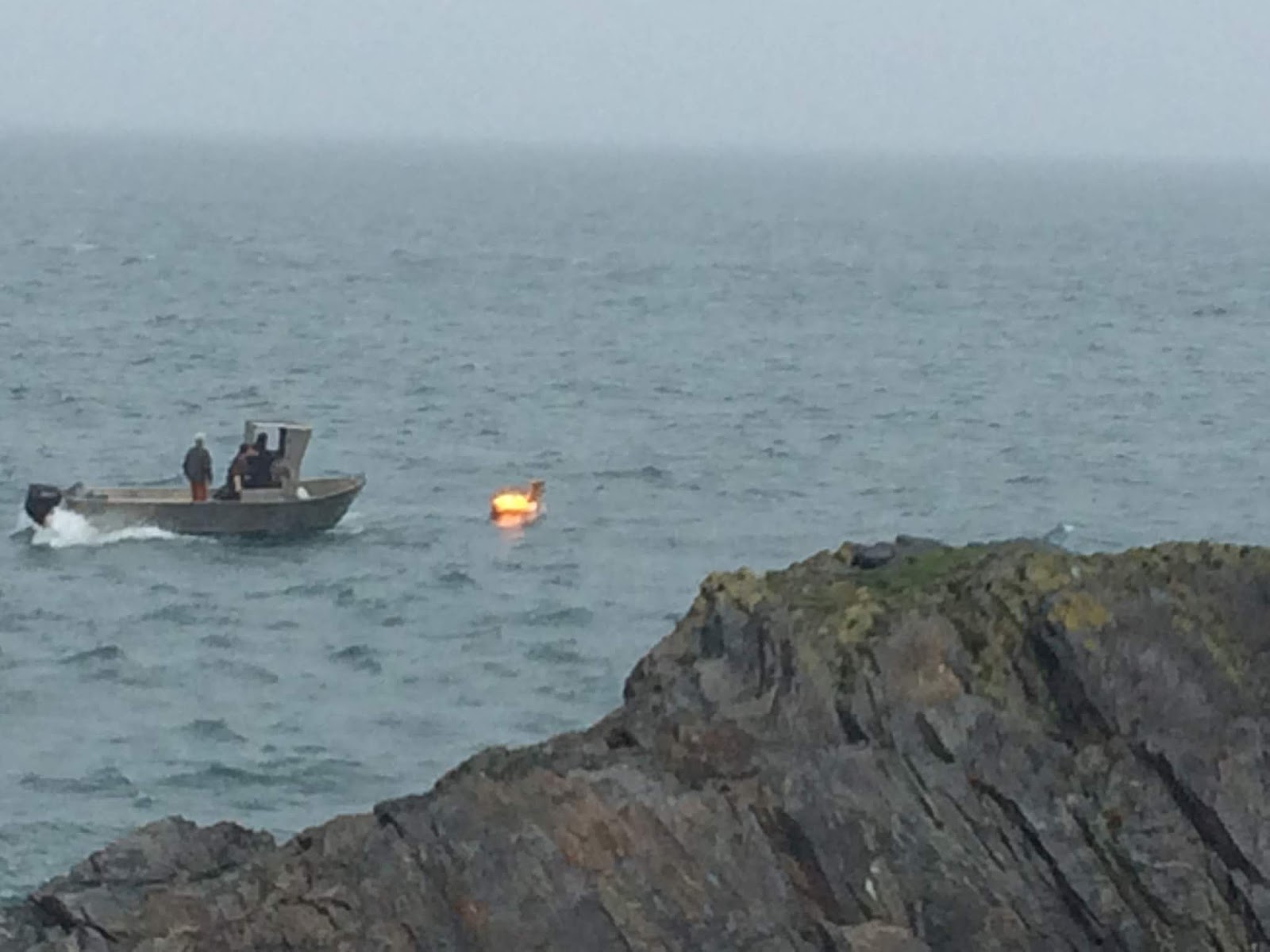
Since we started only one of our number has left the scene, the lovely, gentle Hugh Gray, who sailed a little black cutter named after his Tanta Hedwig. His son created a Viking ship for his ashes and we watched as he set off on his fiery last voyage from Cullipool.


To end in the waters you love seems rather a nice destination. In 2004 the Brother came to perform at the special wee ceilidh we hold in the Toberonochy Hall and was captured by some American Campbells who had brought their aunt back to her place of birth. As he played a suitable lament the urn was opened, about half of the aunt entered the Sound of Luing and the residue engulfed the crowd.


On the Sunday morning there was little wind and the fleet was becalmed under a dreich grey sky, the drizzly rain trickling down their necks.
Through the Sound came a commodious plastic-hulled vessel, which dropped anchor in Kilchattan Bay and sent a lady crew member ashore on a mission, to acquire some lemons for the gin and tonic. Asking a local resident where such a purchase could be made she got the reply "I regret, Madam, that there are no lemon shops in Toberonochy, in fact there are no shops here at all."
At that moment out on the water the Brother, still in sombre mood, filled the bagpipe with blaw and started on a tragic lament, in keeping with the grim morning. On hearing this the lady said, obviously stunned at thinking she had gate-crashed an aquatic wake, "I'm terribly sorry to intrude on your small community in this time of grief," and made her way back embarrassed to her yacht.

Chan eil bùth an drasta

Sunday, 15 May 2016

Return from Luing

Political mooring post
For the fourteenth year the muster people duly assembled for a weekend of serious sailing, eating and culture. It's not every small island that can host a proper ceilidh with turns that included a Telemann flute concerto, but Luing is special that way.


This year the sun shone and a steady wind blew, ideal conditions for the fleet of little boats to reach South down to one of our favourite bays a mile or so North of the Dorus Mor. On the yellow Kelpie I shipped along an illustrious crew, the guru from Bernisdale himself handling the jib, Judie and Phoenix on the bailers. After lunch the wind freshened and we had a fast circumnavigation of Shuna back to base, to unwind a bit before the festivities. Sunday was more of the same, with Clare and Tina working the ship, a picnic on Eilean Gamhna and a really hard beat back home, as the weather was returning to the usual West coast pattern. As usual the weekend finished with some intellectual stimulation in the form of diverse lectures on coracle building, open boat sailing, chaos theory and such like topics.

The change in the weather had been predicted, so the ship was left ashore and recovered on the Friday. Buses are few in Argyll, but friendly neighbours aplenty. There was a funeral at Kilbrandon and our kindly minister gave me a lift to the graveyard, from where it was only half an hour's brisk walk to the ferry. (The old kirk contains some of the finest stained glass windows in Scotland, by the wonderful Douglas Strachan.)

Kilbrandon Kirk on a sunny morning
The wee ferry at Cuan

It didn't take a lot to persuade Richard Pierce to join me for the sail across and the voyage back. It was the best sail of the year so far, sparkling seas and a steady wind giving us a reach across. A couple of hours later the wind had veered a bit and Richard had another reach back, covering the seven miles in about an hour and a quarter in his flying machine.

Reaching down Shuna Sound

Past Degnish Point

Home, at rest

Tuesday, 3 May 2016

Return to the Sea (and blogging)


The last couple of years have been extremely busy for me, as I have been involved in establishing a fine art gallery in Glasgow, see www.leiperfineart.com As a result I've hardly been sailing and have had little time for blogging.

Both of my yachts, Stroma and Juni, are for sail, through www.woodenships.co.uk , which doesn't mean the end of yachting for me, but a change of course. It's forty years since I became the guardian of Stroma and I no longer have the strength or the nerve to get the most out of her. Juni is an absolute delight, a mahogany gem on the water. Now that she's restored to a reasonable condition I feel that I have done my duty by her and hope that she'll find her way to a peaceful mooring at the foot of someone's garden in a nice part of the World.

The old adage was a foot (waterline) for each year of age, but that probably always was complete rubbish and certainly is now in our austere age when virtually nobody sails with a paid crew. In my view it makes good sense to reduce the size of the boat to keep it manageable.  I marvel at the faith of elderly folk in the use of hydraulics to weigh anchor and electric winches to get in massive genoas. I'd far rather sacrifice a little comfort and speed by keeping the ship small enough to work safely without such things and mainly single-handed, as most of my sailing is destined to be solitary.

I've been checking out Francois Vivier's Beniguet , which looks just about right for the purpose. Any comments would be appreciated.

Meanwhile Scottish Coastal Rowing continues to spread. I've mainly been rowing with the Isle of Seil's Selkie but I'm now getting involved in the new Glasgow Coastal Rowing Club, which currently hasn't a website, but can be found on Facebook.

And the lovely historic Isle of Luing continues to exert its pull. Last weekend a couple of dozen small skiffs, wherries and similar classic shapes were to be seen thrashing about in a stiff breeze in the wonderful stretch of water North of Crinan. the photograph at the top of this post shows my Kelpie charging along on a reach with self at the helm, Iain Oughtred forward and Judy and Phoenix bailing, the old Ensign of Scotland on the sail and the Toberonochy Dolphin flying at the stern.

photo courtesy of Mark Robertson

Sunday, 18 May 2014

Bilderglug Report and a Sombre Postcript


Bilderglug 2014 showed how much fun you can have when it’s really cold and wet. The ditty bag my Swedish friends Petter and Birgitta gave me has a legend which translates “my little boat makes me awful wet round the middle when it’s stonking”, which just about sums up this year’s highly secret muster in a tiny village on a small much perforated island somewhere.

At least having the Kelpie there in advance meant that I could drive round in comfort and warmth. It was good to get the tent up and the chefs in charge of the enormous Friday feast really surpassed themselves.

Saturday was fun, charging about in a brisk wind and rain with the borrowed Mrs D while Mr D gave his Flashboat a test drive under sail. Circumnavigating Right Island was followed by picnic on Shuna and a trip home round Wrong Island to base, with barbeque and ceilidh courtesy of Paul and Chris with squeezebox, clarsach and fiddle. Songs in sundry tongues from English to Russian, voices female and male, some classical flute solos and some poems and stories too. All good traditional stuff and this year two complete sets for the Jig, which means that sixteen can now do it and at this rate the whole company will be managing it by 2016.

Sunday was wet and cold, Mrs D had been reclaimed and so I was alone. It blew a bit, but not enough to make things interesting. It rained, then rained a bit more.

At lunchtime we visited Pol na Gille once again, in the shadow of cages licensed by the so-called Scottish Environment Protection Agency to hold about 2000 tonnes of salmon, up to half a million mature fish. My article published a year ago about the industrial pollution of the bay seemed to have produced a result, as most of the debris had been removed, no doubt because there’s now a new application in to ruin the bay round the corner with yet another fish farm. Here is the map showing the location:


A cold, wet, sombre Sunday ended with a warming evening of “lectures”, some of which may or may not be eventually published online.

Recovery of the Kelpie took place the following week with the aid of the buses and the ferry to the island, then a lift from Richard who took the photos at the top of this post.

Postscript

Industrial fish farming is doing a lot of damage to the SNP and hence to the cause of Scottish independence, which is desperately sad, because I believe that whichever major party was in power we would see precisely the same destruction of the environment.

There was massive expansion under the previous Labour regime and while the Libdems and Tories will not get near to power in Scotland this century their few surviving placemen vote for the farms whenever they can. A pathetic example of this is Councillor Currie from the Isle of Islay, elected by a population which refuses to allow farms, but who felt he could safely vote for the one at Ardmaddy.

The policy seems to be driven by civil servants who have far too much power and who have become far too close to the industry for proper independent analysis of the issues. In case we the public find out what’s going on, under the freedom of information rules, government has decided not to require the industry to disclose data on subjects such as the prevalence of sea lice. No land-based industry would be allowed the same liberty.

Nobody expects politicians to care for the environment, but they should care for the fragile micro-economies in places like Seil, whose private sector businesses are entirely dependent on the quality of life and the visitor experience. Pollution from the farms put an end to recreational diving years ago, by wrecking many of the delicate life forms that exist below the surface. Placing colonies of caged salmon in most of the bays will put an end to the pleasure boating, kayaking and pottering that bring so many visitors. Killing or scaring off the local wildlife self-evidently puts paid to eco-tourism (officially over a dozen “rogue” seals were shot last year at Pol na Gille).

The proposed “farm” at Shuna Cottage will if allowed destroy the amenity of one of the last unspoilt anchorages and may mean the end of Bilderglug, which has done its bit for the local economy for the last twelve years. Comments can be registered with the local authority by following the link here:


Argyll and Bute planning portal


Sunday, 20 April 2014

Bilderglug again


Secret messages passing, of course now overheard by GCHQ and others, suggest that Bilderglug may be about to happen again, perhaps for the twelfth time.

A forecast of a light Easterly proved accurate and it was too good a morning to miss, but on Easter Sunday no buses or ferry and Vice-Admiral Sir B**** A****, Bart (applied for) doesn't have his modified Ninigret afloat yet to supply a run home. Solution - the venerable Nutshell, now nearly twenty eight and the best little tender in the world.

I got the Kelpie underway at 0800 with the Nutshell in tow and we ran down to Toberonochy before a gentle breeze with a falling tide, grounding on the slatey sand at 0945. A good cup of strong coffee, some chocolate and chat, then off under oar at 1045.

There followed a pull of 45 minutes against the tide in Shuna Sound to the North of Shuna island, about one and a quarter miles, then a half hour hike across to Right Island for a break of fifteen minutes for bananas and a drink of water.


There was then a long stretch of four and a half miles home, with a little land breeze, which sadly faded and became a fresh little Easterly just when port was in sight.

Altogether a good day was had, about seven miles rowed in two and a quarter hours in a boat under eight feet long.

Saturday, 27 April 2013

Another Chapter closed at Ardmaddy, but the Book's not written yet!


Read to the end to see the significance of this picture

This week there was a good chance to see democracy in action, Argyll style, at the Corran Halls when the PPSL Committee met to decide the controversial application for a 600,000 capacity fish farm in Seil Sound.

The application had attracted about 800 objections, of which over 100 came from residents of Seil, Easdale and Luing, representing about a  quarter of the adult population. A further 140 or so came from mid-Argyll, another 125 from the rest of Scotland and about 350 from the rest of the United Kingdom, many of them holiday visitors, and 65 came from abroad. There were also 44 letters in support, of which one was from a local resident.

Those who have been following this saga will know that some years ago Ardmaddy was selected as a “pilot relocation project” by the Scottish Government to receive a transfer of the total production from a site in Loch Riddon, which had been polluting to such an extent that much of the wildlife there had become extinct. As a result the site at Ardmaddy had its capacity increased from 800 tonnes (200,000 fish) to 1300 tonnes (325,000 fish) but it was soon found that the natural capacity of the environment could not cope, as the strong tidal streams round the top of Seil Sound were carrying away huge quantities of fish waste, toxic chemicals and pesticides with some ending up in the nearby Firth of Lorn, which enjoys special protection under the European Habitats Directive.

Faced with having to relocate the operating company decided not only to move further South down the Sound but to apply for an increase of permitted biomass at the same time, to a total of 2,500 tonnes. Representing 600,000 mature salmon, this is the maximum that can currently be licensed for any farm in Scotland.

As consultees the Argyll Fisheries Board argued that it would be better to relocate without simultaneously increasing the biomass, to discover if the new site was truly better than the existing one. This would seem to be the prudent scientific way to do things, but wasn’t to be.

Although the major problems with large scale industrial fish farms are to do with pollution and waste disposal it seems that Argyll & Bute Council has convinced itself that such matters have nothing to do with the planning process. Astonishingly (and perhaps to the surprise of the applicants) the Council decided it was unnecessary to require an Environmental Impact Assessment.

Accordingly the issue came down to one of jobs – preserving employment in the operating company and its suppliers versus the threat perceived by the local residents, and expressed in their strong objections, to their own jobs in tourism and leisure based businesses. Here we saw some instances of local democracy at its very worst.

A supporter of the application claimed that unlike fish farming, tourism employs mainly “folk from Eastern Europe”. Underlying some councillors’ remarks seemed to be a feeling that jobs in tourism don’t count. There used to be a feeling that it was somehow demeaning to work in a service industry rather than to do “real work” such as in agriculture and fisheries and one would have hoped that such days were long gone.

Councillor Devon let slip her feelings in asking for figures about “your tourism” as if the industry is a trivial local thing: one would have thought that a politician would know that the sector is bigger by far than any other outside the public sector, generating, according to Scottish Government figures 130 times more revenue than aquaculture does.

Councillor Currie spoke strongly in support of the application, despite knowing that his home community of Islay had protected their jobs by seeing off efforts by a fish farm company to establish a similar operation there (746 locals plus 102 visitors signed the petition against).  Perhaps he’s hoping that the people back home don’t get to hear how he voted.

At the end of the day not one of the committee found any merit whatsoever in the points put forward on behalf of the residents of Seil and the application was granted unanimously.

This closes a chapter in the story of fish farming around Seil, but the book isn’t written yet. This week also saw an application going in to SEPA for yet another 2,500 tonne installation in a proposed new site off the bay at the South west corner of the Isle of Shuna. 

The image at the top is the plan of the proposed new farm off Shuna. It's vital that anyone who wants to continue being able to sail in Argyll gets involved in stopping this madness.

Please watch for progress on http://www.saveseilsound.org.uk/wordpress

Saturday, 8 December 2012

Bilderglug Fleet Summer Manoeuvres 2012


In which “looks like light winds for the weekend” joins the pantheon of famous last words.

Today mid-Argyll is dreich and grey and with the boats safely ashore there are only memories of the best moments of Summer. The words above come from the briefing from the Supreme Commander of the Bilderglug Fleet, who had commissioned a force to explore mutually supportive open dinghy sailing in an area of strong tides, rocky shores and unpredictable weather, just for fun.
 

Thus at the end of July ten mariners in five craft set out on a short morning shake-down to Bagh na h-Aird at the South end of Luing to wait for the South-going stream. 


The target for the first night was the harbour of Kinuachdrachd a couple of miles down the East coast of Jura. Pronounced sort of Kyanooachrach I’ve heard that its English owners call it KiloDelta.

We got a good stiff WNWly wind across the rather neapy tide, by no means the worst you could get but still a bit lumpy in the whirlies near the Corryvreckan. A few minutes after clearing the point I decided that the jib was a bad idea, got it off and made sure that the tent and all the gear and food were safely stowed and covered, then settled down for a wet crossing.

Some took a port tack just North of West towards Scarba and slightly against the tide, to get closer to the Jura shore they would eventually beach on, whereas I decided on a long leg on starboard tack with the tide, but began to worry how I could eventually get across. The tidal stream strengthens as you get further South and runs like a river quite close to the shore. In the end it didn’t seem to make much difference and we all arrived off KD more or less together.

As we closed the shore the Kelpie was swept half a mile or so past her intended landfall, but a quick tack brought her inshore of the tide, then there were a number of short tacks to get back up-tide to the harbour. Just as we were gathering way after one of these we got knocked down in a squall and a good load of solid water came aboard, a bit annoying when everything had stayed dry so far.


The idea behind the excursion was co-operation, so everyone had brought something to the party with no duplication. Thus the Bilderglug Fleet was well provided with plenty of food and drink, as well as our communal rain shelter. The accumulation of outdoor skills meant that we were soon warm and fed and ready for a good night’s rest on the heather.


Next morning I was pleased to find the Jura ticks had not found me wholesome, but others hadn’t been so lucky. Maybe Highland ancestry has some benefits.


On Day Two we had a splendid sail. Some were worried about being carried on the flood into the Corryveckan, which can happen if you don’t have enough wind to drive you across it, so they started Eastwards towards Carsaig Bay. I reckoned there was enough wind and had a fast reach North, although those whirlies and eddies were at it again and you’re very close to them in a wee open boat.


All made it safe and well to a lovely bay under the North-east corner of Shuna. At least the bay itself is lovely; the outlook is ruined by one of a number of gigantic industrial fish farms that Her Majesty’s Commissioners and Argyll & Bute Council have conspired to allow in this area of great tourist potential and scenic amenity.


We were ashore in good time for rest and reflection, also for some to dream of future voyages.


And future ships to do them in.


Once again a good sail was followed by a congenial and warm evening by the fire, although the  Kelpie’s master and commander went to sleep and missed the DIY pyrotechnics.


On the third day the Kelpie had a fast run home before a gathering breeze, while for the rest of the Bilderglugs there was a hill climb above Arduaine followed by a challenging beat back to Luing.

Altogther it was an entertaining and enjoyable weekend, once again proving the seaworthy nature of little traditionally shaped boats and that by sticking together and sharing resources one can safely achieve things that would be tricky and miserable done solo.

The Wherrymen

The Wherrymen
Two old friends on the water