Featured post

The Scottish Islanders

  Get your copy from  www.shop.yachtarchive.scot  !

Showing posts with label isle of Seil. Show all posts

Monday, 26 February 2018

A nice Interlude


After a few days of planing with a very sharp final blade and sanding by hand and machine it was great to find that the skiff had a place for me on one of the nicest days of the year so far. Here's what I left behind:


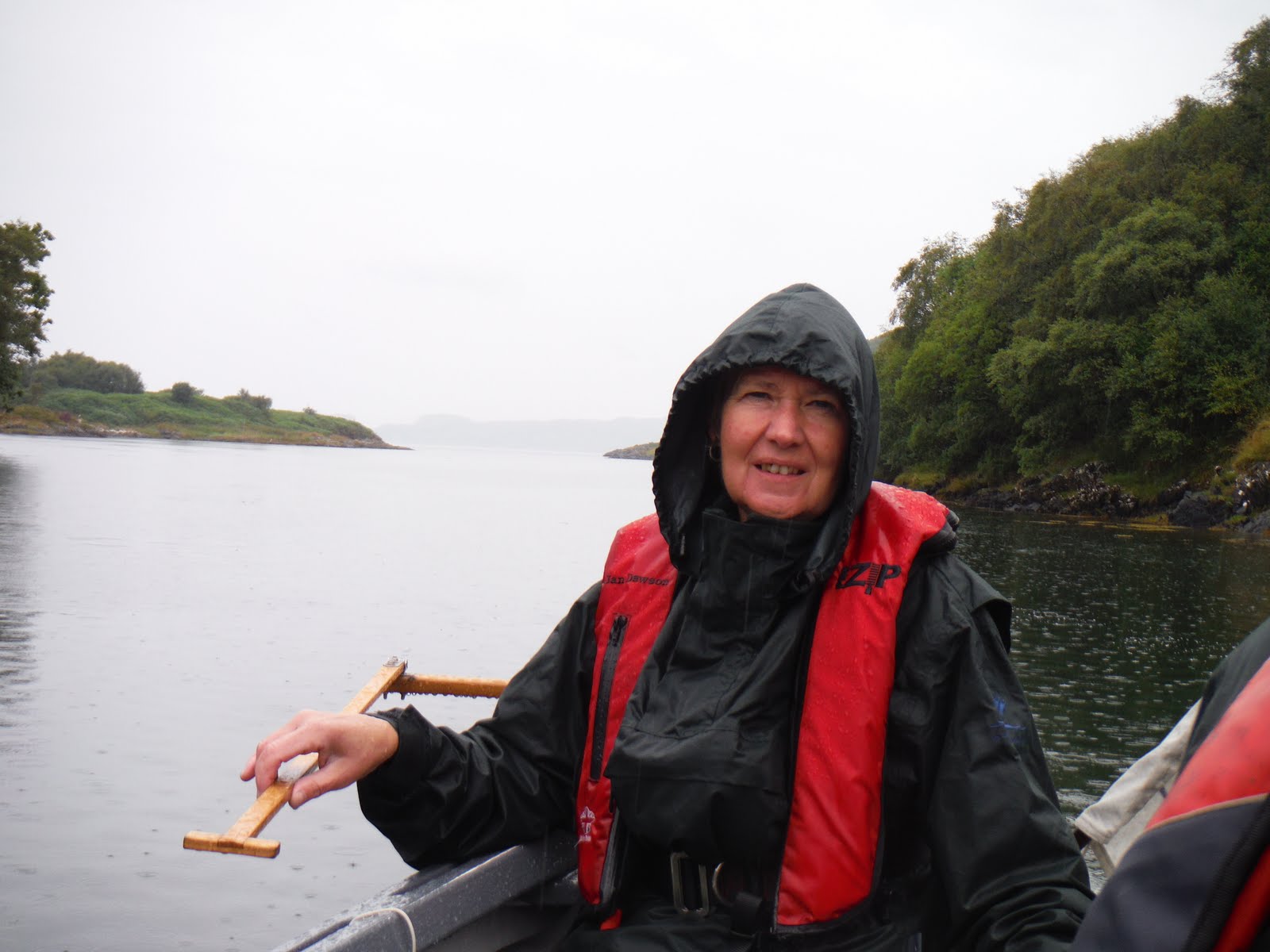
It took our cheery crew about half an hour to row from our base at Balvicar North under the Bridge and out to the great Atlantic, getting our first view of Mull this year, the hills with just a dusting of snow.

On the way there was a chance for the Convenor of our Isle of Seil Coastal Rowing Club to pick up a nice pick-up float for her mooring. A good example of The Art of the Progue


We all had a great time, including Angus the ship's dog.


Our community rowing club is one of the smallest and we welcome visitors, whether new to traditional rowing with proper oars or not. If you're in mid-Argyll please get in touch, either on our website as above or through this blog.

Sunday, 9 March 2014

The Easdale Ferry


Until recently almost any journey on our western seaboard would have involved a ferry crossing or two. The ferries were part of the lifeblood of the coastal communities and stories about them form an interesting component of our social history. The skills of the ferrymen were legendary in keeping vital routes open in all weather. 

Greatly improved roads and numerous bridges have reduced the numbers considerably and ferrymen and women are now quite a rare breed. Some of the ferries from earlier days can be seen gently rotting in remote bays, a reminder of the greater skills required of the early motorists than those of today.


There seems to be constant pressure, certainly from landowners if not from the ordinary folk, to reduce ferry links further by constructing more bridges and causeways. After all, having a proper road link to the mainland provided at the taxpayer's expense will easily add a zero to the end of whatever figure one's island is currently valued at. The implications of this in terms of rapid influx of new residents, pressure on island roads and so on are pretty obvious. Perhaps more important is the loss of the peculiar quality that makes islands special, the uniqueness of access by ferry. 

I was able to reflect on this a few days ago when crossing to Easdale for a quick visit that had been arranged before the wind got up. With over 30 mph blowing across the Sound I wouldn't have been surprised to find the ferry off, so there was a little surprise and apprehension when I saw the two ferrymen and their dog setting off in response to my summons. I needn't have worried, because the trip across and back was a model of expert seamanship and boat-handling. It would take a lot to stop the Easdale ferry running. 

Thursday, 1 August 2013

Bilderglug Report - Skiff Cruising works


It was that time of year again, when some of us get called out for service on the Bilderglug Fleet. This time someone had the idea of borrowing the Selkie from the kind islanders of Seil in place of our own ships. The idea germinated into a full-blown weekend of experimentation to see how Iain Oughtred’s wonderful creation would perform under sail and also to test the feasibility of cruising in an open rowing skiff. There was relief all round when the Admiral announced that he had no objection.

There’s a very serious side to what follows, so this post continues with a disclaimer- don’t try this at home!

Rowing skiffs such as the St Ayles are designed specifically for rowing, with slender lines to provide a sleek, easily driven hull. They will not necessarily possess sufficient reserve stability to be safe boats under sail. By contrast a substantial working boat, such as my own Christmas Wherry, will take any amount of wind, sea and bad weather but it’s a tough pull to heave her through the water under oar. We approached the weekend with great care and the knowledge that the Fleet included a couple of engined ships that would never be far away. Secure in the knowledge that our friends would look after us if need be we set up the Selkie with my wherry’s sprit rig.


Purists will point out that the original Fair Isle skiffs, from which Iain’s design was developed, carried a low aspect dipping lug rig and were presumably sailed whenever possible. That’s as may be, but we don’t know the conditions under which they sailed, whether they had a load of fish aboard or whatever. The modern view would be that an unboomed dipping lug is not a particularly safe rig in any small open boat. Sprit rig has a number of distinct advantages over the lug and properly set up is efficient and easily handled. It drives well to windward, but its main advantages come when coming ashore or if a sudden squall approaches, when the sail can be brailed in to the mast in a jiffy. In a really serious situation the sprit can simply be hauled out, so that you’re left with half the area in a cut down leg of mutton shape.

The weekend was to prove that the skiff is certainly able to be sailed under a suitable rig in safe conditions. Winds were light but she managed a tack angle of about 110 degrees and came about easily with the help of the wherry’s little jib.

As far as cruising a skiff was concerned the three of us aboard had plenty of space for our tents, gear etcetera, but had we been five up space would have been a little tight. What follows is a log of the trip.


Day One Friday 26 July, HW Oban 2019 GMT = about 2050 BST in Seil Sound. Crew this day, Topher, Jan, Sue and myself.

Tides were very important in this trip, as the streams are strong locally. It’s often not understood that in Seil Sound the flood tide tracks the Eastern, Ardmaddy side running North until the Sound narrows, then follows the shore down the Western, Seil side Southwards into the Cuan Sound, so that the guide tells us

“The North-going tidal stream in the Sound begins 4 hours 20 minutes after high water at Oban and the South-going stream begins 2 hours before high water at Oban.”

Many don’t appreciate that although the stream direction changes the water level continues to rise or fall up to high or low water respectively. All very confusing but also important.

The effect of this was that leaving at about 1800 BST we could follow the Seil shore down with  the stream and then fork West into the Cuan Sound with an increasing tide in our favour.


With three rowing and one coxing we tramped along in a lovely sunny afternoon and  soon reached the Cuan, closely following the Torsa shore and passing inshore of Eilean Fraoch and Glas Eilean (heather island and grey island) to reach the narrow passage between Torsa Beag and Luing. We were inspected by several members of the local seal families who inhabit the bays and haul-outs in the Sound.


The tide was flowing fast against us in the passage, but it was easily stemmed by some firm paddling and we passed through Ardinamir to rejoin Seil Sound. There followed half an hour or so against the last of the flood tide, enlivened by Topher’s recounting the tales of Emanuel Pyecroft, until at 1720 we beached for the night in Kilchattan Bay.


Total distance rowed was about six miles.

Day Two Saturday 27 July, HW Oban 0831 and 2058 GMT, hence the stream going Northwards from Ardluing from about 1400 BST. Crew this day, Topher, Jan and myself, with coxing by Laurence.


After a pleasant breakfast we had a nice row South with the ebb against a gentle breeze to beach at Bagh na h-Aird (the bay at the point) for lunch and a look at the yachts in the West Highland feeder race from Oban. Setting off about 1330 BST we rowed round to Ardluing, then unbrailed the skiff, hoisted the jib and had our first experience of a St Ayles skiff under sail. The last of the ebb was bringing the stragglers over the finish line off the buoy as we drifted past in what promised to be a hot afternoon.


Despite us all being old sailors we soon decided to return to the oars. With three rowing and Laurence at the helm we got along at a good steady clip, the tide increasing as we travelled North into the swirls between Fladda and the Dubh Sgeir, then across a wide stretch of glassy water past Easdale and on to Insh. We followed the shore line closely to inspect the hermit’s house, built into a cave with glazed windows and a drystane patio perched high on the cliff.


Our destination for afternoon tea and cake was the lagoon in the North of Insh, a place of astonishing beauty that could easily be in the Pacific. It disappears at high tide, when it can become unsafe in the Atlantic swell and any weather, but was idyllic and safe for our visit. We were beginning to learn that skiffs have distinct possibilities not shared by other craft. In the now windless conditions our friends in their Wayfarer had endured a long tow behind the Minna and we reflected that had we been aboard our own boats we would have shared their fate.


After tea we rowed round the North of Seil to Puilladobhrain (pool of the otter), where the skiff could thread her way with care through the reefs and save a mile or so of effort. We beached at about 2000 on Eilean Buidhe (yellow island) near the wreck and in a place far too shallow to be troubled by yachts.


Total distance travelled about thirteen miles, one under sail.

Day Three Sunday 28 July, HW Oban 0909 and 2139 GMT. Crew this day, Topher, Jan and myself.

We woke to pouring rain and one of these days where you are reluctant to leave your tent. Unlike our friends with masts those of us in the skiff had no worries about passing under the Bridge. They on the other hand had to balance having sufficient not to ground on a falling tide with having sufficient clearance and there were worries that tidal predictions are not always quite accurate.

In the event the Admiral had it right. We set off at 0930 BST and all passed down the channel on high water with nearly a metre of clear air above the masts on the Minna and the Back Magician.


Clearly in Calvanist country we shivered in the rain and felt we were paying the price for the previous days of lovely sun. We tried a bit of sailing but the inactivity made us colder and we were happy to beach at lunchtime in the North of Shuna, our chosen campsite.


After a nice hot lunch the sun came out and we introduced some of our friends to the delights of skiffing, making a brisk mussel-hunting excursion to Eilean Gamhna (calve island) just a sufficient distance to bring up blisters in hands unused to rowing. It was good to get the tents and clothing dried out and have time to prepare a nice dinner. 


Afterwards Laurence and Thomas got us all building reed boats, which sailed with varying results.


Distance travelled about eight miles, mostly rowed.

Day Four Monday 29 July, HW Oban 0949 and 2225 GMT. Crew this day, Topher, Jan and myself.

Another wet morning followed, but with a promise of better conditions later. With a Force Two South westerly we tried a couple of hours of sailing before the cold got the better of us and we went back to rowing to warm up.

We sailed enough to discover that the skiff tracks nicely in light airs. Surprisingly she carried a little weather helm and in careful hands could be put about without stalling. She was very stable and we felt that we would be happy to try her in stronger winds. The main thing learned was that she balanced nicely under a modest rig set far enough forward so as not to interfere too much with rowing. There are definite possibilities for skiff-sailing.


image courtesy of the Admiral

We abandoned our sailing experiment to concentrate on the serious business of catching our dinner. We rowed up to the Cuan Sound where we could set a line in the tide and soon had three fine codling aboard, caught each time close to the seabed on our bottom hook.

Our final port of call before returning the Selkie to her station was a sentimental visit to Port na Morachd (port of the big i.e. important people) an historic port of refuge full of history and now threatened by a massive industrial fish farm just offshore, which Argyll & Bute Council has just unanimously consented despite a huge mailbag of objections, including well over 100 from residents of Seil, Easdale and Luing. The main drivers of the local economy here are tourism and leisure and bizarrely the same council is promoting a kayak trail through the Sound.

It felt appropriate to make a last visit to this lovely bay before it becomes out of bounds. Coming ashore we discovered a feature that I had certainly not noticed before, a line of huge stones almost certainly the remains of a Viking or early Scottish boat noust.

This area is steeped in archaeology, with Port na Morachd overlooked by the pre-historic Dun Fadaidh on the mainland and Caisteal nan Con (house of the dogs) on Torsa. I am fascinated by the castle. It is generally supposed to have been a hunting lodge of the MacDougalls and is known to have become Campbell property the year before Bannockburn, to become MacDougall property again in the Sixteenth Century. The MacLeans of Duart also possessed it for a while and as they were known as the dogs their tenure provides another theory about its name. It's probably of prehistoric origin and has been cleverly built into a natural rock outcrop with later modifications including possibly the installation of a chimney, an item only found only in the grandest of Scottish homes until quite recently. Nearby is a lovely sheltered bay, ideal for beaching boats. Sadly none of this counts with the planners.


We climbed the steep hill behind the Port, harder work by far than our earlier rowing, to admire the views out West to Colonsay and North to the Sound of Mull. From our vantage point we spotted the beautiful Fife yacht Kentra, visiting the West coast for her ninetieth birthday cruise.
 

Finally we scrambled and slid back down to sea level in heavy rain squalls for a brisk row up the Sound, to give the Selkie a good scrub and leave her on her pontoon in time for the club’s evening row.

Distance travelled about seven miles, mostly rowed.

In summary we rowed for over thirty miles in total, dined well and remained friends throughout, altogether a great way to spend a Summer weekend and a clear demonstration after the excitement of the Worlds that our skiffs are not confined to racing.

The charts in this post are used courtesy of Antares Charts, a great co-operative operation that is great value and really worth supporting. 


Tuesday, 11 June 2013

Rules - What are they for? What is their status?


Rules - What are they for? What is their status? 

I’m sure that most of us just want to go rowing, but there are some sad people who think about dry and dusty things like the rules. Later this year when we go to the Skiffieworlds there will probably be quite a few who are not just sad but a little upset as well, because we are likely to see modifications in construction that we discussed during our own build but rejected as outwith the spirit of Scottish Coastal Rowing.

The viral growth of the fleet has taken everyone by surprise and it’s clear that the measurement rules would have been much more tightly drawn had this been anticipated. As a result SCRA has commissioned a full review of the rules with a view to bringing in amendments for discussion at a future AGM. I am a member of the group charged with considering the existing rules, gathering views and offering advice.

All of us on the group are wearing two hats, because we are also involved in our own clubs and want to win races. Now that we at Seil are on the water and gaining our own experience we should be thinking about the issues surrounding the rules, so that we can adopt a position at any future SCRA meetings where amendments are discussed. I’m posting about some of the issues, in the hope that it will stimulate thought and perhaps a bit of discussion through comments.

I suggest that it’s possible to identify a number of quite distinct reasons why we need rules for boats in a class. I can think of four, safety, strength, speed and spirit. There may be a fifth that spoils the alliteration, cost, but with the kit-built skiffs I suspect it’s less important than we think, as the big items are all fixed.

I won’t waste time describing why the first three are important. By spirit I mean the range of emotional factors that have come together in the last three years or so surrounding the St Ayles skiffs and their communities. It’s a mixture of nostalgia reflecting the history of the boat type and shape plus the unique elements that make them attractive and in time will become a tradition.

Traditions all start somewhere, usually for good reasons which get lost as time passes. All sports have them for a variety of reasons, good and bad. Good reasons tend to reinforce the sense of belonging to a community, bad ones lead to exclusivity (c.f. certain bowling and golf clubs). We’ve all come across this, probably without actually acknowledging that in a sport one can do things for no obvious practical reason.

In our rules group I have argued that we should be aware of the importance of spirit and not shy away from promoting it as a value. It’s actually the only reason why any of us would take to the water in an attractive, slightly old-fashioned looking wooden boat with oars hanging off wooden thole pins and a flag pole on the front. Otherwise we’d be scooting about on sliding seats in carbon fibre contraptions and probably wearing designer lycra.

As we all know, the concept of the St Ayles skiff was developed at the Anstruther Fisheries Museum to commemorate certain traditions and perhaps revive them. In no particular order the historical antecedents were:

Scandinavian, ultimately Viking, boat shapes.

Historical Scottish fishing practice.

Recreational and competitive rowing in our east coast towns, particularly among the miners.

Traditional styles of rowing with long oars, kabes or thole pins.

The rules as presently expressed do refer to the spirit of the St Ayles skiffs, but there is a lack of detail, also an apparent reluctance to be open about the importance of this. As a result particular provisions designed to entrench the spirit have been justified on the other grounds, safety, strength speed and cost.

In the group I have argued that we should have the courage to acknowledge that rules making a boat strong may have nothing to do with safety, rules about speed may have nothing to do with either of those and rules about spirit absolutely nothing to do with any of the others.

Some of the issues are fairly clear. For example as we learned during the build adding rocker by reducing the keel at the ends is not allowed. Others are less so. Here are some of them.

Rowlocks.

The rule requiring these to be of wood has been justified on cost grounds, but metal crutches are demonstrably cheaper and longer lasting that wooden pins or kabes. Also some clubs have made clever wooden imitations of carbon fibre racing fittings, enabling oars to be feathered.

Feathering oars.

As a consequence of clever woodwork feathering has become possible and seems to be within the current rules. We have to think about whether or not this is the style of rowing the clubs (and we personally) want to see.

Should feathering oars be banned? On balance my personal view is, yes, they should be. I would argue that the traditional system with kabes or pins is central to the experience and much easier for inexperienced rowers to master. My views might change after a lot of hard upwind work though.

Spoon blades/choppers

Spoons are disallowed, ostensibly on cost grounds. That justification doesn’t stand up, because it’s cheap and easy to laminate curved blades using the same procedure as we did with the stems. It seems truly a question of spirit.

Materials

The existing rules allow a number of specified traditional materials apart from wood – “Brass, Silicon Bronze, Stainless Steel, Gunmetal” and go on to say “The only synthetic material permitted in the boat construction is the glue which should be of Marine Quality, and will usually be Epoxy resin or a Polyurethane glue”.

I think everyone has problems with the letter of this. Our polypropylene strips are illegal, but most skiffs have something similar, as bronze ones cost about £300. One recent skiff is said to have stainless steel thole pins, done with no intention to gain an advantage.

Footrests are not shown in the plans, but are necessary for rowing efficiently. A discussion is ongoing about the extent to which they may incorporate metal adjusting/strengthening strips.

Rudders

Alec Jordan’s original view was that the design should be completely open, to allow ideas to develop. During our build we discussed how it would be better for the pintles to be in a vertical line to the water and how this could be done with an outrigger. We decided not to do this and to keep the leading edge following the aft stem. Given the lack of a rule banning outriggers it will be interesting to see what people turn up at Ullapool with.

Selkie's very legal rudder


Later this year clubs will be asked to comment on these issues and if they want to entrench some basic principles which would purely be intended to preserve the spirit of inclusive community participation and the obvious good things that are causing this project to grow so quickly. It will be interesting to see what each regards as important to the experience of being involved with the St Ayles skiffs. We should be thinking about our own contribution to this. I await our own discussion with interest.

This post was written originally for www.seilskiff.org.uk and is reposted here for general interest.


Thursday, 24 January 2013

700 Years ago this Day


On 24 January  1313 King Robert Bruce granted in favour of Sir Dugald Campbell, Laird of Menstrie, Clackmannanshire, born at Lochow (Lochawe) 1259 or 1262 and son of Sir Cailean Mor a charter of the lands taken from the MacDougalls consisting of Kilcongen (Kilchoan), Degnish, Auchinaclosh (Kilninver) , Auchinsaule (Kilninver), Caddiltoune Ardmaddy), Garpynging (Kilninver), Ardincaple (Ardencaple), Ragray (Kilninver), Kilninver, Esgeallan (Kilninver), Clachanseilach (Clachan Seil), Leternacrosh (Kilninver), Scamadil (Scammadale), Kilveran (Kilninver), Letternamuck (Kilninver) and the isle of Toresay (Torsa), in exchange for providing a twenty six-oared galley equipped with men and victuals.

Seven hundred years later the following exchange took place between Eoghan o’ the Lang Skiff and Choinnich Sgarbheach, the Sage of Doune:
Eoghan: I don't know what the MacDougalls had done to deserve having their lands taken away and Sir Dugald had a few years earlier backed King Edward against the Bruce. It all goes to show the Campbells usually come up smelling sweet. Glad (in a way) that my great great great Grannie was one.
Choinnich: It was in the Pass of Brander that the MacDougalls learned a lesson taught by Robert the Great, with young Colin Campbell at his shoulder, to the effect that EDW I was a bad person.  That is what they did and some people in Argyll have yet to forgive.  Now, while it is the case that the Campbells, as signatories of The True Solemn Oath and Covenant, found themselves opposed to the heirs of Marjorie Bruce (who would have done far better to marry young Colin of Argyll rather than Walter Stewart), and thus sided with a wee bit Gairman Lairdie, the MacDougalls appear to have escaped without a blemish on their estates, although their character is well known throughout Argyll.  Now I find myself asking, 'What is this about taking lands off the MacDougalls?  There is surely only MacCallum Mhor that has the power to do such a thing, and himself short on the powers that were once his to command.  If it is not Cleann Caimbeul that is doing this thing then it has no businness to be done for we alone can do such a thing and end up smelling of roses, even if they be the Floo'ers o' Edinbro.  Stand proud in your Campbell heritage, my kinsman.
Eoghan: Ach, ye have an answer to evrytheeng, ma pretty Freen!
The charter was granted less than 50 years after the conflict between the emerging Scottish kingdom and Norway was resolved at the Treaty of Perth in 1266, which was prefigured by the Battle of Largs in 1263. The early Scottish kings were finding it a hard job coming to grips with the people of the islands, who retained fond memories of the autonomy previously enjoyed and of course were themselves partly of Norse ancestry. The Bruce operated a policy of consolidating his grip on the main land by building castles and installing suitable tough guys to control the unruly Gaels.

It’s interesting to see the notorious political flexibility of the well-named Campbells (literally Cam Beal – crooked mouth, not of course referring to a physical attribute) to the fore so early in the history of our nation.

Sea power was vital to ruling the islands in the pre-road period. Providing a galley of 26 oars was a major endeavour justifying the grant of a huge tract of land, although one can imagine that retaining control would also take some effort. There would have been a big tribe of angry MacDougalls to contend with for a start.

I’ve tried to identify the various estates involved, extending from Loch Awe in the East to the North shore of Loch Melfort on the South along to Degnish Point, then the West boundary running up the middle of Seil Sound to Clachan Seil, but including Torsa Island with the Castle of the Dogs and a North boundary running somewhere to the North of present-day Kilninver along to Loch Awe again.

The anomaly is the inclusion of Ardincaple at the North end of the Isle of Seil. Literally Ard na gCapull, the “point of the horses” this may refer not to real horses but to the black rocky reefs and breaking waves off the point, resembling in the mind of the poetic Gael wild horses. Ardincaple is the site of Ardfad Castle, the seat of the MacDougalls and awarding this to the Campbells would have been a serious provocation, especially as the remainder of the island seems not to have been included. Perhaps that was granted to another of the Campbell knights.

Regarding the actual galley one can assume that there would have been thirteen thwarts or benches, two oarsmen on each and “rooms” of about a metre in length, suggesting a hull length of at least seventeen metres, fifty six feet, if we allow a couple of metres at each end. The image at the top of this post has seventeen oar ports, thirty four oars, and the biggest galleys seem to have been forty oared, but there’s a lack of archaeological evidence and it’s always possible that once the charter had been granted the galley didn’t actually materialise.  

The Wherrymen

The Wherrymen
Two old friends on the water