Featured post

The Scottish Islanders

  Get your copy from  www.shop.yachtarchive.scot  !

Showing posts with label scottish coastal rowing. Show all posts

Friday, 22 March 2024

Memorial to Iain Oughtred, Boatbuilder and Inspiration


Iain Oughtred was born in 1939 and grew up in Sydney. He was a shy child, who didn’t enjoy his studies, but from early on he developed a fascination with aeroplanes and boats and the science around them. He became involved in racing the National Gwen dinghies that were a feature of the scene on the Harbour. These were flat bottomed racing boats, designed in 1942, with a hull just twelve feet long, weighing just ten stone (63.5 kg), but with the foresail on a bowsprit and what Iain called a “shy spinnaker” set on a ten foot pole, giving them a massive sail area and requiring incredible skill to keep them from turning over. By the 1950s the postwar availability of new glues and synthetic sailcloth increased the performance, so that he claimed, in an article he wrote in 1958, that one had been timed at 23 mph in a “gale-like wind”. He built seven of them and became the class champion. His long term friends knew him as Isig, from the number on his sail created from black tape.

After working for several yacht designers, in 1964 the lure of the Swinging Sixties brought Iain to London, where he established his own practice in his own distinctive style. There was at that time a huge interest in self-built sailing boats, led by the Daily Mirror sponsoring Barry Bucknell’s Mirror Dinghy at the 1963 Boat Show. Iain knew that a self-build need not resemble a shoe box and started putting out drawings of  hulls that were lovely as well as fast and seaworthy, accompanied by detailed building manuals, ensuring that anyone with the most basic skills could build one. His fascination with Viking designs led to his move to Scotland and then to Bernisdale on Skye, twenty three years ago. There he was truly in his element, working in his boat shaped drawing office and eventually reaching over a hundred designs. He’s best known for one of his last ones, for the community-built Scottish Coastal Rowing skiffs, with over two hundred in Scotland and almost the same number elsewhere. 

Iain was a quiet, deeply spiritual person, who invariably put others before himself. He was reluctant to embrace the internet, preferring to develop a personal connection with his clients, always available to take a call to resolve a problem. His drawings were works of art, invariably sent with a handwritten note adorned with tiny sketches. 

There is no easy way to leave this life, but it was a relief to know that Iain’s final few weeks were made as comfortable as possible in the brand new Broadford Hospital. His good friend and neighbour, Natalie Steele, had insisted on his being shifted from the back to the front of the building, with a view over Broadford Bay. As cards began to arrive from the boatbuilding and coastal rowing communities who owed him so much, and it turned out that one of the hospital staff was even building one of his boats, he was recognised as someone very special indeed. Although beyond the reach of any potential treatment, he was in no pain whatsoever, and so remained fully alert and cheerful. 

In his final days Iain had visits from his son, Haig, over from Lisbon, and his brother David, from Hawaii (what an international family!), also from many friends within easier travelling distance. Then in the morning of 22nd February we got word that he had quietly passed away during the night.

I understand that, by the time you read this, a quiet Quaker service will have taken place on Skye. I suspect that his sailing and rowing friends here and abroad will organise their own events later in the year. And, to preserve his legacy, a group of friends, with the agreement of his family, will be setting up a small charity to ensure that his designs live on and continue to support the tradition, culture and skills of which he was such a keen advocate.


Monday, 13 September 2021

Rowing from Loch Linnhe to Kilchoan


I’ve been reflecting that I’ve just completed the longest sustained physical effort to date in my seventy three years on this planet, rowing for a continuous five hours, minus short breaks for a slug of water, against a wind of a good Force Three, perhaps Four at times, with some confused tidal rips added, on our passage from Lochaline to Tobermory on Saturday. My deepest respect and admiration go to our Convenor, who insisted on battling out the entire trip over three days from Loch Linnhe to Kilchoan.

Robbie had created a very full and careful passage plan, incorporating our respectful consensus about the times of the tides, which were just off Springs and didn’t promise to be very helpful, with Low Water on the first day about 1500 and of course progressively later.


The crew assembled at the Linnhe moorings on Friday, where we were greeted very warmly by Paul and sent off in a dreich flat calm, coxed by Robbie down to our first wee stop in a lovely bay at the North West of Lismore. There I took over the coxing for the next hour or so of rapid travel with a big ebb tide, which seemed to follow us round the Morvern shore for another swap over, another slug and a bite of nourishment. We didn’t see much wildlife in the murk, (just one unidentified big thing made a splash behind us), but were glad of the ideal rowing conditions in what my Mother called a wetting rain. Distance travelled 21 Kilometres over four hours.


A very pleasant evening was spent in Lochaline, dining rather well in the Nest, followed by cabadaich agus deoch in the social club, a fine establishment, a little Seventies in style, then a night in the bunkhouse.


As noted above, the second day was quite a challenge. After offering encouragement and support to the local Witches of Morvern we set off about midday and had a fast ebb for the first five hundred metres or so. For the next hour Sue, Adam, Steve and Robbie took on some pretty challenging conditions as I did my best to keep us clear of the worst of the tidal rips and bring us round inshore as far as possible, where we assumed the tide would be slacker. By the time of our first changeover I was glad of the chance to warm up, if apprehensive about the challenge to come. In fact as the day went on the waves became a bit more regular, but the Sound feels very long when you’re travelling up it at about thirty heaves per minute.
Wildlife on this section amounted to one big grey seal, who stuck his head up and no doubt would have scratched it in wonderment had his flippers been long enough. I don't count the hundreds of caged salmon that we passed at Fiunary, the fittest of them leaping incessantly on the surface, the property of the “Scottish” Sea Farms company, in reality like most of the industry foreign owned. Aquaculture Scotland tells me that the site was only stocked in May, but the fish looked mature and may have been shipped in from a problem site elsewhere. Mortalities are currently about four and a half tonnes per month, as we hit maximum sea temperatures and sea lice levels.


We had expected to finish in style with the flood going North through the Diorlinn, but instead had to overcome an adverse stream. Inside we were met by our hosts for the evening, John and Lynne from the Isle of Mull club. Distance travelled 23 kilometres over six hours.


After we secured at the pontoons and rediscovered some ability to walk we were whisked off for hot showers and a great dinner and deoch at Dervaig. Off to bed at nine and missed the tennis!
Day Three was quiet once again. We left at nine, myself coxing again for the first half, accompanied by our hosts aboard their lovely Harrison Butler, surely one of the most practical ships ever designed. This final leg of about ten kilometres lasted just a couple of hours.


James then quickly rustled up some bacon rolls before driving me off to the ferry terminal. I was privately happy to travel back the long way (the van having only five seat belts). I had a chance to sample the delights of The Gallery, carrot and walnut cake and a good strong coffee, followed by Isle of Mull ice cream from the shop on the front, both signs of how Tobermory is increasingly attractive to visitors. The Mishnish still looks great, sadly the Macdonald Arms, once home to the legendary Bert Hall, not so good.


Then, with an hour or so to spare before the bus I found a nice American fellow over here with his father’s ashes, who seemed happy to listen to a few stories. The bus driver was a cheery man who started the chat by saying “I bring you up in the morning and take you back at night” and was a bit thrown when I told him I had arrived in a rowing boat. The bus was packed full, everyone masked up apart from a moustachioed BFB who spent a lot of the trip on his mobile. CallyMac made him mask up to get on the ferry, so he did actually have one.


Post script: We've made it into the Oban Times, fame at last!


Wednesday, 1 May 2019

The First Loch Awe Adventure


The event was well named, because visiting Loch Awe is indeed an adventure.

Coastal Rowing is quickly spreading inshore, and this event has shown one
again what close competition you can have on tideless waters. Conditions last
Sunday were ideal, with totally still water during most of the event.

The arrival of skiffing on Loch Awe is entirely due to the efforts of Gordon Leveratt
and his wife Maggie, making what I hope isn’t too stressful a journey from an organised
world to the wonderful anarchy of the skiffies. Having built the lovely Mingulay, he
established the KIDS (Kilchrennan, Inverinan and Dalavic CRC) and they already
have sufficient numbers to justify a second skiff.


Last Summer Gordon invited some local skiffs for a visit, and we rowed down from
Kilchrenan to explore Kilchurn Castle. We didn’t know that we were a trial for greater things!

image courtesy Richard Pierce, Luing


Dalavich had always been a bit like Brigadoon for me, a place I wasn’t quite sure existed,
although I’ve lived nearby for over thirty years. I can confirm, as can fifty tired rowers,
that it not only exists, but offers one of the best bases for a skiffing event that you could
wish for. There’s plenty of space for parking and unloading, a huge level campsite, cabins
available for those who want some luxury, including hobbit rooms, a community centre with
a proper hall for ceilidhs and nearby the Wild Rowan Cafe with great home baking.

Gordon had laid on everything for a safe, happy, competitive event, including even a towing buggy
to the launch site.

I missed the Friday arrivals and the musical evening with Martin McLaughlin on the bagpipes.

Saturday morning was a bit dreich and rainy at first, but soon cleared to allow a lot of social rows
and “try a row” sessions, also some great trips to the dreaded prison island of Ardchonnel and some
of the twenty two local crannogs. While I was out with North Queensferry we saw the local osprey take
a fish back to her treetop nest, worth the trip for that alone!


We had a great meal in the hall in the evening, followed by the ceilidh hosted by local group
All About the Cake, locals Laura Neville, Jane Wilding, Jeannie Holles and Andre van Well
playing out of goodwill. The fear an tighe, Guy Neville, managed to get about forty skiffies up
to dance a passable Reel of the 51st Division.

image courtesy Chris Mitchell, Kinghorn

Sunday was much brighter, with almost still water.

I had agreed to hold one end of the starting tape, always quite nerve wracking when there’s
a biggish fleet on a transit. Despite our general dislike of discipline skiffies do rise to the occasion
and the fleet lined itself up straight for a perfect start. All I had to do was pull the trigger, then off for
banana cake and coffee while ten crews battled it out.

image courtesy Chris Mitchell, Kinghorn

Being a land based event the distance was 7.4 statute miles from Dalavich to Taychreggan, then a crew change and an individual start for the race back.

The outward race was astonishingly close, with Sandbay from St Andrews covering the distance
in 1 hour 16 minutes and 8 seconds, followed by Arran’s Seabhag 22 seconds later, five boats within
the next 12 minutes and finally the KID’s own Mingulay on 1 hour 37 minutes.

It’s a great tribute to the Renegades that they made the whole trip without a crew change and achieved
times of 1 hour 25 out and 1 hour 39 back.

The fastest boat on the return trip was Seabhag with a run time of 1 hour 19 minutes, followed
by six boats in the next twenty minutes, then Blue Bay, Mingulay and finally St Moluag on 1 hour 48.

Combined results made Arran’s Seabhag the overall winners, then Sandbay from St Andrews
and Yolande from Kinghorn.

We had a good shore crew working on the times, Heather writing them up and Nigel making sure
that the right boats got the right times!


It all ended with a cheery prizegiving and some beautiful trophies.


Here is the complete list of the times:


Monday, 26 February 2018

A nice Interlude


After a few days of planing with a very sharp final blade and sanding by hand and machine it was great to find that the skiff had a place for me on one of the nicest days of the year so far. Here's what I left behind:


It took our cheery crew about half an hour to row from our base at Balvicar North under the Bridge and out to the great Atlantic, getting our first view of Mull this year, the hills with just a dusting of snow.

On the way there was a chance for the Convenor of our Isle of Seil Coastal Rowing Club to pick up a nice pick-up float for her mooring. A good example of The Art of the Progue


We all had a great time, including Angus the ship's dog.


Our community rowing club is one of the smallest and we welcome visitors, whether new to traditional rowing with proper oars or not. If you're in mid-Argyll please get in touch, either on our website as above or through this blog.

Sunday, 28 January 2018

Working with Epoxy

Only the bowsprit to varnish

I’ve been involved with epoxy resin, rather too closely for my liking, for about thirty years and have developed something of a love/hate relationship with it. Fortunately it hasn’t caused any other issues, which is a little surprising, because before I became as fully aware as I now am of the risks a fair amount of it found its way onto my skin. There is currently a surging interest in working with it, not just for boatbuilding, but also making cabinets, musical instruments and so on. I thought it would be helpful to offer some tips and advice from an experienced but lay perspective.


The advantages


The curing process involves the coming together of the two components without requiring a third factors, such as moisture or air. This means that it does not shrink during curing and can thus, subject to the addition of suitable fillers, be perfectly gap-filling. In fact joints can be made a little loose and still be strong, something that infuriates traditionally trained craftsmen and women.

Over the years I've tried various other glues that were said to be gap filling, but it seems that none truly was. But I have at least one boatbuilder friend who will disagree with this.

The main advantage is simply that a joint made with epoxy, if properly protected (see below) will be far stronger than the wood it is joining. 


The disadvantages

The main one is the risk to health. We are told that epoxy resins and the relative hardeners are not carcinogenic but I'm not anxious to be the person who proves that wrong.

Demonstrable os the fact that exposure to the components, probably the hardener rather than the resin, results in people becoming sensitised, so that any time they are newer to epoxy they come out in red blotches and feel weak. I once knew an old retired boatbuilder who could not even sit in the cabin of a boat built years earlier with epoxy without this happening. 

Less important is that it's one of the most unpleasant substances to work with, sticky of course but in a rather special, nasty way.

It's also very sensitive to ultra-violet degradation and must not be used as an unprotected external coating, however née it looks when fresh. This is a very good reason for avoiding brightwork altogether, just giving the cured surfaces several good coats of gloss paint to keep the light out, saving heaps of future maintenance work in the process.

Finally, it's usually more expensive than other glues.

Next I'm going to describe briefly how I use epoxy and in the process explain how to capitalise on the advantages and minimise the downside and save money.

Gloves or no gloves?

Personally I prefer not to wear gloves, because I believe it's better not to get my fingers sticky in the first place.

When building a community skiff a few years ago we had to adopt the industry standard of providing boxes of surgical gloves and requiring people to wear them. In fact two pairs must be worn, as it's almost impossible to get them off without getting glue on one's skin. I suspect that wearing gloves gave some people a false sense of security and made them careless, because most of the glove could not be used a second time. If you get a hole in the end of a finger you're in real trouble.

When you get glue on your hands, which of course I do, wash immediately in warm water with conventional soap. In no circumstances use acetone - it removes the natural protective oil in the skin and facilitates the passage of toxins into the body. Doing this forced a career change on a man I used to know, from modern boatbuilding to the manufacture of fake antiques, the latter more profitable but not without risks, only judicial ones rather than to his health.

Use weighting scales rather than pumps

I've yet to find pumps that were accurate ad have given up using them, since portable digital scales and so cheap. Protect the scales with plastic film.

This enables very small quantities to be mixed accurately and saves money and mess. By the way I've been told the correct West mix is 100:17, not 5:1!

Use disposable containers

Washing out and hoarding the pastil cartons that supermarkets insist in using is a sure sign to one's partner that another boat will be along on a year or two, if he or she hangs around that long.

I like the wee yogurt ones, because the corner suits my thumb and ensures that I pick it up the same way each time. The bigger soup and cream ones are great for larger mixes.

Read the Instructions (as Mother always said)

The best companies provide instruction manuals and sell ranges of mixers and fillers for all purposes to produce the best joints, coatings, space fillers etc. Buy those and use them. Using sawdust to bulk out joints may seem to save money, but may result in a glue starved joint.

Use Clingfilm

For example, laminating inwales from long strips of softwood involved mixing ore glue than I like to work with and unavoidable handling of these bendy, slippery strips.To cope with this I got a big commercial roll of plastic film  and covered the bench with it, then a second layer on which the strips were placed. Once they were coated (leaving a couple of inches at each end dry, to enable them to be lifted and cut off later) I flipped the glued faces together and folded the film over to enclose the workpiece totally. It was then easily transferred to the outside of the hull and left to cure. Later it would be lifted off, cleaned and fitted permanently to the inside.

Use heat

I read a lot about jobs being halted during periods of cold weather, but think a lot of this can be avoided if the glue starts out reasonably warm. I keep mine (in an old feed box, to avoid mess) in the boiler room in the house. Heat guns are handy, too.

To Pre-wet or not to pre-wet?

This is one of the new religions taking over the World. The Gospel according to the Gougeon Brothers says to do it, but it doubles the spreading time. There's no doubt the first coat of epoxy disappears into the dry timber by the time you apply the second coat with the fillers. Adding some filler with colloidal silica renders the mix less runny and so less inclined to sink in, so just use one coat? On the face of things this should save both tie and glue.

I won't disclose my preference, my beliefs in this field are personal, but just say that I've yet to have a joint that failed and the basic trick is to use plenty of glue.

As Captain Pete said, the time to worry about whether you used enough glue is not when you're five miles offshore in a gale!


In her cowshed

An early trip


Saturday, 20 January 2018

More about the joys of Skiffing (not the Lonny Donegan type)


Imagine sporting events taking place with hundreds of participants, thousands of spectators, police and ambulance people about but no arrests and no injuries! In Scotland! Welcome to the World of Scottish Coastal Rowing.

Ullapool 2013


Imagine over 400 rowers in a total of 75 traditional rowing boats racing from Dumbarton to the Glasgow city centre, again nobody got arrested or hurt, apart from a few blisters! Welcome to Clydebuilt Festival 2017, due to be repeated on 15 September 2018.


Anster's finest at full stretch


There was even time to launch couple of new traditionally built boats. Glasgow's great Lord Provost Eva Bolander, herself a rower, wearing the gold chain.


Spot the mystery man in the crowd


From quiet beginnings a few years ago skiffing has grown and grown, been exported world-wide, become the major keep-fit exercise for thousands of people, many of whom never imagined they would ever take up an oar, linked communities through common interest and gentle, occasionally strenuous, but always good-natured competition, with virtually all funding raised within the communities.

Perhaps because we don't make constant demands for public funding, don't use carbon fibre, don't buy our boats from the boating industry, have fun, row to coastal pubs, have picnics on islands, invite strangers along to join us, we are virtually ignored by government agencies such as Scottish Rowing, the self-proclaimed "governing body for rowing in Scotland". The annual subscription to that outfit, with its team of sport administrators and experts, would be twice the total annual budget of my home club, Isle of Seil Coastal Rowing! No thanks.

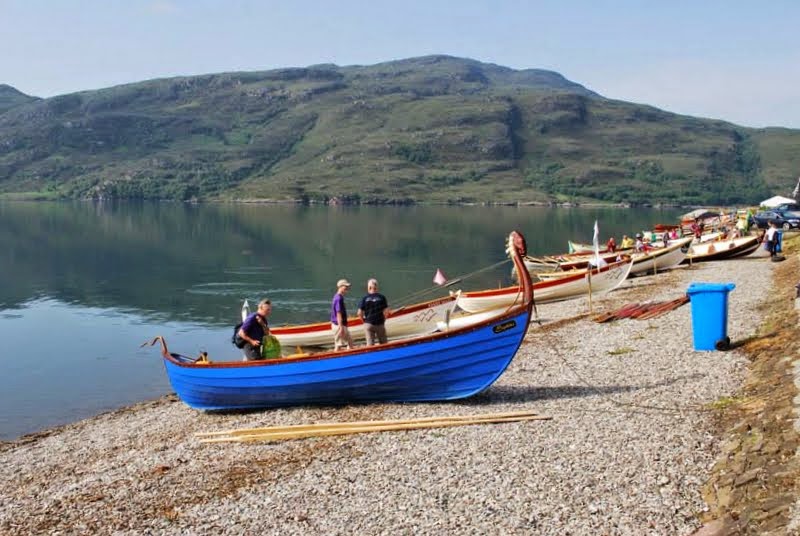
The top image is of our crew battling it out in Ullapool at the skiffieworlds in 2013, a few weeks after we launched our Selkie, an event hosted by the always innovative Ullapool Coastal Rowing Club.

Musical skiff Sephira in the foreground


We were represented at the 2016 event in Northern Ireland with the help of some wonderful rowers imported specially from the United States, although our resources didn't stretch to taking the Selkie over.

We are now working towards the 2019 Worlds in Stranraer and hope to be there in force with the skiff Selkie and a mixed crew of Seilachs and friends from near and far.


Clarification for younger folk, Lonny Donegan did skiffling, not skiffing!

The Wherrymen

The Wherrymen
Two old friends on the water