Featured post

The Scottish Islanders

  Get your copy from  www.shop.yachtarchive.scot  !

Showing posts with label john gardner. Show all posts

Saturday, 29 June 2013

A nice pulling boat for the sea.


One of the dreadful things about building any boat is that after the present project is safely up in frame, or on the moulds if you build upside down like most of us do, one’s thoughts turn to the next project. Mutterings along the lines of “haven’t you got enough boats already?” do absolutely nothing to dampen things down. There are several reasons for these feelings.

Boatbuilding is itself a very basic and intrinsically compulsive activity. It seems likely that the human race was going afloat for millennia before the wheel was invented. After all, why build roads when the sea and river are here for nothing? Historically our islands were the centres of commerce and administration and hence culture, also the interface with other cultures far away and thus responsible for most of our genetic mix.

Constructing a boat is a fascinating blend of practicality and artistry, a three-dimensional object which must work, keep us safe and last in a destructive environment but which can also be handsome and even beautiful.

Finally, as with everything else, we do it because we can. We have acquired the tools and skills and why stop now, when every boat we build is an improvement in what has gone before. Ronnie McG from Kilcreggan told me once of an uncle who built livery skiffs by eye and continued to produce them at the rate of one every four weeks or so, long after there was no market for them and all his other faculties were giving up, “just because it was what he did”.

So, my record to date is: a a Joel White Nutshell, which took 6 months in 1986, Mystic John Gardner’s Swampscott Dory from Volume One in 1988, his Quincy Skiff in 1990, David Ryder-Turner’s Sonas between 1992 and 1994, Iain Oughtred’s smallest stem dinghy in 1996 and Walt Simmon’s Christmas Wherry in 2006. The significant gap before the wherry was taken up with rebuilding Stroma after a museum destroyed her and since 2006 I’ve been restoring Juni (and building a house). Most recently Selkie hit the water after the community build on the Isle of Seil. Not all my own work, but I was proud to help.

The next project will be a pulling boat with long enough legs to get up a good clip with one or maybe two people sculling, but not too difficult to handle on shore (so that she gets used)  and fine enough lines not to be a pain, but also firm enough not to cause alarm. Oh dear, I’ve just described two or three separate boats.

A Whitehall type, or Iain’s Acorn at the longer length, say sixteen or seventeen feet, or the lovely but extreme Flashboat, would get the speed, but such boats at shorter lengths are tippy spindles. At the intended longer length she’d be fine until caught in the wind and tidal chops we get around here. And probably blow away if left on the shore.

Shorter boats, such as the larger tenders, are too bulky for recreational rowing and don’t get the speed, if safe.

I’m tending towards an elongated tender, taking an existing design that combines a firm bilge with smooth lines and extending the mould spacings to add some length. The ends should be as vertical as possible, to maximise immersed waterline. Many of Iain O’s designs fail to do this, an exception being the Tammie Norrie, which should go on the list. It’s a plus too, that Alec Jordan has kitted her.

That makes me think of a traditional Cornish rowboat drawn by Percy Dalton, plumb ends, nothing fancy, just a good basic no-nonsense boat. I seem to have lost my copy of his book – must see if the lines are googleable.

A near vertical transom means of course that a little Mercury or similar could perch there, handy if someone wants to go fishing.

As often before I’ve turned to the sage of Mystic Seaport. The closest to what I have in mind is the Lawley tender, which is too short for the purpose at twelve feet, but what if drawn out a foot or two? She has the proud stem, firm bilge and lovely traditional transom that would hold their own in any company. The lines look good and would cope with being drawn out I think. She could be built in strip but, what the hell, better to do her in fine clinker, with lots of planks per side and make a proper job of her!

Does anyone have a better idea?   

Tuesday, 4 December 2012

More Marine Painting


I am humbled by the fact that my blog derives as many hits from browsers looking for maritime images  as from my own efforts. Truly pictures speak a thousand words.

The late John Gardner was an inspirational fellow seaman, drinking companion, loyal and generous friend and not least one of the finest maritime artists of the last century. I publish his work with the consent of his family, as they are happy for John to be remembered and his work shared, just as he himself enjoyed it being shared through his calendars. Having said all this it’s always nice to be asked, rather than have permission taken for granted and I think it would be appropriate if anyone using an image took the time to send a wee acknowledgement to me for forwarding to the family.

John's images can be found throughout this blog, as you'll see in the list opposite.

Now, continuing my habit of getting a hurl for nothing, I’m moving back to the Nineteenth Century.

The McLean Museum in Greenock houses a treasure trove of art, much of it maritime in nature in keeping with a town that lived on shipping and shipbuilding. They include some great paintings by the town’s William Clark and I  asked the Museum for their consent to republish the following images. They’re happy, subject of course to their involvement being acknowledged. I’m adding their blog to my links list and suggest that any fellow maritime and historical bloggers should consider likewise. I hope that if you decide to republish anything you will extend this great public asset the courtesy of a similar acknowledgement. There are some very interesting articles on their blog and they deserve a lot more followers than they presently have.


William Clark lived from 1803 to 1883 and so his work covered most of the Victorian age. 

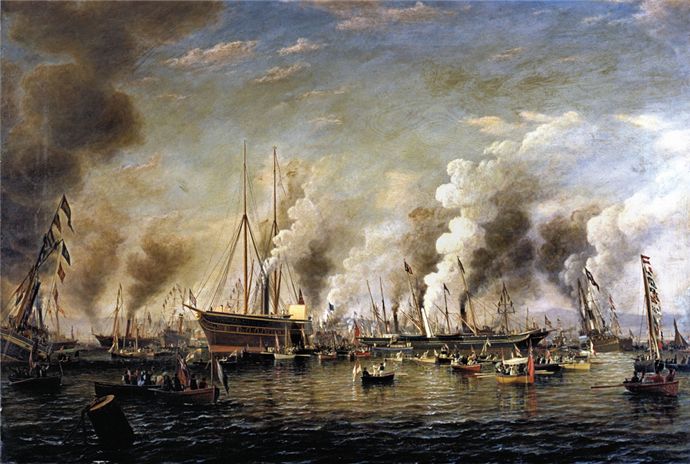
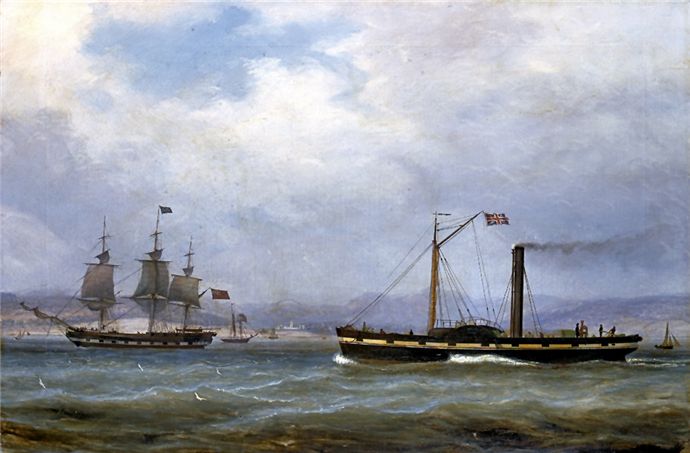
The image at the top of this post is of the Eldon, which I suspect was in the Australia trade around the 1840s. The first and second images below have the museum’s own captions added. Many thanks are due to the Leggy Prawn, who alerted me to the Museum's  great archive in the first place.


A mid nineteenth century oil painting on canvas entitled 'The Queen's Visit to the Clyde 17th August 1847' by William Clark (1803-1883), showing a view of Queen Victoria's visit to the River Clyde in 1847. The scene is on the River Clyde with a group of large and small vessels decked in flags with many smoke plumes visible. The participating vessels are left to right, Hercules, Chieftain, Fire, Queen, Conqueror, Admiral Garland, Victoria & Albert, Mars, Scourge, Undine, Fairy, Thetis, Sovereign, Premier, Craignesh Castle. Signed and dated 'W. Clark 1847' at the lower left by the artist.


A mid nineteenth century oil painting on canvas entitled 'The Tug Conqueror' by William Clark (1803-1883), showing a scene on the River Clyde off Greenock with a wooden hulled paddle tugboat on the right and sailing vessel on the left. In the background the building popularly known as the 'Duke of Argyll's stables'. Unsigned by the artist.


Next we see some shipping becalmed off the Cloch - how often have we been there? And finally the visit of the Fleet.


Monday, 31 October 2011

John Gardner's Quincy Skiff


The late John Gardner of Mystic Seaport was apparently unable to pursue a teaching career on graduating from Columbia because of his political views, but formal education's loss was a great boon to the wooden boat community. Very few people combine practical ability with good writing skills, but his books on building classic small boats are so clear and inspirational that each chapter seems to cry out "please build me".

So I found myself while building the Swampscott dory in Volume one devouring the other chapters and wondering which would shout the loudest. In the event the modified Quincy skiff won out and became my next project. At the start of the chapter on her the Guru writes that she

“should row well, but build easily and cheaply. This is not a racing shell, obviously, nor is it intended for the open sea. This simple skiff should do well on lakes, large rivers, and sheltered waters along the coast.”

There were aspects of the construction that seemed particularly intriguing. She has an almost flat bottom formed from four softwood planks spliced together, two per side, to form chine logs that will be cross-planked over later.


Once cut to shape, the logs are set upside down on horses positioned at a convenient height, then suitably bevelled, and the transom and stem are added. Next the enormous plywood sides, over eighteen feet long and each needing two scarfs, are tortured into shape.

The book didn't actually say how difficult it would be to do that last bit, nor did it point out that a dry fit usually goes rather better than the real thing. I did this build single-handed and could have done with a helper to control the plywood sides, sticky and slimy with glue, as they slithered around on the temporary building moulds. Bringing the sides together was a real struggle, as I had decided to add both at once, in order to balance out the inevitable stresses on the jig. For a while this caused me a real panic, until I decided to screw battens to the plywood sides to get a proper grip on them. The battens could then be subjected to a lot of force with Spanish windlasses.

Fortunately I wasn't using a fast-hardening glue, and I eventually managed to close the gaping spaces at the bow at the expense of a lot of cursing and badly blistered and glued hands. After this planking the bottom and adding the seats was pretty simple.

The result was a stylish and very unusual rowing boat. The only problem was that we don't live on a lake or large river, nor is our coast all that sheltered. Perhaps I had skipped over that first paragraph in my eagerness to get building. With her flat bottom and long slab sides this skiff is no boat for a cross wind of any strength, or a seaway. In a calm she's a delight to row and my wife still recalls the trip we had one very crisp and sunny New Year's day, travelling effortlessly over four miles down our loch and back.

Because calm days don't happen often in our part of the world the skiff passed fairly soon into the hands of friends who did live beside a sheltered loch, whose sons got great use out of her. They are now grown men and the family have moved on, but the skiff is still on the lochside, more than twenty years later and reasonably serviceable, although some of her bottom cross-planks have been replaced from time to time.


Update on 2 November 2011

Dave Gentry has kindly allowed me to share some photos he took of this Quincy skiff doing good service in the catering trade. He has a fascinating collection of designs on his own website, here:- http://www.GentryCustomBoats.com


Sunday, 9 October 2011

Olympic Yachts - More Images from John Gardner


For Olympic year 1996 John Gardner produced a series of former competitors, which I am happy to show here.

Above is Magda IX, designed by Johan Anker, the Norwegian winner of the Gold at the 1912 Games held at Nynashamn in Sweden. Sadly there were only three entries, the others being Erna-Signe from Sweden and Heatherbell from Finland.


Next we move on to the 1936 Berlin Olympics, the sailing events taking place outside Kiel. The British entry Lalage, designed by Charles E. Nicholson, won the Gold, after a tense series of seven races at the end of which Lalage, the Swiss Ylliam III and the Norwegian Lully II were all equal on points. Unexpectedly the Swiss entry was then disqualified for infringing the amateur status rule. In the redistribution of points between the other two Lalage came out one point better to win the series.


 In his mind's eye John must have been on almost the same spot I was sailing over in 1998 when I took this picture during a race in quite windy conditions. You can see the U-boat memorial in the background in both images.


Fast forward to 1948 at Torbay in Devon. Here we see Johan Anker's Dragon Class yachts, Norwegian design of course and the winner Pan also from Norway, narrowly beating Sweden's Slaghoken and Denmark's Snap.


For Helsinki in 1952 the Swede Richard Sarby designed the Finn Class for single-handed racing with an unusual rotating rig and unstayed mast. Competitors drew lots for identical boats built by Borreson of Denmark, whose Paul Elvstrom won the series with four wins, beating Britain's Charles Curry and the Richard  Sarby himself picking up the bronze.


Next we have the Star Class at the 1964 games on Enoshima Bay near Tokyo. The Bahamas entry Gem took the gold, the American Glider the silver and Sweden's Pelle Pettersson the bronze.


On Lake Ontario in 1976, in Solings, Denmark's Odds-n-Ends took the gold despite only winning one race, the Americans took the silver and the East Germans got the bronze.


Finally John Gardner chose to depict the Tornado catamarans at Long Beach in 1984, the gold going to New Zealand with a boat built by Reg White of Brightlingsea, Essex, the silver to the United States and the bronze to the Australia. With one hull out of the water these machines can easily reach twenty five knots.

Friday, 22 April 2011

John Gardner, marine artist, more images

Cutty Sark

"Her cutty sark, o' Paisley harn,
That while a lassie she had worn,
In longitude tho' sorely scanty,
It was her best, and she was vauntie."

Designed by Hercules Linton, construction started by his firm of Scott & Linton for shipowners John Willis, but her specification was so high that she bankrupted them, so the hull was towed across the River Leven to be finished by Denny Brothers. She was launched on 22 November 1869 and is one of only two surviving composite clippers, along with City of Adelaide, below.

Following a serious fire in May 2007 her restoration has changed course and now involves raising the ship above the level of her dock and incorporating her in a novel architectural construction, which her Preservation Trust confidently states will ensure her future for at least fifty years without the need for further maintenance! The project can be visited at http://www.cuttysark.org.uk.


Passat

Passat and Pommern were two of the famous "Flying P" ships operated by the shipowner Ferdinand Laeisz of Hamburg. He had idiosyncratic views about how to operate a shipping line and was enormously successful as a result. Reasoning that a bunch of old codgers at head office would forget what life was like at sea he retired his captains to office jobs at fortyfive. He preferred to see that his ships were exceptionally well-equipped, instead of paying hefty premiums to underwriters. Each captain had a power of attorney from the firm authorising him to instruct emergency repairs anywhere in the world.  In the early years the line suffered virtually no accidents, so Herr Laeisz was able to obtain cargoes usually obtained only by steamships. The ships attained incredible speeds, often eighteen knots with enough wind, and from about 1910 they began to suffer collisions with cross-channel steamers, who often misjudged their speed. Because of this Herr Laeisz acquired a fleet of steam tugs, which collected his ships off Dover and towed them home to Hamburg, returning with the next out-going ship. John has depicted this in his image of Pommern.

Pommern

Several of the "Flying P" ships were bought by Captain Gustav Erikson of Mariehamn in Finland, who continued to operate in sail long after almost everyone else had given up. As a result Pommern is still on show at Mariehamn and Passat is moored at Travemuende outside Luebeck.

In researching this post I was delighted to discover that the Laeisz company is still going strong and you can read more about them here:- http://www.laeisz.de


Af Chapman

Af Chapman is now an easily-recognised landmark in Stockholm Harbour, externally as original but internally fitted out as a tourist hostel. She started out as a speculative build in Whitehaven in 1885, when orders were scarce, and in 1888 found Irish owners who named her Dunboyne. She had a successful career under sail, latterly as a Danish training ship, ending just before the Second World War, during which she served as a barracks. She was rescued for her present use in 1949.


City of Adelaide


City of Adelaide was built in 1864 at Sunderland for the Australia trade, transporting emigrants outwards and returning with wool. Her best run was 65 days from pilot to pilot. Subsequently she had various careers, including a training ship, a hospital ship during the First World War (which involved cutting ventilation openings in her sides), a gunnery school and then for many years she was moored in the centre of Glasgow as a floating club under the name of HMS Carrick.

During her clubhouse years she had a tendency to sink from time to time, but being in a shallow berth she was always successfully refloated. Unfortunately someone had the bright idea to shift her down river to a new site and almost simultaneously someone else jumped in and had her listed as a "Grade A" listed building, as far as I know the first time this had happened to a floating structure. One consequence of this, whether or not intended, was that the adjoining wharf where she was to be moored would like the ship become subject to strict planning constraints and frustrate the purposes of the speculative house-builders who owned the site. In the event she solved the problem by sinking again, for reasons which have never been disclosed, before reaching her new berth. This left the City of Glasgow with the problem of a "listed building" submerged on the bed of the Clyde.

The Scottish Maritime Museum (so-called but in reality rather a parochial operation), backed by various public bodies in Ayrshire, saw an opportunity and in 1992 acquired ownership. At first she lay in Irvine Harbour, shrouded in black plastic sheeting and constantly sprayed with water to keep her tight, but obviously not an appealing sight. Regrettably in September 1993, against expert advice from Alexander Stephen of Linthouse, whose firm had maintained her, the museum had her hauled out on a slipway to provide a better attraction for visitors. This was the start of her undoing, as within a few months gaps were showing in her sides and it must have been obvious that she would never again float. Nonetheless she continued to consume vast amounts of public money until in 1999 the museum gave up on her and eventually sought permission to demolish their "listed building". To date this hasn't happened and her best hope currently is that descendants of her original passengers will be successful in transporting her to Australia and a new life. They are currently the preferred bidders among a number of organisations intent on rescuing her. See http://cityofadelaide.org.au

Polly Woodside


Polly Woodside was built in 1889 at Belfast and in her first eight years rounded the Horn sixteen times. In 1923, having sailed in the Pacific for New Zealand owners under the name Rona, she became a coal hulk in Australia, which paradoxically led to her preservation, as in 1968 her historical value was recognised and she was saved by the Australian National Trust. She is now berthed in Melbourne and can be viewed online here:-  http://www.pollywoodside.com.au

Saturday, 16 April 2011

John Gardner, marine artist

St Peter, the ship of Vitus Bering

Last May John Gardner, one of Scotland's finest marine artists and a great and loyal friend to many, sadly passed away unexpectedly. Peter and I first met him in August 1974 just before the start of a yacht race in Oban Bay. We were foolishly taking part in West Highland Week in my small open Loch Long and, knowing that we had no cooking facilities, John's Unity sailed up alongside and passed across a hearty plate of sausages and beans. We became two of many who were to enjoy his friendship and benign influence over the years.

You can read the nice obituary that appeared in the press, here:- Herald Obituary

As a little tribute to John I am reproducing a selection of images from his Ships of Discovery series from 1988.

Fram, designed by Colin Archer, the ship of Nansen, Sverdrup and Amundsen

Santa Maria, the ship of Christopher Columbus
S Gabriel, Vasco da Gama's flagship
Robert Peary's Roosevelt
Captain James Cook's Endeavour
Pourqois-pas?, the ship of Jean Baptiste Charcot

The Wherrymen

The Wherrymen
Two old friends on the water