Featured post

The Scottish Islanders

  Get your copy from  www.shop.yachtarchive.scot  !

Showing posts with label clyde. Show all posts

Wednesday, 9 October 2013

The Crinan Canal not quite for me


In 1971 I visited Mr Hain, the manager of the Royal Bank, and asked him for a loan to buy myself a boat. To my shock he instantly agreed and soon after I found myself the owner of the Loch Long Class yacht no 98, Gaudeamus. Once I’d repaid the money Mr Hain told me that had I been looking for, say, a fridge he would have been much more dubious about the idea. He hadn’t understood how important it was for me to get afloat and that for some having a boat is one of life’s necessities.
I bought Gaudeamus from Edinburgh University, one of four boats that they were forced to sell after lobbying by Gordon Brown and others, the Students Association seeing anything called “yacht” as a symbol of privilege.
Although less than ten years old the University’s boats (the others were, of course Igitur, Iuvenes and Dum) were all suffering from the constant hard use and lack of proper maintenance typical of club yachts, especially those made available to students. She had a lot of broken frames and her sails were exhausted. All this made her affordable, with Mr Hain’s help.
Loch Longs are of course technically yachts, but they lack many of the features that one might expect to find, such as a cabin. Doing serious coastal cruising in one is quite a basic undertaking, but that is exactly what I wanted to do.


In late September I set off from Cove with a friend we’ll call Big Jim with the intention of cruising the West coast. We made good progress down the Firth of Clyde and through the Kyles with the intention of making Tarbert our first port of call. But exhaustion and darkness took over and we eventually anchored in Skate Hole, somehow getting in without hitting “the rock which covers at H.W.” according to the CCC Sailing Directions, see image below.


After a rather uncomfortable night we woke to find ourselves in more or less the same spot, in retrospect surprising, given the lack of chain in our anchoring arrangements. We got underway and had a fast run down to Inverneill, where the parents of a university chum gave us breakfast and encouragement, then on to anchor in the shallows off Ardrishaig.
At this point a small element of realism entered our world. We had allowed ourselves just a week for our first trip and had already spent longer than expected just getting to the canal and plainly the traverse would take longer than what was left of day two. The plan to explore a few islands began to look a little unrealistic. It seemed a good idea to do some serious investigations into what might lie ahead and these started off in the hotel, where we soon found such good company that we ended up staying the night.
The following day we walked the canal and spent a pleasant afternoon in the public bar at the Crinan Hotel, which was in those days a friendly place. We ended up quite unable to walk the nine miles back and got a lift back from a nice old fellow in a Land Rover, who turned out to be the Bishop of Argyll. We found Gaudeamus a few hundred yards nearer to Lochgilphead, pitching about in a South-westerly half gale, nasty muddy waves breaking over her bows. So we booked ourselves in for a second night, abandoned plans for the cruise and began to realise that the main focus would be on getting back home.
We left after breakfast on day four, beating into short steep waves thrown up by the strong wind against tide. The little ship coped well, less so the rigid pram dinghy, which constantly filled so that we had to stop and bail it out every half hour or so.
Off Tarbert we passed a tiny plastic cruiser with three aboard, struggling a bit but seeming cheerful, the only other craft we saw all day.
Each long tack across Loch Fyne got us half a mile or so closer to Ardlamont Point, which we rounded as it was beginning to get dark. It had taken many hours of constant hard work to get there. The wind had steadily freshened during the day, but now we had a lee in the West Kyle and flew down on a reach to Tighnabruaich, where we found a mooring. The hotel was full but we persuaded them to find us some space to doss in our sleeping bags. The talk in the bar was about that little plastic cruiser, which had been lost an hour or so after we had passed her, drowning her crew.
Severely chastened, weather-beaten and tired but a bit wiser, we had an uneventful day five spent reaching and running back home. I haven’t seen Gaudeamus for many years but it’s good to know that she is still around. These tough wee boats have a habit of surviving. Big Jim is still around somewhere in the South of England.

Sunday, 30 June 2013

Yet another Mystery Yacht


The success rate to date has been 100%, thanks mainly to the Leggy Prawn, who as it happens has also had a hand (or perhaps a claw) in this one.

The image is from a lovely big portrait photograph in the Royal Northern & Clyde Yacht Club so most likely shows a West coast, probably Clyde scene. 

There seems to be a large strangely-shaped white building on the shore in the background.
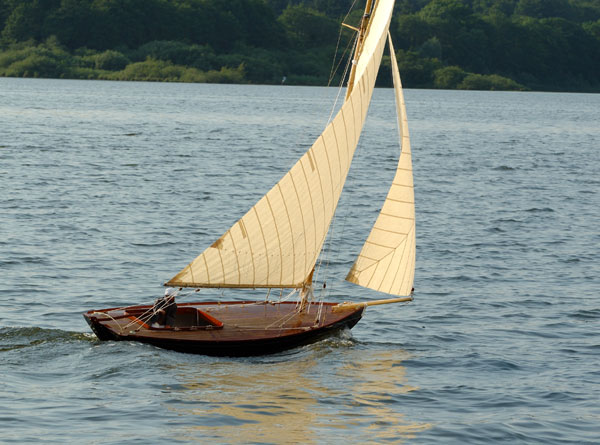
In the centre of the cockpit appears what may be a hand on the jib sheet, with rather a smart white cuff showing.

The Prawn was crawling around the RN&CYC last weekend and expressed a view, but I won't publish it at this stage, so as not to spoil the fun.

One thing that struck me was the width of the panels in the sails, which seem incredibly narrow if that is truly a hand showing.


Tuesday, 25 June 2013

Clyde Classic Regatta 2013


The first ever Clyde Classic Regatta and Design Symposium took place at the weekend, centred on the lovely old clubhouse of the Royal Northern & Clyde Yacht Club at Rhu. The event was inspired, organised and run faultlessly by Gordon Drysdale. It was an utterly brilliant idea to combine sailing in a wide variety of leading designs with presentations from experts in a number of fields and to set the whole thing in such a place.

I first crossed the portals of the RN & CYC, then just the RNYC, with Spratt & McGlurg over fifty years ago in a bygone era when boys only spoke when spoken to and the  yellow oilskins hadn’t changed since before the War. Today one still has the same feeling of awe at the building and its contents - the paintings, the full models and the almost unlimited display of half models showing the talents of designers today both known and unknown. The Club is now unique in Scotland and deserves to be preserved at all costs as a national artifact.

What luck to receive an invitation to such an event! I put out some feelers as a result of which my old chum Iain set about persuading people that I knew the waters of the upper Clyde “like the back of my hand”. Know, yes, but last sailed on around 1975. The result of this relatively innocent deception was a berth on the Ayrshire Lass as one of two superannuated hands and the ship’s navigator.

The Ayrshire Lass has been around the Clyde since 1887. Through a good bit of the last century she was the command of the astonishing Liz Todrick, shipwright at McGruer & Co, who lived in a cottage above Clynder with no electricity and a goat for company. Her rigger colleague and my pal Iain Gillies told me that she could sometimes be seen on calm nights rowing the Lass for miles back up the Gareloch to her mooring. Advancing years overtook both and Liz couldn’t be rebuilt, but her yacht could be and was, in Ireland by Michael Kennedy, courtesy of Paul Goss. Liz lived long enough to go out on her former yacht in its reincarnation. In her nineties and blind she was able to steer by feel and sense required corrections to the sheeting.

On Saturday Paul wasn’t around, which was of course a pity but perhaps as well, as bus-pass-entitled lawyers would perhaps not be his first choice to crew his Victorian racing cutter. Getting out of the cockpit onto the foredeck was perhaps more of a challenge than staying on its varnished surface once up there and if invited again I’ll take a small rope ladder with me - see above photo.

Our race was enjoyable and we took a sort of scenic route from the start line at Rhu past Rosneath and then along the shore almost to Kilcreggan as we inspected various buoys looking for the right one to turn. Fortunately, word of my local knowledge had spread and most of the competition followed us, adding a good couple of sea miles to our track. At the back of my mind was the idea that the mark was painted red, so it was a surprise to eventually find that it was green.

Our hosts, Theo and Andy, were incredibly polite and wonderfully fit and competent, giving Martin and myself an excellent day out and a blast of fresh air away from our respective dusty purlieus. There was no real damage done to the result, there being only ten seconds on handicap between the Lass and the Tringa, a more modern racing machine from 1902, whose skipper Helmut had relied on my local knowledge.


Martin at the helm


in contemplative mood

the ubiquitous Winifred was there

we should have followed the local guys
the lovely Gylen 2, built by Adam Way
David Ryder-Turner's design Amber
Scottish Islander Isla looking great
Ayrshire Lass, William Fife II, at rest with bowsprit housed 
Wliiam Fife III's Tringa, stunning recreation by Gisela und Helmut Scharbaum
Tringa's foredeck
Tringa's cockpit
Adam admires Helmut's artistry

Tuesday, 4 December 2012

More Marine Painting


I am humbled by the fact that my blog derives as many hits from browsers looking for maritime images  as from my own efforts. Truly pictures speak a thousand words.

The late John Gardner was an inspirational fellow seaman, drinking companion, loyal and generous friend and not least one of the finest maritime artists of the last century. I publish his work with the consent of his family, as they are happy for John to be remembered and his work shared, just as he himself enjoyed it being shared through his calendars. Having said all this it’s always nice to be asked, rather than have permission taken for granted and I think it would be appropriate if anyone using an image took the time to send a wee acknowledgement to me for forwarding to the family.

John's images can be found throughout this blog, as you'll see in the list opposite.

Now, continuing my habit of getting a hurl for nothing, I’m moving back to the Nineteenth Century.

The McLean Museum in Greenock houses a treasure trove of art, much of it maritime in nature in keeping with a town that lived on shipping and shipbuilding. They include some great paintings by the town’s William Clark and I  asked the Museum for their consent to republish the following images. They’re happy, subject of course to their involvement being acknowledged. I’m adding their blog to my links list and suggest that any fellow maritime and historical bloggers should consider likewise. I hope that if you decide to republish anything you will extend this great public asset the courtesy of a similar acknowledgement. There are some very interesting articles on their blog and they deserve a lot more followers than they presently have.


William Clark lived from 1803 to 1883 and so his work covered most of the Victorian age. 

The image at the top of this post is of the Eldon, which I suspect was in the Australia trade around the 1840s. The first and second images below have the museum’s own captions added. Many thanks are due to the Leggy Prawn, who alerted me to the Museum's  great archive in the first place.


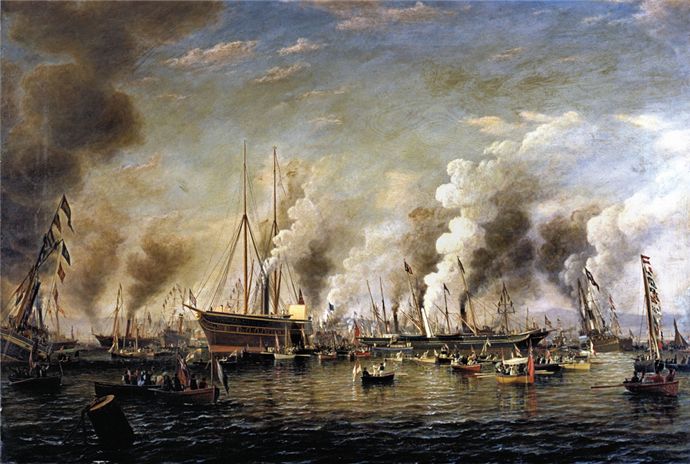
A mid nineteenth century oil painting on canvas entitled 'The Queen's Visit to the Clyde 17th August 1847' by William Clark (1803-1883), showing a view of Queen Victoria's visit to the River Clyde in 1847. The scene is on the River Clyde with a group of large and small vessels decked in flags with many smoke plumes visible. The participating vessels are left to right, Hercules, Chieftain, Fire, Queen, Conqueror, Admiral Garland, Victoria & Albert, Mars, Scourge, Undine, Fairy, Thetis, Sovereign, Premier, Craignesh Castle. Signed and dated 'W. Clark 1847' at the lower left by the artist.


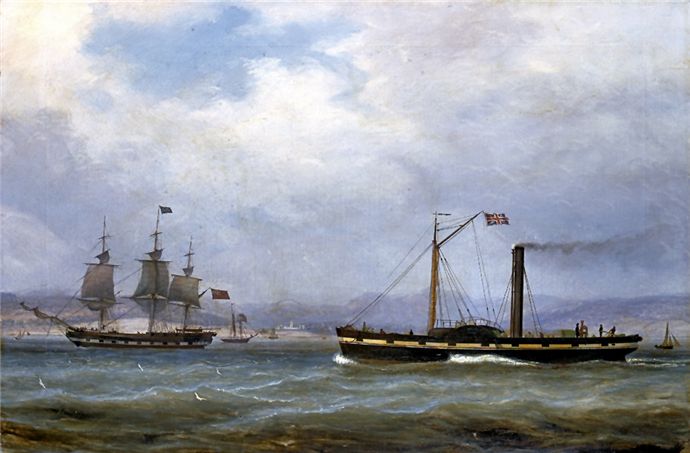
A mid nineteenth century oil painting on canvas entitled 'The Tug Conqueror' by William Clark (1803-1883), showing a scene on the River Clyde off Greenock with a wooden hulled paddle tugboat on the right and sailing vessel on the left. In the background the building popularly known as the 'Duke of Argyll's stables'. Unsigned by the artist.


Next we see some shipping becalmed off the Cloch - how often have we been there? And finally the visit of the Fleet.


Monday, 13 February 2012

The oldest One Design in the World (and a chance to buy her)


Avid readers of this blog (you know who you are, I don’t) know how I love a good mystery. If you guddle through my earlier posts from 2010 onwards you’ll find my attempts to trace the histories of long-disappeared yachts and their owners, which have resulted in occasional successes and one or two tales of maritime adventure and even espionage. On reflection it’s actually quite surprising that so many old craft, built as they were in an impermanent medium and often used hard in rough conditions actually survived, the more so when one reflects on the habits of the early owners of racing craft who cannibalised an older boat for rig and fittings for the new one.

Occasionally the hours spent originally in libraries when I started out in a pre-internet age and now done online from a remote corner of Scotland produced real and very satisfying results. Earliest was the discovery that the Scottie survived as she approached her first century, still making ripples on the Wansee.Read that post here:- Scottie, a tale of espionage

More recently I posted on the one-designs of George Lennox Watson here:- The Clyde 17/19 foot Class 

The Master in his prime

I suggested that his nineteen foot lugsail boats created for the Clyde Canoe Club in 1886 were possibly the oldest one-design class in the World. I had to be tentative, as I knew that the Dublin Waterwags of the same year make this claim, supported by the advertisement placed in the Irish Times of 18 September 1886 by their founder Thomas B Middleton, which started off

“It is proposed to establish in Kingstown a class of sailing punts, with centreboards all built and rigged the same, so that an even harbour race may be had with a light rowing and generally useful boat…..” 

Waterwag at Dalkey
At that time I didn’t have a precise date for the Watson boats and also didn’t want to upset the Irish friends whom I meet mostly in cyberspace but sometimes also along our shores, but help has now arrived in the form of Martin Black’s masterpiece “The Art and Science of Yacht Design” which arrived here recently and has put paid to all work around the house for the time being and coincidentally published by some of those Irish friends. Martin records the Dumbarton Herald of 18 August 1886 reporting 

“Early in the present season the Clyde Canoe Club ….. resolved to add to their fleet of lugsail craft, three lugsail boats…. and on Saturday last, 14 August, the three left the Leven for Gareloch…”

The first boats of both classes were built by R McAlister & Son of Dumbarton. It would be fascinating to read any surviving correspondence among the promoters of the two, as we know there were very close family and sporting connections across the Irish Sea at that time.

So there we have it, nearly a dead heat and certainly a victory for the Celts, as both classes beat the Solent by a couple of years.

In my original post I recorded three more boats built in 1887 and a final one in 1888. Martin reports a total of nine, the first three named Red, White and Blue, three more built by McAlisters in 1887 for the Royal Clyde YC, which he doesn’t name and a final three in 1891 by Paul Jones of Gourock, also unnamed.

So what about my 1888 boat? I was thinking about the Banshee, which the Watson design list published in Martin’s book describes (design no 149) as a “Clyde 17/19 ft”, 2.5 tons and built by A McLaren at Kilcreggan. Incidentally Martin also lists the Nell (design no 156) as a “Clyde 19ft”, also 2.5 tons and built by J Adam of Gourock.

Confusion is caused by the emergence of another class hot on the heals of the first one, the 17/19s, about which we know quite a bit. To which class did Banshee and Nell belong?

In my post I wrote that we didn’t have photographs of the earlier boats and posted the lines and sailplans, copied here:-


  Here is a half model of Red, which is just a wee bit clearer than the above.


But I have now learned that one of them, Banshee, still exists. Not only that, she’s for sale, via Gareth Worters of the Dauntless boatyard. Contact details are posted below.  To me she looks like one of the original boats and not a 17/19, which generally weighed in at 3 tons and seem to have much deeper keels.

She’s had a very thorough professional restoration, including making and fitting a new stem, stern post, lots of planking repairs and reframing and an entire new deck structure. From the photos below it seems she’ll need very little, apart from a final coat of paint, to get her sailing again. Gareth tells me that there’s a good set of spars, finished to a high standard and a suit of sails.


As visitors will know this blog is unmonetised and totally non-commercial and I want to keep it that way, but I am happy to help friends in the world of old boats. If you want to pursue the Banshee further you can find Gareth on garethdauntless (at) aol.co.uk.

And if you miss out on the Banshee, don’t forget that Hubert Stagnol is building and has maybe finished (I haven’t heard from him for a while) another of the original design in France, about which I posted here:- Red lives again


Tuesday, 15 November 2011

Tringa lives again - in more ways than one


I was totally astonished to receive the guest post which follows, with a digital album of photos. Blogging is a strange, solitary activity, which has to be seen as its own reward, especially one like this which makes no pretensions to be a money-spinner. Sometimes a bonus turns up, an unexpected gem of information or a story from another corner of the World from a kindred spirit.

I leave it to Gisela and Helmut Scharbaum to describe their obsession in their own words.

"Our interest in model making started sometime in the 1990s. I have always been interested in sailing and when we both saw a model of a wooden sailing ship during an exhibition of model makers, we decided to buy a model kit for Christmas. It was a modern plastic yacht, but since then we have been infected and many radio controlled models followed. We developed our interest in the classic wooden ones, which were not available as a kit. So we started to construct them completely according to the drawings, made everything for ourselves and thus we became more and more experienced.

One day in 1999 we saw the film "enchanted by the dragon" on TV,  a film made by Tom Nitsch, a German film maker with special interest in Fife and his yachts. He knows a lot of the history, the yard and the owners. Secondly the book about Fife, written by Franco Pace, an Italian photographer, confirmed  our wish to build a model of a Fife yacht.

We chose Fulmar, an 8mR and soon we found out that research was difficult and the drawings were hard to get. In the end we managed it with the help of the owner and since then things became much easier. Travelling around in Scotland and South England and the Mediterranean followed, and especially with the help of the RNCYC, especially Ian Broadley and May Kohn and all the other people in Scotland we learned so much about the Fife´s , found so many pictures and drawings which allowed us to build these models as close to the original as possible.


The first time we saw Tringa was in the book Fast and Bonnie, it is the  picture which shows her standing on an iron slip trailer at Robertsons Sandbank. It was the design of the hull which is so remarkable, that we fell in love somehow. After finishing the model and having seen her sailing in 1:4, we made another step further and decided to try 1:1.


5000 hours later Tringa is sailing at the Baltic. There was a lot of learning by doing and one of the most dificult problems was to get the fittings. In the end we visited Classic Marine in Woodbridge and Ording Blokken in the Netherlands to order the fittings for the deck and the mast. For the rest, for example the roller fairleads we made wood patterns and let them cast in Britain at Haworth Castings. Research, trying to find out what Tringa looked like is one of our most favourite jobs.


The Schlei area is nowadays an area for leisure activities like sailing. But it still exudes its own special charm. Our problem is Tringa´s draft which is about 6 feet, and the shallow waters of the Schlei are tricky. For example our first trial was stopped by a sandbank, but we managed to get  free again.


This year we left the Schlei for two weeks and crossed the Baltic towards Sonderborg and Aero. Tringa is seaworthy, she always lets you feel well and safe, she also forgives mistakes and is easy on the helm even in rough weather. She is always in a hurry, we logged 8 knots in fresh wind with a reef in the mainsail!


Sailing around with Tringa is like walking on a catwalk. Everyone is watching, asking, and taking photographs. We are faster than the Nordic Folkboats, which are especially designed for the Baltic. Addictive .


But the modern sail cloth induces a lot of power to the rig, therefore it was useful to add two more frames to fix the plates for the shrouds securely. This strengthens the forward hull and leads the force directly to the metal floors and keelbolts. Former designs were too weak at this point.


The runners are quite important for the same reason. We also have to get used to all the sheets and halyards, but after having made some experiments this summer, everything works better and better. "

Specifications:
Overall length: 24 ft
Length on waterline 19 ft
beam: 7,5 ft
draft : 6 ft
displacement 3 tons
ballast 2 tons  lead
sail area 45 qm (500 square feet)
main 37 qm
foresail 8 qm

frames 5x3 cm
planking 2cm cedar, and larch beyond the waterline, glued with Aerodux and covered with glass fibre (800g Biax)
deck plywood 8mm and 6mm teak/mahogany , the spars are of spruce
bow sprit is of Oregon pine

There's a short film about this talented pair that can be viewed online here:-

www.sailing-films.com

And there's a great deal more information about the old 19/24s here:-

www.clyde19-24.org.uk

Tuesday, 18 October 2011

A dirty old night on the Clyde


It was late in the season and the sun had not been seen all day. If it hadn't been my turn to assist the race officer there's no way I would have gone, and as I drove down through wind and rain I wondered if even the Loch Longs would turn out to race.

They always do, of course, and on that evening fifteen or so years ago there were also a pair of Islanders.  With only two starts there wasn't a lot for us to do. I had a good view from the top of the clubhouse and took these pictures of Cara and Gigha battling it out.
 
Above is Gigha, then recently restored and owned by David Spy, romping in before the start.


Here is the scene in the last minute, followed by a couple of shots just after the start.


The boats were sent off on a long beat from Gourock to Hunters Quay, followed by a short reach down the Firth and then a run home. The race officer figured that even a couple of hardened old sea-dogs like David and Martyn would find that enough.

Here are some shots of Gigha as she bashed her way over towards the Kilcreggan shore.


The weather thickened so much that we lost sight of both contestants for a while. Eventually as visibility got even worse the wind moderated a bit and Gigha emerged from the murk, a few hundred yards ahead of her rival.


Gigha carried her full canvas throughout this race, which meant that she was pretty pressed at the start but had the advantage later, helped by David's crew being willing to hoist a spinnaker. Martyn decided to keep the full main and fly a tiny storm-jib. This helped Cara after the start, but gave her a serious handicap later on.

Traditionally the Islanders never reefed, but I think that with stronger modern sail-cloths they are now easily over-pressed and go better with a shorter main and not dragging their side-decks through the water.

The Wherrymen

The Wherrymen
Two old friends on the water