Featured post

The Scottish Islanders

  Get your copy from  www.shop.yachtarchive.scot  !

Showing posts with label sailing. Show all posts

Wednesday, 13 December 2023

The Scottish Islanders


Above is a fantastic photograph of the fleet racing in the last major event before war put a stop to such things. When I was putting my book together, I was delighted at the support from companies such as Beken, who were content for me to use a portrait image of my own Islander, Stroma, without payment. This image isn't in the book, it came from someone whose forebears had purchased a copy at the time. Perhaps we'll eventually do a reprint.

The feedback from purchasers has been very positive, also I've been getting sent material, such as the photograph, also anecdotes about the boats and their families, which is making the whole exercise feel very worth while. There's a lot of social history that deserves to be recorded, not just regarding the older, rather patrician families, but also just about the characters who made the west coast and its little bays and havens a lot of fun. I'm thinking of men like Boyd Keen, who made it into the book, and the recently departed and much loved Cubby MacKinnon, about whom a book, Mistress and Commander, appeared a few years ago.

Seriously, the book is quite a limited print run, and it's selling quite well, via social media only, because the margin between cost and retail price rules out major bookshops. So, if you want a copy, or know someone whom you think might enjoy it, you can find the online shop at

www.shop.yachtarchive.scot


Sunday, 23 July 2023

Summer Report


Here in mid Argyll it's been a very mixed summer for sailing. We had a great spell of sunny weather in June, but with many days when there was either no wind at all, or a furious land breeze brought on by the heat. Then it seemed that summer had gone, and for a month there we had cold wet days, with a lot of easterlies, which here mean nasty squalls and no fun at all. The image above was taken by pals on one of the few recent good days.

We have had some interesting visitors to our loch. A month ago the extraordinary Kaos managed to squeeze her way into the head of the loch, the flagship of a Walmart heiress with, one understands, two skippers and a crew of forty two. The weather was dreadful that day, with little visibility and lots of rain, so it wasn't a surprise when she left and returned to warmer climes, where she was visited by environmental activists with pots of red paint. 


Around the same time, there arrived on our shore one of the oddest ships we've seen ever seen here, a reinterpretation of one of the oldest craft in the world, and the brain child of the guru of Ullapool. Arriving in bits, it took him some time to connect it all together, with what looked like scaffolding poles.


I declined the chance to spend a wet weekend on Eilean na Gamhna, the Isle of the Stirks at the head of our loch.


The weather improved the next day and the Admiral posted this image of her travelling fast.


Finally, a visit from a ship that would suit fine, if one were seeking a live-aboard and had a bit of cash.


Built by Hall Russell of Aberdeen in 1963, she's one of the last of the fine, stylish cruisers that Scotland once produced in great numbers. Now named Jura II and sailed by her hands-on owner, Cameron McColl, it was lucky that we had a fine morning for me to get out for a photograph.

The lack of good sailing days hasn't bothered me too much, as I've been very busy with the publishers of my book on the magical fleet of Scottish Islanders, one of which, Stroma, adorns the top of this blog.  I'll soon be in a position to reveal full details, so, if you're interested in traditional boats and the folk who fall in love with them, watch this space! In the meantime, see my last post for information on the Scottish Yachting Archives.

Friday, 22 July 2022

Brian Corbett


About ten years ago I was looking out of our house at Loch na Cille in mid Argyll and saw a fellow on the other side of the loch launching a very pretty, interesting little yacht. I soon saw that he was in some difficulty and realised that he was in a spot where the seabed is mud rather than the hard shingle that we have on our side.

After a quick change of clothing I raced round the head of the loch and found a fellow above his waist in extremely cold water faced with a problem that he couldn’t resolve on his own. After Winifred was duly launched and moored and the trailer recovered my new friend Brian came round to the house to warm up. Thus started a friendship that continued on the water, when he visited for events and regattas and also online, as we found that we shared an interest in yachting and boating history.
I was to learn that Brian was a man of wide interests, with an unpretentious confidence in his ability and a belief that we should all try to leave the World a better place. Latterly we were in contact regarding Heritage Harbours, of which Brian was keen to identify a few here on our West Coast, also the Coastal Project and Pericles, a European initiative aimed at sharing cultures across nations.
Brian’s sailing ability requires no comment from me. On his visits to Argyll he was usually single handed and although I was never aboard her I imagine Winifred wasn’t the easiest boat to sail in a breeze. I’ve annexed a selection of images from times here and on the Clyde.


He was a most decent and entertaining man, about whom Anne and I will retain many happy memories.

Sunday, 28 June 2020

Happy Holidays on the Costa Clyde


MacAllisters yard in the 1970s was a cheerful place to spend winter weekends. It was run by two men, I think brothers-in-law, Mr Buck and Mr Kinnear. It was rumoured that the family fortune had been made from manufacturing carbon paper and when photocopiers came along they had decided that the next growth industry was running boatyards.

The yard was a sort of retreat for the various dreamers and escapists who inhabited the boating scene of those days and the two functioned as wardens. Discipline was maintained through the mechanism of Johnnie Buck’s Fourteen Day Clause, which nobody had ever read; the mere mention of it was enough, as most of the craft couldn’t have been shifted in a fortnight even if one could have found another home.

The sheds contained a remarkable collection of yachts in various levels of disrepair, probably about half of which went to sea each summer. A few, such as the wonderful Solway Maid, seemed to have been there for decades, I think because Mrs Carr, the widow of the original owner, couldn’t bring herself to part from her.

George Wolfe was one owner who did go to sea each year, in a lovely big motor cruiser, the Whigmaleerie, possibly a Laurent Giles design or a Fred Parker Fleur de Lys, but it pained him greatly to do so. Each winter every varnished surface was taken back to bare wood and redone, only to be subjected to salt spray and ultra violet all summer.

Young Alfred, Freddie Mylne, kept his Hillyard the Hillary there. He was very kind to me and gave me bits of gear when he found I was working on Stroma, his uncle’s design from 1929, in the adjoining shed.

John and Billy Gardner were present each weekend to work on the Unity, thirsty work that invariably took them to the end of Woodyard Road, where we discussed Rippingille Stoves and other niceties from the Riddle of the Sands. Sadly that nice wee hostelry, like the Gardners themselves and many of the others I write about, isn't there any more.


The doyenne was Mrs Keppie, a wonderful old solo sailor, who was privileged to be allowed a caravan in a corner of the yard, and kept a little cruising yacht in perfect condition.

Latterly the yard was managed by George Hulley, who has also died, just at the end of last year. He ran a chandlery business and had the sole agency for the epoxy glue that many of us were using. He refused to stock the slow hardener, because he claimed Scotland was too cold. When you used the fast stuff in hot weather it could go off in minutes with lots of waste, which perhaps helped sales.

George was best known for his involvement with the Ardens, and that’s a good topic to end this essay.

Here is an advert from the Glasgow Herald of 25 May 1960:

“Holiday Afloat for £30

The first motor charter cruiser service on the Clyde has been established at Helensburgh and on Sunday the eight ton cruiser Morning Sky is due to leave with the first party of six persons on a week’s cruise on the Firth of Clyde.

The prototype motor cruiser was specially designed for hire work by the Glasgow naval architects Alfred Mylne & Co for the Arden Yacht Company, a new venture by two Glasgow business men John McNiven and Donald Crockett.

The second boat is due to be launched by the end of the month. Chartering from Sunday to Saturday costs £30, and such has been the demand that the first boat is booked until mid September.

The boat was designed to keep down the price both of construction and chartering, so that a high class yacht finish was not contemplated.

Morning Sky is 28 foot 8 inches overall with a beam of 8ft 6in and a shallow draft of 2ft 6in. The air-cooled diesel engine of 13hp, driving a four bladed 18 inch propeller through a 2 to 1 reduction gear, gives a speed of seven knots and a cruising range of 150 miles.

There are berths for six persons, more than 6 ft headroom in the cabin, and the boat is chartered fully fuelled and watered and complete with cooking stove and utensils, crockery cutlery and bedding. The firm will even put groceries on board if they are ordered in advance.

The cruisers will be covered by insurance and for third party risks up to £25,000. Their cruising range has been limited to the Clyde above a line drawn West through the Little Cumbrae and the North of Arran, which leaves plenty of water to explore.

The boat’s outfit includes the sailing directions of the Clyde Cruising Club, a set of charts with suitable anchorages marked, anchor, chain, warps, fenders and a ten foot dinghy."

Thus was introduced Scotland’s first charter business, set up by two enterprising Glasgow businessmen and boating enthusiasts in premises in East King Street, Helensburgh. To build the boats they recruited the young George, a time-served boat builder who had been building Air-Sea Rescue craft in the RAF.

Years ago, John McNiven’s son Renwick sent me some nice memories of the early years of the business and a picture of the first of the “Skye Class” boats.


It would be interesting to know if either of the two survives. John wrote:

“Charter operations started up from an abandoned wooden pier near the head of Loch Long, however it turned out to be abandoned for a reason and the council promptly condemned it and put up the barbed wire fencing shortly before the charter boats were due to return.

One of the first charter parties turned up with a sea-going trunk fit for a passenger liner, this being too big to go in the cabin was left on the cockpit sole for the duration of the charter. However after this start the party phoned later to say that they were in ‘A-roach-er’ and after some language translation it was ‘Arrocher’ at the head of Loch Long, turns out that the point of the call was to say they needed a new anchor. The 30 fathoms of chain and anchor had gone runaway over the side in too much water depth in Loch Long breaking the securing strop.”

The motor cruisers were followed from 1963 by the very neat little Arden Fours,

“the concept being a ‘Folkboat with headroom’, sketched during a meal using napkins!”


Thirteen were built in wood, then another fifty five hulls were built in fibreglass in England and shipped to Helensburgh to be finished. A final two, to a slightly different design, were built in 1971/2.

"The journey along Helensburgh’s promenade always had a large following, but then the tractor could only pull at a walking pace of 4 mph!"

Lots of Arden 4s survive and do good service as tough, seaworthy little ships with no great pretensions. One of them, built as Dirlie for the Crockett family has arrived in Kilmelford.


Post script: I found online the following quote, which could be a transcript of our chatter in that wee pub at the end of Woodyard Road, as it makes as much sense.

"Dumbarton is never fun.
Fine, young man, it was fast… I found an old buy boat chin, and it has a photo of yore Ardennes forest zone tribe, she is generic can not see the keel - This is the same design? …the yore Ardennes forest zone 4 would have been to add wood and then later in the GRP…. im not sure if the george hulley is designer when time i being chatted designer he mentioned a certain extent, he suggested it was not his. He also told me that some arden 4s augmented england south.- georges hulley in the dunbarton in operating a candle maker enterprise.
In Hulley Dumbarton Now, I may be disturbed."

Sunday, 17 May 2020

Cold Return to Normality


Today the weather is absolutely dire, low visibility, constant rain, strong wind. Although I’m glad the boat is ashore I’m reminded that such conditions have resulted in some of the most memorable trips.
This is the first time this Century when a group of small boat lunatics hasn’t assembled at Toberonochy on the Isle of Luing, thanks to the Johnson Plague. That weekend is incredibly special, with overtones of return to childhood, challenging trips in small open boats, most of which we have built ourselves, and most of all an extraordinary bunch of people from incredibly diverse backgrounds united by an interest in traditional boat types.
My yellow boat, the Kelpie, was built by me in 2006 specifically for the muster. I wanted something primarily seaworthy that could carry up to four but also be easy to single hand, with an interesting, safe rig and lots of bits of string to keep the crew busy. She’s an open boat, fifteen feet long, with a lot of displacement which makes her stable but a hard pull if you have to row her.
The design is based on an old New England salmon wherry, drawn by Walt Simmonds of Duck Trap Boatworks in Maine. I’ve changed quite a lot, including the rig, which is a sprit sail cut for me in 1988 by the late Gayle Heard of Tollesbury, one of very few with the ability to do it. He’d made it for another New England boat I’d built before, a Swampscott racing dory that had proved to be just too racy. Here's a photo of her under her original rig; the sprit sail tamed her but when the boat went to Angus, seen here, I kept the sail.


Decades later it still sets perfectly. At first the wherry wouldn’t sail properly to windward, something my designer friend Richard Pierce sorted by advising me to move the centreboard forward. Perhaps New Englanders usually sail in reaching winds. Richard also donated a jib, which helps greatly going into the wind.
At the end of the event in 2012 my crew had to go home promptly, leaving me with a single handed trip. The forecast on the previous evening was dire, offering a strong cold North-easterly building up during the day with rain arriving from mid-day. I decided to set off, because if things became impossible that wind would blow me back to where I’d started from and I’d be no worse off. With an escape route available you should always go.
My friend Brice took some photos of my departure, see below. I got the jib up at the start, but it soon had to come back down as the wind freshened. As a result progress was slow, with the Kelpie slamming a lot in the nasty short chop, then the waves gradually got bigger and she really got into her groove, charging along with her rail a couple of inches clear, luffing in the puffs and eating up the distance to windward. In the squalls bathfuls of water would come in over the side and it was tricky pumping it out, a bit like wrestling with an eel while still steering and keeping control of the sail.


After a couple of hours Kelpie and I were well into Loch Melfort when the rig fell down. The sail is tensioned by a long, bendy spar, the sprit, held in place by a line curiously, for Glaswegians anyway, termed the snotter. This had parted during a squall, leaving the rig accidentally scandalised and flapping like mad, quite useless for further windward progress. It would be easy to fix, provided I could make it safely to land to do so.
There was no possibility of rowing up to windward to the safe, North side of Loch Melfort. The South side was quite close, but a dangerous lee shore with waves breaking on the rocks. The exception was one little inlet with a bit of shelter, but I saw at once that it was inaccessible, being barred by the lines of black buoys of the mussel farm, fastened with steel wires along the surface stretching for several hundred metres.
Mussels have never been successfully cultivated there, due to the prevalence of seasquirts, but the Swiss company who “own” this bit of Scotland’s seabed keep the floats there in order to preserve the value of their planning permission. This is exactly the sort of problem some of us have tried time and again to bring to the attention of the authorities who license these things, to absolutely no avail. The general public have the inalienable right to use the surface of the sea for the purposes inter alia of navigation and recreation, but the Crown Estate, who hold the seabed in trust for us, ignore these rights and make money by granting leases of the seabed. Surely the Swiss, with no seas of their own, should stick to tax dodging, cuckoo clocks and occasional sorties into the America's Cup?
Downwind from the mussel farm was another nasty lee shore with waves breaking on sharp boulders. The only course was to run downwind to the shelter of the point at Arduaine, losing over a mile of hard won distance to windward, passing close inshore inside the reef, where there's a deep narrow passage before beaching on a nice sheltered sandy bay, completely out of the wind. There I had something to eat, fixed the problem and tied in a reef to reduce the sail for the return to the fray.
I relaunched and there now followed a hard beat of about three hours into a really cold North-easterly with occasional squalls of sleet, each tack bringing us closer to home and a hot shower.

Saturday, 9 May 2020

The Log of the Stroma


Summer Cruise 1977
Note: Stroma is a twenty eight foot racing yacht built in 1929, number 4 of the first group of Islanders, designed by Alfred Mylne and incredibly fast as well as seaworthy. They were intended to be sailed by a crew of three, originally had an engine, but Stroma had none. I had bought her the previous September and this was my first serious cruise, also the longest trip I ever made in her and the longest holiday I ever took. I found her log when clearing papers during lockdown. The photo is from 1930.


Crew Ewan and Peter
Day One, 16th July 1977
Oban
Wind NNW 2-3, cloudy, showers
Departure delayed due to theft of dinghy from Donald Currie’s shed, reported to Police and new one purchased. Left the Brandystone at 15.45
Passed between Maiden Island and Ganavan, tacked to Lismore,
Passed the Lismore light at 17.10, wind dropped, slow progress up the Sound of Mull.
Ardtornish light at 19.00, wind died away, ghosted to Salen, anchored at 22.25. In hotel by 22.55
22 miles, 7 hrs 10 mins
Day Two
Wind fresh SE. Rain
Left Salen 09.45, rann before freshening breeze up the Sound, past Tobermory Bay at 11.00, wind backing ESE,
Ardnamurchan Light 12.15. Severe squalls and wind strengthening, ran under full sail for a time, then dropped main and doing 3 knots under jib alone
15.00 wind moderated, reefed main, good progress to Mallaig, passing entrance at 17.00, heavy rain, poor visibility.
Wind dropped and went NW. Arrived Isleornsay at 19.30.
Spent evening chatting with Black Angus Nicolson (Aonghas MacNeacail) in the Inn
51 miles, 9 hrs 45 mins
Day Three
Wind light, N, dry, cold
Spent morning checking rigging and repairing various fittings, halliard cleats etc, that had been damaged the previous day.
Left 15.00 wind now NNW 2 - 3.
Passed Kyle Rhea 17.30, Kyle Akin Light 18.45, got forecast of fresh N - NE so decided to go to Plockton rather than Broadford, anchored 20.45
20.3 miles, 5 hrs 45 mins
Day Four
Wind light, NE, heavy rain, poor visibility
Left 10.45, close reach past oil platform, Crowlin Islands passed at 12.25
At Sound of Raasay wind went North, rain squalls for one hour. Porpoises in shoals of fish, gannets diving.
Passed An Tom Point in extraordinary winds, light and all directions, anchored Portree 16.05
21.6 miles, 5 hrs 20 mins
Called on Peggy (my then wife’s sister and a nicer person) and Harry (married to another sister)
Day Five
Very heavy rain all day, wind moderate.
Boat very wet inside, decks leaking. Spent day trying to keep dry.
Met Dick Ede and Jean Inman, dined with them and Peggy aboard off mackerel Dick had caught.
Note about Dick: He was a fisherman who had been working single-handed out of Newlyn, hunting bass in the English Channel, a robust activity, who was up on holiday with his then partner Jean. He had moved up to London and was missing the sea. I haven’t seen him for many years and hope that he’s fine.
Day Six
Very heavy rain all day. Wind strong S to SE
Spent day in Portree, then Dick wanted to go sailing. Went out with him, while Peter and Jean headed off to Tianavaig to visit Danny Sleigh, with intention we would all meet up there. Savage squalls off the Point, turned back, re-anchored and hiked six miles over to Tianavaig. Made fire on shore, ate sausages.
Note: Those squalls still haunt me a bit. They came down over the tall cliffs and pinned the boat down, so that easing the sails didn’t help.
Day Seven
Very heavy rain, light wind.
Dick wanted to go fishing and turned up with two lines, with about two dozen hooks on each. Spent day drifting around while he caught mackerel.
Note: Dick worked the two lines together, hauling them over his shoulders and all the while calling to the fish “come fill up me lines, fill up me lines”. He could tell when all the hooks were taken and quickly stripped off the struggling mackerel. They soon had filled the cockpit, then, as I wouldn't allow them into the cabin, the dinghy and he only stopped when we were knee deep in fish and had no space left to put them. We ferried them ashore and found some fish boxes, gave a lot away to tourists, then took residue to the Fishselling Company at the pier, where the manager weighed them at eleven stone, deducted one stone for “water” and paid us £5. We were being watched by local fishermen and considered it wise to go to the Taigh-osta a Cidhe, put the money on the counter and got out alive.
Day Eight
Wind SW 3, heavy rain
Left Portree 12.25, reached out of bay, wind freshened in the Sound of Raasay, fast run to North of Rona, passed at 14.45, weather cleared and had great broad reach in force 4-5, passed Carra point at 16.15. Anchored in Shieldaig, Loch Gairloch at 17.15
Evening in the Badachro Inn
29 miles, 4 hrs 50 mins
Day Nine
No wind, heavy rain
Went to hotel for breakfast, spent day drying out.
Dick and Jean turned up, having watched us leave Portree and driven round. Dick had found a broken creel and fixed it, also had caught some whiting and cod, which we cooked aboard and ate with them. After dinner baited pot with a Gurnard Peter had caught and set it.
Gale warning.
Day Ten
Gale from North, heavy rain. Recovered pot, got two large crabs and ate them. Evening in hotel.
Note: That pot had been set over a mile from where we were anchored and was a hard upwind against the gale, which Dick enjoyed.
Day Eleven
Wind NW 3 - 4 heavy rain
Left Loch Shieldaig 10.05, tacked down loch, passed Port Henderson at 11.00. The Ballad “Scalliwag” motored up to join us and set sail. Wind veered North, freshened and day cleared. Raced Scalliwag South, Passed Applecross 1.20, Lonbain 13.20. North end of Crowlin abeam at 15.15, gybed onto Port tack and reached down to Kyle Akin, passed light at 15.47, seven minutes ahead of the Ballad, arrived at top of flood tide, then South going stream carried us down, severe squalls between Glenelg and Isleornsay, anchored there at 18.10 just in front of the Scalliwag.
Evening in the Inn
48 miles, 8 hrs, 5 mins
Note: This was surely sailing at its very best, hour after hour at maximum speed before a following breeze, with a strong tide the entire distance.
Day Twelve
Wind light, variable, sunshine
Left Isleornsay 10.20, ghosted down Sound of Sleat, passed Armadale 13.00, wind died and caught mackerel on way into Eigg, where anchor down at 17.15
21.5 miles, 6 hrs 55 mins
Note: We anchored in about two fathoms inside the island that protects the bay. Our efforts at fishing were just as pathetic as our day's sail had been. The fish that swam about under our keel were so small that they had no difficulty in nibbling the bait from our hooks without any risk to themselves. After a walk ashore, when after we discovered that at that time there seemed to be no facilities whatsoever on Eigg we turned in for an early night.
Day Thirteen
Wind fresh NW, bright
Note: At about five in the morning I was woken by Stroma rolling on an Atlantic swell which seemed to be setting in. I took a look outside and noticed that there had been a definite change in the weather. We now had a very clear dry summer morning and there was a breeze. By this time Peter was also awake and after some discussion he agreed to assist with getting the anchor and setting sail, provided he could then return to his bunk to complete his night's repose.
Thus at about 5.45 am Stroma was underway. We slipped out Southwards from the bay and were soon on a close reach in a fresh Northwesterly breeze. I was pleased that I was alone in the cockpit and could treat the bright, sparkling morning as my very own. Actually I was sharing it with various seabirds and the occasional fishing boat could be spotted far off when we rose on the big Atlantic swell.
The Islanders are wonderful boats on a reach, when you really feel the power of the mainsail. Soon the Cairns of Coll started to appear on the horizon and then we were in flatter water as we sailed down the East side of the island to Arinagour.
If you are engineless it is always better to pick a safe spot to anchor where if necessary you won't have difficulty getting underway during the night. I was glad that Peter was now awake as we had some tight tacking to get into the chosen spot some distance from the steamer pier. By nine thirty we were anchored and ready to spend the rest of a lovely summer day ashore. It would have been fun to carry on, but we only had a couple of days left.
20 miles 3 hrs 50 mins
Day Fourteen
Wind SW 3, bright
Left Arinagour 11.10, broad reach to Ardmore Point, wind dropped and caught five mackerel before it returned. Close reach to Tobermory Bay, sailed round the bay to see if any boats we knew were in, left again at 15.30, fast reach to Salen, anchored at 17.10
15 miles, 6 hrs
Back to hotel.
Day Fifteen Wind N 3-4, cloudy, slight rain.
Left Salen 09.15, got spinnaker up and had fast run down the Sound, passed Lismore Light at 11.30, moored at Brandystone at 12.30.
15 miles, 3 hrs 15 mins
We had sailed on ten days out of fifteen and covered about 240 sea miles at an average speed of about four and a half knots.

Monday, 27 April 2020

A haunted Mill, Watery Graves and the Toberonochy Lemon Shop


As the MacCrimmons were to piping so the MacFadyens are to handling the wee ferries that keep the place running. Single tickets are on offer, for those who expect to fall in love with the island, or maybe have a boat to recover, but most will buy a return for their eventual reluctant departure.


Since the start of this century an event has taken place in conditions of secrecy only rivalled by the Bilderberg Conference, but less damaging by far to global peace and prosperity, consuming no oil whatever and attended by a much nicer bunch of people, on this small island off the West coast of Scotland.


It takes place in the open air, but participants are untroubled by the vagaries of the weather, viewing extremes of rain, strong wind and temperature as stimuli to, rather than distractions from, their water-borne adventures. In all conditions they congregate. Strong winds and adverse tides present challenges to ever-longer turns to windward; in fact one year the weather obliged with a 180 degree wind shift while the crews were resting for lunch after tacking half a dozen nautical miles South towards the deadly Dorus Mor, coinciding with high water which gave a return journey of equal unpleasantness against a cold wet Northerly and a strong ebb tide. Despite, or maybe because of, such things participants, who like those at Bilderberg are all personal invitees, return year after year. Only the Great Johnson Plague has put a temporary stop to it.
Once over the ferry you’ll travel down slowly through a very Hebridean landscape, unusual for an inner island. Be careful when you reach the water mill; it’s inhabited by water elves, sithichean-uisge, who will inflict terrible punishment if you fail to leave a hair from your head as a tribute. Great hares, the size of dogs, will lollop past you.
Since we started only one of our number has left the scene, the lovely, gentle Hugh Gray, who sailed a little black cutter named after his Tanta Hedwig. His son created a Viking ship for his ashes and we watched as he set off on his fiery last voyage from Cullipool.


To end in the waters you love seems rather a nice destination. In 2004 the Brother came to perform at the special wee ceilidh we hold in the Toberonochy Hall and was captured by some American Campbells who had brought their aunt back to her place of birth. As he played a suitable lament the urn was opened, about half of the aunt entered the Sound of Luing and the residue engulfed the crowd.


On the Sunday morning there was little wind and the fleet was becalmed under a dreich grey sky, the drizzly rain trickling down their necks.
Through the Sound came a commodious plastic-hulled vessel, which dropped anchor in Kilchattan Bay and sent a lady crew member ashore on a mission, to acquire some lemons for the gin and tonic. Asking a local resident where such a purchase could be made she got the reply "I regret, Madam, that there are no lemon shops in Toberonochy, in fact there are no shops here at all."
At that moment out on the water the Brother, still in sombre mood, filled the bagpipe with blaw and started on a tragic lament, in keeping with the grim morning. On hearing this the lady said, obviously stunned at thinking she had gate-crashed an aquatic wake, "I'm terribly sorry to intrude on your small community in this time of grief," and made her way back embarrassed to her yacht.

Chan eil bùth an drasta

Wednesday, 18 September 2019

Sweden Revisited


I hadn't been in Sweden since 2005 and can't really explain why I left it so long, since it has to be my favourite country. Perhaps it's because the last time I returned with a restoration project, and you can't cope with too many of those, see An Expedition to Stockholm

Seriously though, finding Juni was a truly good thing, which got me interested in Swedish designs and designers. Coincidentally Juni is on the point of leaving for a new home, in good hands to be looked after by someone with much greater skills than I have.

I was very sad to learn that Sonja Herlin had passed away in July, just ten days short of her 102nd birthday. I had been indirectly in contact with her from time to time through my Swedish friends at the Herlin Society, but had never met her. I think she was pleased that I had rescued Juni and I'd love to have heard about her exploits in her.

Sonja had enjoyed an incredibly full and interesting life and stayed very competent mentally to the end. There's a nice video of her sailing one of her father's creations here: Sonja sailing, aged 93

Isn't that the nicest wee cruising boat of your dreams? Tore Herlin was a genius.

We were picked up by my old friend Petter, who immediately plunged us into boat porn.


Then into town, where I had to meet up with Evert Taube, possessor of a unique singing voice and style to match, a saint to Swedes and of course inspiration to ABBA.


Stockholm is as interesting and lovely as always, a great example of a well run Northern European country that should be an inspiration to all of us Scots. The monarchy has been turned into rather a nice tourist attraction without too much baggage and just enough theatre.


At night the city, especially the old Gamla Stan, where we were lucky to be staying, is full of life and interest.


Further afield the city lights are magic on the water.


Great use is made of the water for urban transport via countless ferries.

Here's Petter and me in 2005,


And here we are, with Birgitta and Paul in 2019,


back at our favourite Pelikan. Hope to get back before long.

Monday, 2 September 2019

A Wild Journey round the Isle of Mull


Birthe Marie is a Danish fishing boat, built in the 1930s and rebuilt and refitted for charter work by Mark Jardine of Iona.
Mark in his element.
This Summer hasn't been great for sailing in small boats, with days without wind and others when there's been too much, meaning I haven't been out much in the Mariota. Signing up for a Wild Journey on the Birthe Marie seemed a good idea to get in some serious sailing and also to explore the wild Atlantic side of Mull and the various islets and outliers in safety.

On a Wild Journey you'll be spending the entire time out of doors, something I hadn't done since childhood and, to be honest, never for as long as a week. It was challenging at times, but undoubtedly better than sleeping in a confined space with a crowd of folk.

Our only contact with society was a couple of hours in Tobermory half way through the week and strangely it was nice to get back on board and across to pitch tents on Calve Island.


Dusk on Calve Island
We were lucky at the start of the week, with Caribbean conditions, white sandy beaches in little coves and water warm enough for some (not me) to swim.


Our Captain


Having on board Emma, our own dance mistress introduced an element of gentle exercise and hilarity.


Gymnastik auf der Strand

Nice weather meant little wind, but in the second half we got conditions that made me happy to be aboard a sound ship with a wonderful, caring crew in Mark, Neil and David. We had a couple of days when the rain battered the tents all night. On Mull several roads were closed by landsides.

What sounded like a fleet of heavy lorries revving up turned out to be the thundering of a nearby waterfall. Stranger than this was the sound of singing during the night, a magical watery choir of grey seals.

On Ulva, looking across to Gometra
We left Ulva just after this photograph was taken and a couple of hours later were doing eight knots past Staffa in a big rolling swell, wonderful sailing in a boat strong enough to take it.

Looking West to Little Colonsay, gale setting in


Of course the week was about the landscape and sailing, but far more important was the human element. Our group of very disparate people quickly found all sorts of common ground and bonded  into a happy band of semi-competent sail hoisters, rope coilers and even helmsfolk.


The other human dimension was the Isle of Ulva itself. We camped near one of the numerous cleared villages and also made some excursions along the island's remarkable little tracks.

In 1835, when Francis William Clark, a lawyer from Morayshire practising in Stirling bought the island there were about 600 residents in sixteen villages, mainly crofters, but also including boatbuilders, shoemakers and numerous other trades. Many worked in harvesting kelp, which was sheered along the shores, dried in the sun and then carefully cooked to produce alginates that went on to numerous industries elsewhere.

On right a boat noust, on left what's probably the remains of a fish trap

Bracken shows that this land was once in cultivation

From about 1841 cheap imports from the South Atlantic put an end to the kelp industry and Clark responded by progressively clearing "his" land of the tenants who had been there for centuries. Even among the landlord class of his day Clark stood out for his exceptional brutality, personally throwing people out of their homes, burning the roofs off and destroying furniture and effects. Part of the island became known as Starvation Terrace,

"...Where the old and feeble folk cleared from their crofts were placed by Clark, to exist as best they could on shellfish & seaweed till they died."

By 1889 he had reduced the population to 53, by which time he had bought Gometra and Little Colonsay and cleared them as well.

In contrast to elsewhere in Scotland, where ruins of the cleared houses have often been cannibalised for use in dry stane work, the walls of the little houses often still stand, also remains of nousts and fish traps around the shores. The tracks are in remarkable condition, many sections surfaced with smooth stones as a reminder that most ordinary people wore no shoes; the whole an infrastructure representing millions of hours of hard toil by countless generations.I felt a profound sense of grief and anger, tempered by the knowledge that the island has been secured  and hopefully such suffering will never again be inflicted on those who live there.
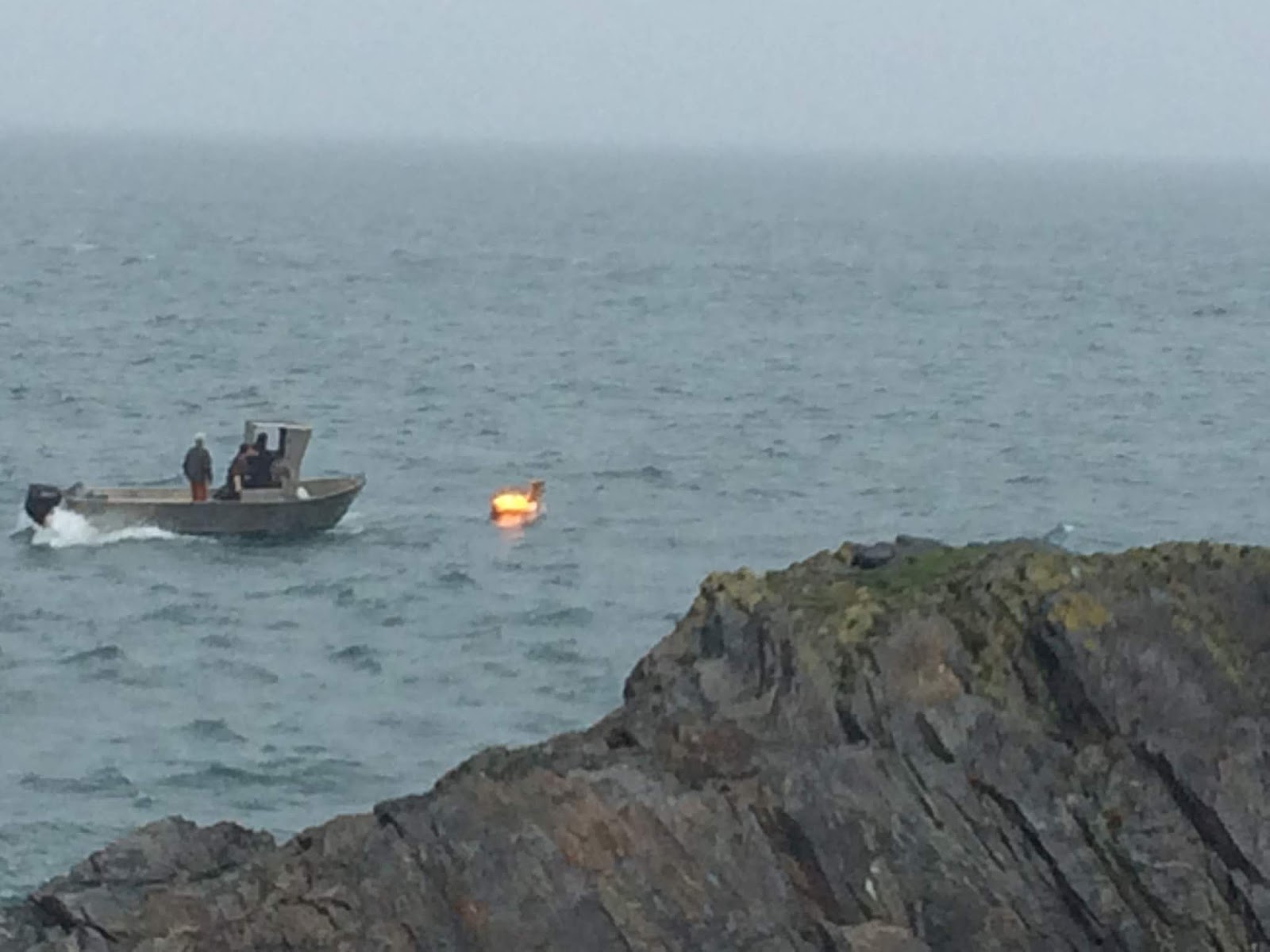
Photo credits Neil Harvey at Wild Journeys by kind permission

To learn more visit Wild Journeys


The Wherrymen

The Wherrymen
Two old friends on the water