Featured post

The Scottish Islanders

  Get your copy from  www.shop.yachtarchive.scot  !

Thursday, 30 April 2020

The Pierce Bracket


My original intention in providing the Mariota with auxiliary power was to build a conventional outboard well at the aft end of the cockpit and use a nice, quite light, 3hp Mariner outboard I had bought twenty or so years earlier and never used. After I had built the well, which included the painful exercise of cutting a hole in the bottom planks, I learned that two strokes don’t like operating in enclosed spaces; they misfire if not provided with plenty of air.
I wasn’t willing to finish the build and take a chance on this, so I decided to look for an alternative motor. Four strokes being heavy, expensive and very bulky, this led me to researching electric power and the purchase of a Torqeedo outboard, also expensive but very light. I’m comfortable with that decision and convinced that a nice clean unit is the way to go, but being slow revving the propellor is 12 inches diameter and would have required that dreadful hole to be much enlarged.
I spent a week or two surgically removing the well and filling in the hole, leaving myself with a nice little storage space to keep a radio or binoculars out of harm’s way, meanwhile thinking about an external bracket.


Freeboard on the Kotik design, an extended Wee Seal, is too high for even a long shaft to bury the propellor adequately. The motor has to be dropped nine inches or so, which means that there is enormous torque. My first attempt at a wooden bracket failed miserably, but with no injury of loss of life. What I thought was quite robust broke apart as soon as the motor’s full thrust came on and showed that any replacement would need to be a metal fabrication, probably with an extra fastening low down on the hull for security.
The guru from An Cala then arrived, examined the state of affairs and came up a with a solution that is simple and strong. It’s a sliding beam that travels within a strong wooden box behind the aft bulkhead, easily pushed out when required and unnoticeable when it’s not. The box is bolted to the bulkhead, but for additional security I’ve added an oak bar. The beam itself is oak. At the outboard end I’ve added a plate, so that we know it’s fully home when not required.


Wednesday, 29 April 2020

Modelling Admiral Popov's Battleship


Last November the Riverside Museum launched their publication celebrating their wonderful model collection. It’s a beautiful work of art and a great tribute to the museum staff such as Emily Malcolm, who spent years on it. We heard Professor John Hume speak of his childhood visits to the ship models in the old Kelvingrove Art Gallery. I was another of those Glasgow children taken there at weekends in the days when much of the ground floor was devoted to the city’s enormous collection of ship models, a tradition that continues nowadays in a rather restricted form at the Riverside.
Among the sleek racing yachts and the ocean liners some real oddities stood out, none more than the almost circular Russian Imperial yacht Livadia, her mystique enhanced by her constantly being referred to as Admiral Popov’s battleship. That isn’t exactly true. As we have seen, Vice-Admiral Andrei Alexandrovich Popov was attracted to the idea of circular battleships that John Elder had floated and in September 1879 appointed John Elder & Co to construct the Livadia as a prototype. We can see that it was convenient to test the design as a yacht; a battleship that didn’t perform would be embarrassing.
By 1879 John Elder had died and his widow Isabella had taken over the yard with its workforce of a couple of thousand men. The city of Glasgow owns her portrait and we see one strong, dynamic industrialist. She had head-hunted William Pearce from the Royal Dockyards as chief architect. Popov gave them an unlimited budget, the price being on a “cost plus” basis with a massive bonus if the ship exceeded fifteen knots on her trials. On 27 September Livadia on her third attempt beat the fifteen knots target and won Pearce a bonus of 414,000 Rubles on top of the base price of about 2.7 million.
Thanks to the new book we know that the model at the Riverside was built to the order of William Pearce. For many decades it sat in a case in the boardroom at Fairfields. A second, perhaps more elaborate, model was built and sent by Pearce as a present to the Tsar. It sits today in St Petersburg.


Looking at these models one can see the major features that were important to the Victorians. The model would enable the Tsar’s dream to be shared with an audience who would otherwise have had little opportunity to see the ship in real life. The model would ideally be a demonstration of the modelmaker’s skill and by implication that of the actual shipbuilders.
Victorian modellers sought total accuracy, a “good” ship model being expected to show every screw and rivet, even where it was impossible to produce this truly to scale. Sadly the effect of doing this could be distortion and a loss of the viewer’s ability to appreciate form. Elaborate gilding and paintwork further confuses the picture.
In 2014 I opened a fine art gallery in the city centre. We were on the ground floor of one of what John Hume describes as Glasgow’s Jolly Red Giants, the enormous red sandstone commercial towers that sprang up in late Nineteenth Century Glasgow and still dominate the cityscape.
Our building featured a Sixteenth Century French Renaissance exterior, with external statuary that includes a replica of the tomb of the Medicis, lots of mythical green men and other oddities. It was designed by the extraordinary Scottish architect William Leiper. To describe Leiper in one sentence, think the Scottish Branch of the Gothic Revival, throw in some Scots Baronial, season with Sir Walter Scott and you’ve got him. I decided to put on an exhibition dedicated to Leiper as part of the Festival of Architecture 2016.
So, what’s the connection to Livadia? In 1879 Leiper was having a gay time with his artist friends in Paris when the Tsar brought him back to Glasgow to create a Gothic interior in his new yacht. Being a bit mad about model ships, this was all the excuse I needed to get hold of a model.
I considered but quickly discarded asking the Riverside Museum for a loan of the Pearce model. There would be very obvious practical, insurance and security issues. A new model could show what could be done with modern technology.
I’m glad that we decided not to go with Virtual Reality. In theory we could have portrayed the spectacular interior, but it has to be done well and the cost would have been enormous. Doing it at a basic level, such as can be seen at the Museum in Irvine, does nothing for me. We also wanted something visual to draw people into the gallery, rather than something they would only access once already inside and perhaps have to queue to see.
Also, I simply like physical models. They are easy for the viewer to explore and can convey a sense of romance that technology doesn’t.
Of course this leads to adults and children alike wanting to examine not just visually but with the fingers, the sense of touch adding another perspective to understanding. As a result we lose some magic by protecting them behind glass. The Riverside Museum has solved this in a way that works at a superficial level, but has deficiencies. Livadia is immured at a high level, so you only see her from below, making it difficult to appreciate her remarkable design. We decided to put our model under a glass bubble.
To funding. We had put in for a grant towards the cost of the exhibition from the Royal Incorporation of Architects in Scotland, but of course had been awarded a tiny fraction of what we asked for. At meetings of the steering group for the Festival of Architecture I had met the representative from the National Lottery. There was encouragement to go ahead and we needed a legacy destination. I spoke to Fairfield Heritage to find out if there might be a home for the model in the longer term and they was supportive, but had no funding to buy it.
At this point James Pierce heard about the project. He had just returned from Russia with a wife. I was still investigating sources of funding when I discovered not only that James was keen to go ahead, he’d already made a start, perhaps partly with encouragement from his new in-laws. We allocated part of our grant to reimburse the cost of the materials, but warned him that he was proceeding at his own risk.
Starting work ruled out any prospect of Lottery funding, but looking back it’s obvious that James had to make a start, to meet the exhibition date. Going through a tender process and waiting for an answer would have left no time for actually building the model.
In the event James built the model in his evenings, after a day spent building the spectacular model of the racing hydrofoil Britannia that today sits in the foyer of the British America’s Cup Challenge headquarters in Portsmouth.
We wanted to ensure accuracy and had a problem finding the original drawings. A set on deposit at the Mitchell Library in Glasgow had mysteriously disappeared, as had all the best of the photographs taken by Queen Victoria’s photographers when Livadia stopped in Southampton during her maiden voyage. There was huge disappointment when we untied the ribbons on the lovely leather bound album and found it almost empty. This problem was resolved when James found that a fellow in the States who sold model kits of various historic ships had somehow got copies of the originals and was willing to send him images of them.
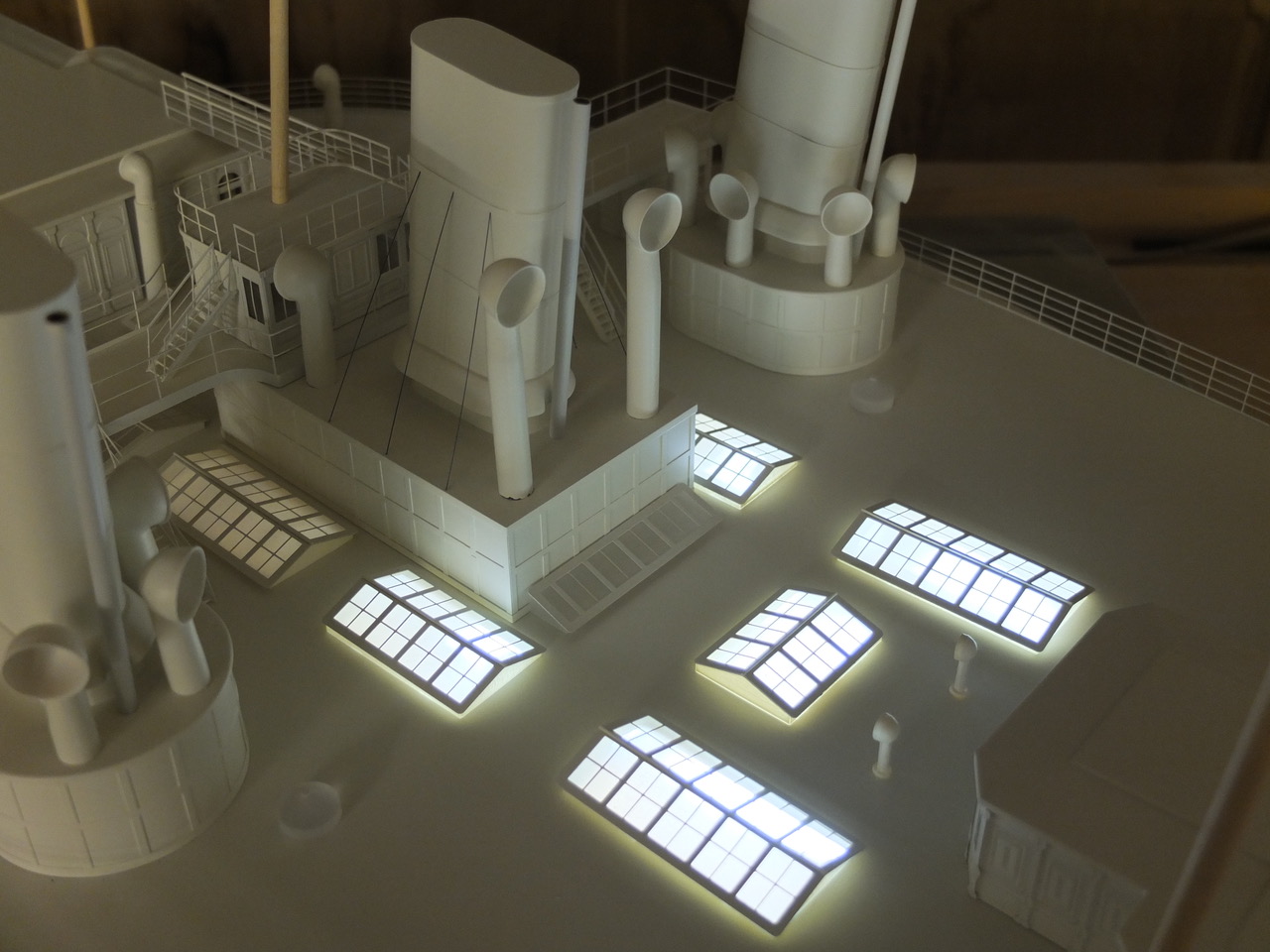
Regarding the style of the new model we opted for simplicity with no colour and no attempt to replicate all the features of rigging etcetera. We also decided on a waterline model that could be displayed easily in the gallery window and internal lighting, given our location on a busy street with a lot of evening traffic.
Our exhibition was a great success in terms of numbers, with lots of people attracted purely because of the model in the window. Among the visitors were the organisers of the James Watt Dinner, a major annual event in the shipbuilder’s calendar, and Richard Pierce and I were invited to show it there. Sadly none of the industrialists present offered to buy it.


Monday, 27 April 2020

A haunted Mill, Watery Graves and the Toberonochy Lemon Shop


As the MacCrimmons were to piping so the MacFadyens are to handling the wee ferries that keep the place running. Single tickets are on offer, for those who expect to fall in love with the island, or maybe have a boat to recover, but most will buy a return for their eventual reluctant departure.


Since the start of this century an event has taken place in conditions of secrecy only rivalled by the Bilderberg Conference, but less damaging by far to global peace and prosperity, consuming no oil whatever and attended by a much nicer bunch of people, on this small island off the West coast of Scotland.


It takes place in the open air, but participants are untroubled by the vagaries of the weather, viewing extremes of rain, strong wind and temperature as stimuli to, rather than distractions from, their water-borne adventures. In all conditions they congregate. Strong winds and adverse tides present challenges to ever-longer turns to windward; in fact one year the weather obliged with a 180 degree wind shift while the crews were resting for lunch after tacking half a dozen nautical miles South towards the deadly Dorus Mor, coinciding with high water which gave a return journey of equal unpleasantness against a cold wet Northerly and a strong ebb tide. Despite, or maybe because of, such things participants, who like those at Bilderberg are all personal invitees, return year after year. Only the Great Johnson Plague has put a temporary stop to it.
Once over the ferry you’ll travel down slowly through a very Hebridean landscape, unusual for an inner island. Be careful when you reach the water mill; it’s inhabited by water elves, sithichean-uisge, who will inflict terrible punishment if you fail to leave a hair from your head as a tribute. Great hares, the size of dogs, will lollop past you.
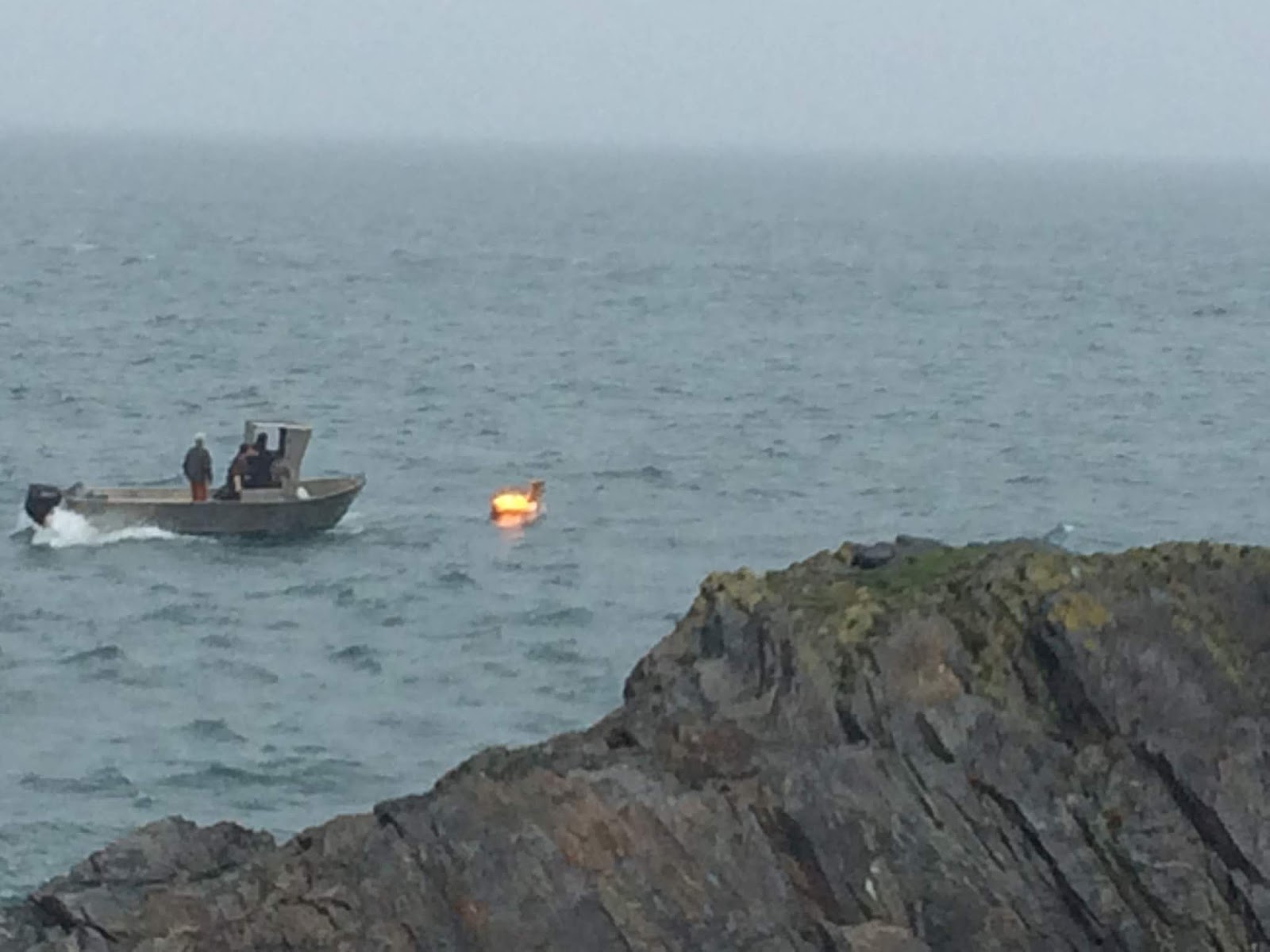
Since we started only one of our number has left the scene, the lovely, gentle Hugh Gray, who sailed a little black cutter named after his Tanta Hedwig. His son created a Viking ship for his ashes and we watched as he set off on his fiery last voyage from Cullipool.


To end in the waters you love seems rather a nice destination. In 2004 the Brother came to perform at the special wee ceilidh we hold in the Toberonochy Hall and was captured by some American Campbells who had brought their aunt back to her place of birth. As he played a suitable lament the urn was opened, about half of the aunt entered the Sound of Luing and the residue engulfed the crowd.


On the Sunday morning there was little wind and the fleet was becalmed under a dreich grey sky, the drizzly rain trickling down their necks.
Through the Sound came a commodious plastic-hulled vessel, which dropped anchor in Kilchattan Bay and sent a lady crew member ashore on a mission, to acquire some lemons for the gin and tonic. Asking a local resident where such a purchase could be made she got the reply "I regret, Madam, that there are no lemon shops in Toberonochy, in fact there are no shops here at all."
At that moment out on the water the Brother, still in sombre mood, filled the bagpipe with blaw and started on a tragic lament, in keeping with the grim morning. On hearing this the lady said, obviously stunned at thinking she had gate-crashed an aquatic wake, "I'm terribly sorry to intrude on your small community in this time of grief," and made her way back embarrassed to her yacht.

Chan eil bùth an drasta

Tuesday, 31 March 2020

Gylen Castle from the sea


Gylen Castle stands guard at the South end of Kerrera, a former MacDougall stronghold built in 1582 and occupied until the inhabitants were besieged by General Leslie in 1647, Deprived of water, they surrendered on the faith of Leslie's promise to spare them, on which of course he promptly reneged, allowing only one young MacDougall boy to survive.

I've written before about my acquisition of the sailing vessel Gaudeamus, here; The Crinan Canal not quite for me. I eventually made it through the canal in 1974 and moored my ship at the Brandystone in Oban Bay, thanks to the wonderful Donnie Currie, then one of our last surviving boatbuilders. Our old friend Donald Brown soon heard of the move and demanded that I take him to see Gylen Castle from the sea. 

Mr Brown was not a man whose demands you could easily refuse. Born and brought up in the family farm at the head of Loch Feochan he had walked daily the five miles to school in Oban. Standing well over six feet he was a commanding presence, also a loud one, as his wartime service as a front line doctor had left him quite deaf. A man of principle, as a medical student he had refused to take part in University boxing. Like many from Argyll he had cousins everywhere, John Stevenson the procurator fiscal and the inspiration for Sutherland's Law, in which he was played by Iain Cuthbertson and Jimmy Macdonald the Oban undertaker being two of them. Jimmy's hearse proved useful when Donald bought a grandfather clock in Oban, but started rumours when it was seen parked outside his house in Glasgow.

We had arranged to meet at the boat, the Browns being already in Oban. On the appointed day I left Glasgow early, but my car developed problems on the way and on arrival I had to leave it in a garage. This was fortunate as by the end of the day I was to be in no fit state to drive.

At the Brandystone I was met by Donald in full white surgical dress, which he assured me being bloodproof was also waterproof, his wife Barbara in more normal clothing and their golden labrador, Juno. The Browns were namely for matrimonial discussions, both being of wonderfully strong character. Donald felt that wife and dog should stay ashore, Barbara disagreed and had Juno had a vote she would have been with Donald. Barbara of course won and we duly made a somewhat risky trip out in the eight foot pram dinghy to my ship.

Gaudeamus is a Loch Long, number 98 in the class, twentyone feet overall and with minimal shelter. here's a picture of a sistership.

Celeano II, built by Robertsons in 1949
We were quickly underway in quite a brisk following breeze. From the outset Juno was distinctly unhappy and cowered under the wee cuddy that you'll see in the photograph. Donald took the helm, while Barbara held on tightly and I did my best to keep calm. We were soon past Horsehoe Bay, avoided the Cutter Rock and made a swift turn to starboard at the bottom of Kerrera Sound.


There followed a nice fast reach in a flat sea under the lea of the island, with a wonderful clear view of the castle, before clearing the coast for the trip back North.

Loch Longs are tough wee boats and I had no doubt that we would make it, but they're not comfortable in a blow with the nasty short waves that we get when there's a good strong tide running. It took several tacks to work our way back to the entrance to the bay, after which we had a run down to the Brandystone. As we picked up the mooring Juno saw her chance to jump into the water, swim ashore and make off.

Once all stowed, dinghy back in Donnie's shed and  Juno recovered, Donald drove us to the summit of one of Oban's peaks, where we were met by the above mentioned John and Jimmie. They said they had been concerned about us and greatly relieved when they saw the Gaudeamus coming round into the bay and flying down to her mooring. Once we were seated we were each handed a pint glass of whisky topped up with strong ale to fortify us for the trip back to Glasgow in Donald's Rover.


Saturday, 8 February 2020

The Black Boat is for sale


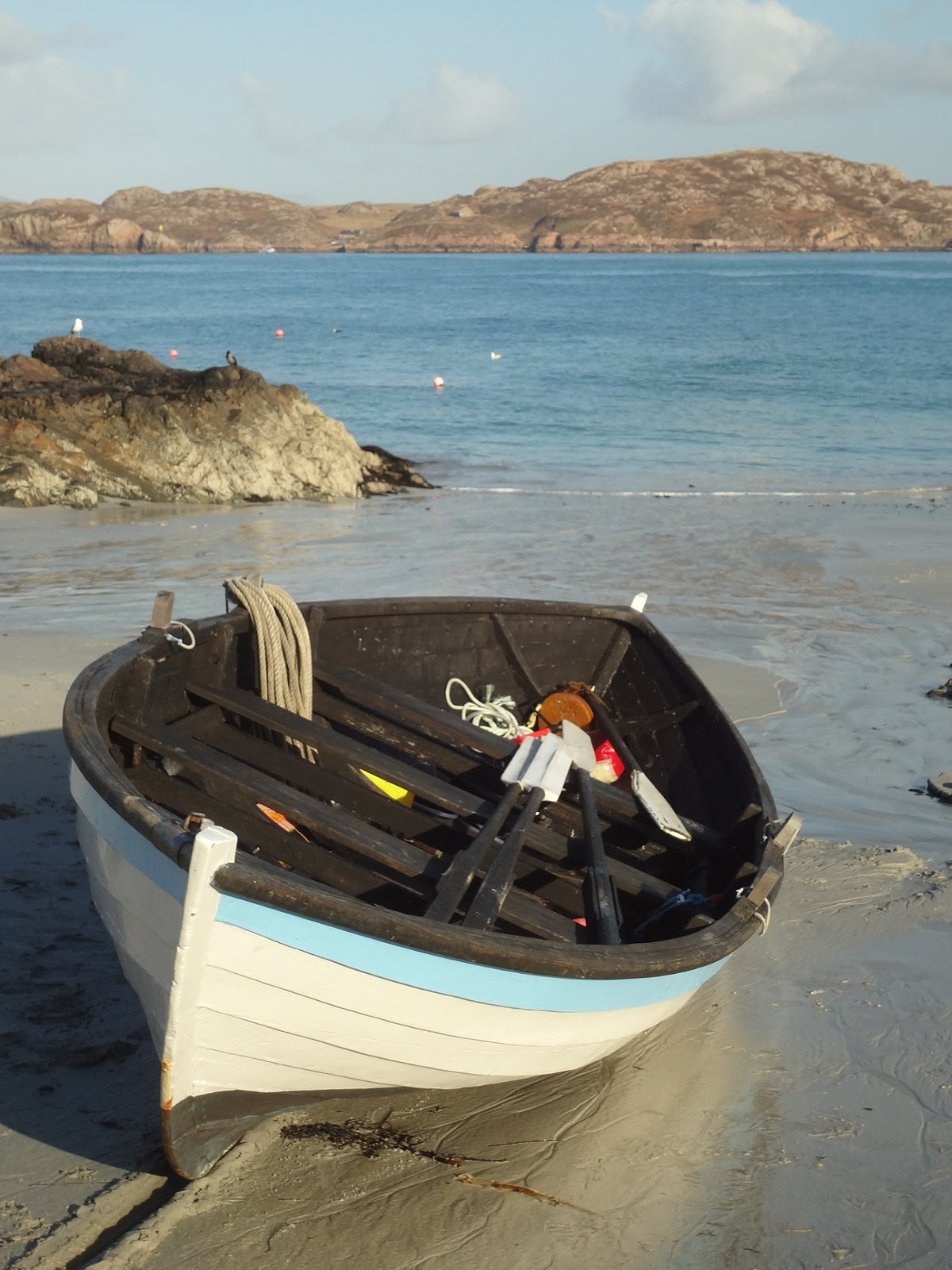
The 'Black Boat' is for sale. A Shetland skiff that arrived on Iona about 35 years ago. No idea how old she is but I'd put her at 80 plus. Very well maintained by Mark Jardine, boat builder, who also owned her before the present owner, my friend John McLean. Just had a new plank put in by Mark and a paint for the season. A bonny boat and a pleasure to row. £1000. Lying Iona. Contact John McLean on the island on 01681 700 642


Monday, 18 November 2019

The Imperial Yacht Livadia


There’s an old saying that the last things anyone wants on a yacht are an umbrella or a naval officer, but a fairy fountain decorated by electric lights in changing colours and sitting in a circular basin surrounded by floral displays must come close. The fountain, built from statuary marble by Messrs Galbraith & Winton, who were later to create the interior of Glasgow City Chambers, was only one extraordinary feature of Tsar Alexander’s fantastic floating palace Livadia II, built by John Elder & Co at Fairfield in 1880. 

She was probably the biggest and certainly the most expensive ship launched into the upper reach of the Clyde at that time. For the Glasgow architect William Leiper the commission to design the interior of this extraordinary floating palace was sufficiently attractive to bring him back from his spell at the Ecole Julian in Paris, where he'd spent two years having a gay time with his artist friends.  One can only guess at the excitement he must have felt on being given an unlimited budget to indulge his imagination. 

The Architect (23 October 1880) described there being on the awning deck the great State Saloon, 70 feet by 40 feet, “in the plan of an elongated octagon of twelve wide-span elliptic arches” with at one end a highly architectural sideboard with Ionic columns, the Imperial arms supported by carved figures and “foliage festoons” with elaborate candelabras. The ceiling was richly moulded and carved in white ivory relieved in gold, the seating in the finest French silk tapestry against a backdrop of heavy crimson plush curtains, the whole in the style of Louis Seize. 


Leiper commissioned the stained glass artist Andrew Wells to design the ceiling of a suite in “Crimean Tartar” style and William de Morgan made a minor but significant contribution with tiles of a special artichoke pattern. 


Courtesy the De Morgan Foundation

That the commission to create the flagship of the Imperial Romanovs, one of the wealthiest families in the World, came to Glasgow was a great tribute to the skills and versatility not only of Glasgow’s shipwrights but also her craftsmen and women. There was also a serious purpose, because for some years naval strategists had been discussing what form the battleships of the future should take, given the new technologies that were developing. 

In 1868 the Scottish engineering genius John Elder had read a paper at the Royal United Services Institute entitled “Circular Ships of War, with immersed motive power”, arguing that increasing the beam of a warship could enable it to carry heavier armaments. This was probably based on thinking about some of the vessels involved in the American civil war, in which Elder had played a significant role by providing the Confederate navy with many of its fast blockade runners. He would have become aware of the circular monitors that the Americans had developed. 

My native city is currently coming to terms with a dishonourable part of her history, her involvement with the slave trade. Elders were just one of several shipyards that grew very rich building fast, paddle-driven blockade runners for the South.

Vice-Admiral Andrei Alexandrovich Popov was attracted to Elder’s concept and in September 1879 appointed John Elder & Co to construct the Livadia as a prototype. 

By this time the yard was owned by the formidable Isabella Elder, John’s widow, who had head-hunted William Pearce from the Royal Dockyard at Chatham to run it. Popov gave the yard at Fairfield an unlimited budget, the price being on a “cost plus” basis with a massive bonus if the ship exceeded fifteen knots on her trials. Pearce, assisted by the Dutch engineer Bruno Tideman, produced a modified version of Popov’s design, reputedly  towing a one-tenth sized scale model about Loch Lomond. 

The result was a turbot-shaped hull, 259 feet (79m) long with a maximum beam of 153 feet (47m), that was launched before about 10,000 spectators on 7 July 1880, when she was named by the Duchess of Hamilton and blessed by a Russian Orthodox priest. 

Her machinery included three main engines for propulsion and about twenty smaller ones to drive equipment and generate electricity, powering inter alia the fountain. On 27 September Livadia on her third attempt achieved a speed of 15.725 knots, her engines running in excess of an estimated 12,000HP, earning Pearce a bonus of 414,000 Rubles on top of the base price of about 2.7 million Rubles. 

At the end of September Livadia left the Clyde on her maiden voyage. At Plymouth the Grand Duke Constantine joined the ship. On October 19 she left Brest despite warnings of foul weather further south, the Grand Duke insisting that there was no better opportunity to put the yacht through her paces than to have her ride out a storm. The following three days and nights were a nightmare for the imperial passengers, with the Livadia meeting 27 foot waves. 

With her shallow draught and blunt entrance she was unable to part the seas, as a narrower ship would have done, instead slamming onto them from above. On the third day the crew found that at least one of the bottom compartments was no longer watertight and it was decided to put into Ferrol in North West Spain, where divers reported that the hull had suffered quite extensive damage. Through the winter, while repairs went on below, the public spaces were used to host numerous balls and high society events. 

Tsar Alexander never got a chance to enjoy his eccentric yacht. By the time she arrived in the Black Sea in the Spring of 1881 he had been assassinated. 

Oddly, Livadia had indirectly saved his life a year earlier, when a bomb placed by one Stefan Khalturin in the basement of the Winter Palace in St Petersburg, directly under the dining hall, went off at exactly half past six, but the Tsar, a man of very punctual habits, wasn’t there. He had taken a detour to show his mistress Princess Catherine Dolgoruki the model of the Livadia, a present from her builders, which had arrived that day. 


Of course the yard had their builder, James Cameron, make another model, which for many decades it sat in a case in the boardroom at Fairfields. In the early years of last Century the yard was persuaded to deposit it with the city.

Today this model sits as part of the main wall display at the Riverside Museum, among a whole array of models of all sizes. There's no doubt of the impact on the casual viewer, but I think it's a great shame that much of the individual detail is lost in the crowd. Also, for the viewer with a technical interest the radical hull shape, which was the whole point and mystery of Livadia, is lost.

Such a builder's model would ideally be a demonstration of the modelmaker’s skill and by implication that of the actual shipbuilders. Victorian modellers sought total accuracy, a “good” ship model being expected to show every screw and rivet, even where it was impossible to produce this truly to scale. Sadly the effect of doing this could be  distortion and a loss of the viewer’s ability to appreciate form. Elaborate gilding and paintwork further confuses the picture. 

In 2014 I opened a fine art gallery in the city centre. We were on the ground floor of what John Hume describes as Glasgow’s Jolly Red Giants, the enormous red sandstone commercial towers that sprang up in late Nineteenth Century Glasgow and still dominate the cityscape. Our building featured a Sixteenth Century French Renaissance exterior, with external statuary that includes a replica of the tomb of the Medicis, lots of mythical green men and other oddities. 

It was designed by the extraordinary Scottish architect William Leiper. I started to research him. To describe Leiper in one sentence, think the Scottish Branch of the Gothic Revival, throw in some Scots Baronial, season with Sir Walter Scott and you’ve got him. I decided to put on an exhibition dedicated to Leiper as part of the Festival of Architecture 2016.

The connection with Livadia meant that we had to have a model. We decided to commission a new, Twentyfirst Century one, rather than try to borrow an existing one. 

As anyone with experience of the various grant awarding bodies will know, there's no point in any private individual, however well-intentioned, even thinking about applying. After wasting a lot of time and effort we at the gallery and our chosen builder, the talented James Pierce, accepted that we were on our own.

The result was delivered on time and attracted lots of visitors to what turned out to be one of the very few truly informative exhibitions taking place during the Festival.


The Wherrymen

The Wherrymen
Two old friends on the water