Featured post

The Scottish Islanders

  Get your copy from  www.shop.yachtarchive.scot  !

Showing posts with label Clyde sailing. Show all posts

Sunday, 17 December 2017

Kyla Sails Again!


Earlier in this blog I've posted the saga of the Kyla and the struggles by the Russells to bring back a trophy from the United States, here : Scots in Oyster Bay I'm delighted to report that I've heard from Kyla's new owners and one of them, Jean-François THAU, President of the Cercle de la Voile du Bois de la Chaize has contributed the following guest post. Blogging has very few direct rewards and this is one of them!

Act One : The Boat

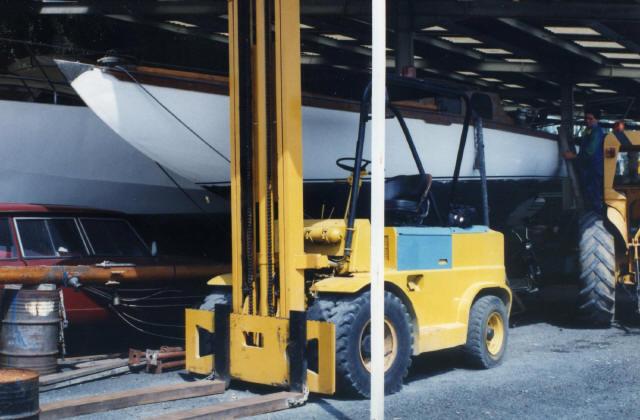
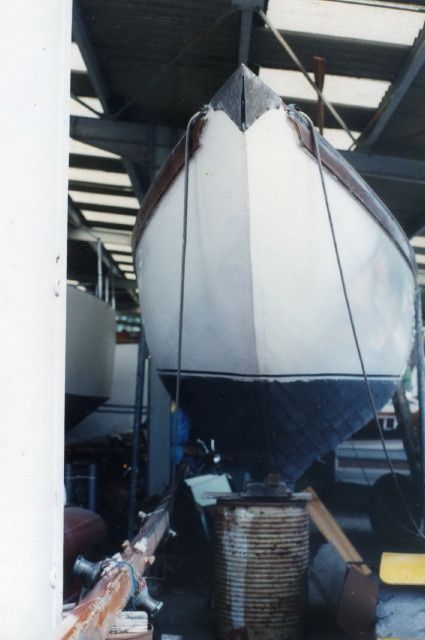
Cornered by machines, a boat of traditional construction sits on her shores. A quick look shows that she’s definitely a six metre that’s undergone a less than aesthetic modernisation. Her name is Blue Monday, date of construction 1934, origin Scottish. Acquired by three pals in 1992, the Blue Monday had seen the start of a restoration that sadly hadn’t been finished by the trio.

In 2006 the Blue Monday is donated to the Conservatoire Maritime du Havre, an organisation that takes on classic yachts and boats, supports their restoration and sells them on.

At the lecture celebrating her acquisition we learn that her original name was Kyla. The first step in her restoration is the decision by the CMH is to give her this back.
http://idata.over-blog.com/3/23/33/42/img289_1_1.jpg

http://idata.over-blog.com/3/23/33/42/img285_1.jpg

Kyle Act Two : Searching for origins


Following some deep research by Dany, the official in charge of acquisitions, the plans are recovered from Scotland. Receipt of these is a great moment for us, because they enable us at last to know Kyla’s true physiognomy. That moment settles some things for us, the helmsman’s cockpit was identical, but we have a different arrangement for the backstays and will have to add two winches.

A visit from Tim Street, the Honorary President of the British International Six Metre Association brings us a whole complement of precious information.

The renaissance has begun!

http://idata.over-blog.com/3/23/33/42/100_0788_1_1.jpg


http://idata.over-blog.com/3/23/33/42/100_0813_1_1.jpg


Kyla Act Three : The Boatyard


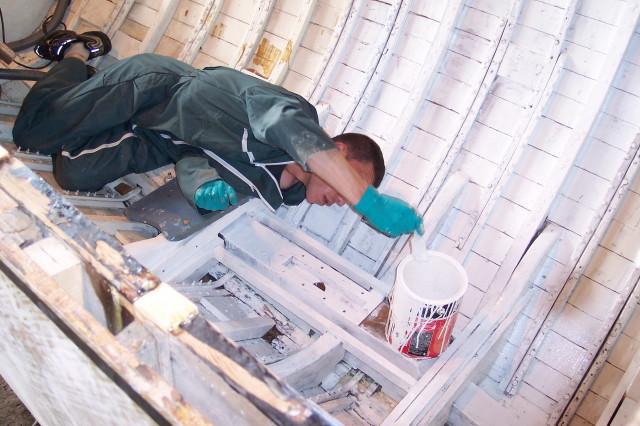
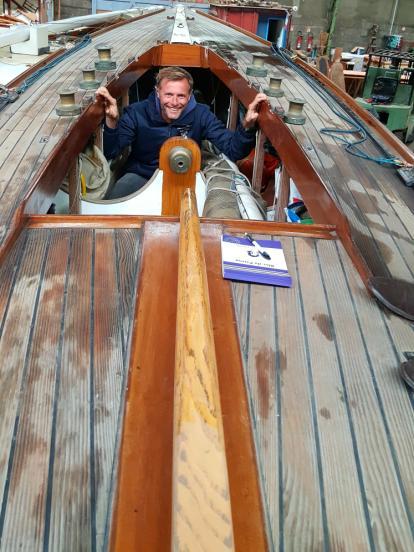
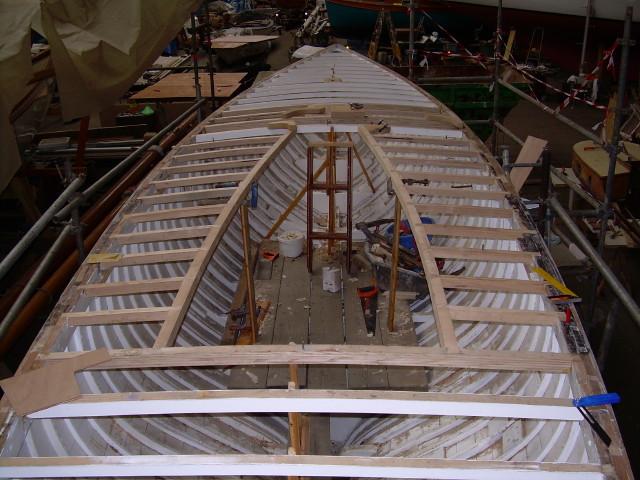
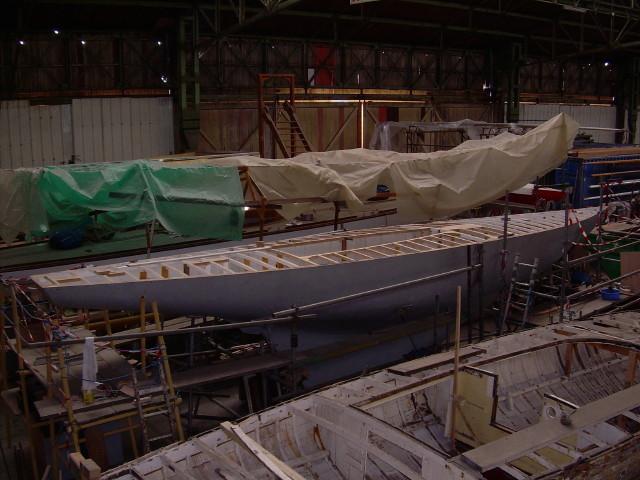
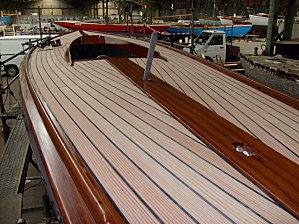
Once the transfer to the yard is done, the work of assessing the real state of the boat and producing an accurate survey follows. This defines the various tasks and how to do them, make provisions, form teams and distribute the work, always remembering that Kyla herself will guide our professional efforts.
http://idata.over-blog.com/3/23/33/42/N1493_1.jpg

http://idata.over-blog.com/3/23/33/42/N1506_1.jpg

http://idata.over-blog.com/3/23/33/42/N1588_1-copie-1.jpg


Kyla Act Four : The Group Dynamic

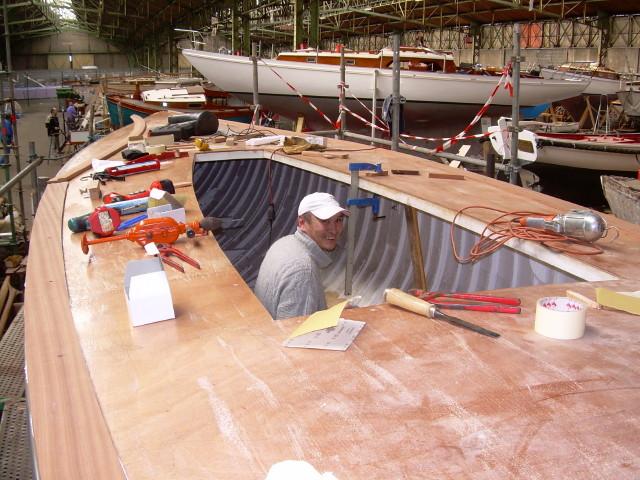
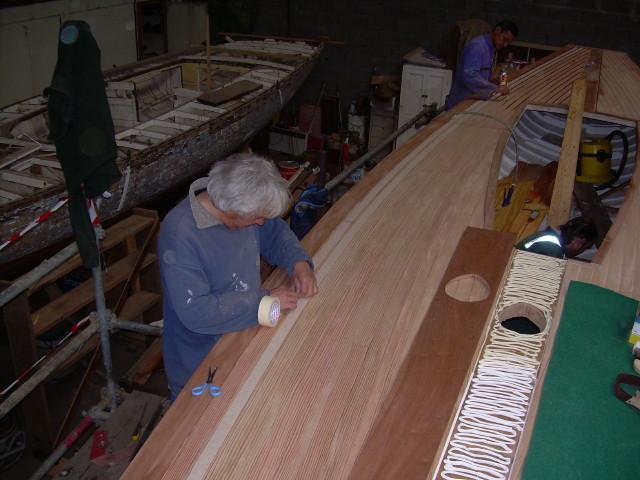
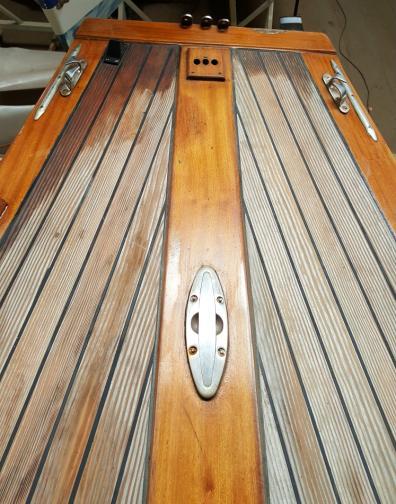
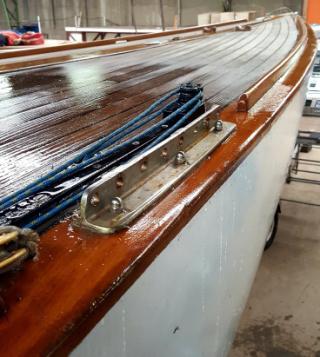
The work proceeds, Kyla’s silhouette takes shape, problems are resolved, such as our blacksmith quickly realising that he has seriously underestimated how much he will have to do on a wooden boat. The dynamic of the group grows in strength, everyone knows his role, every piece of wood has to be perfect, all metal parts solid, aesthetic and brilliant, filling and sanding perfect, the masters words in our ears 

“no shitty painting or varnishing, everything solid and lovely”

http://idata.over-blog.com/3/23/33/42/2007_07190389_1_1.jpg

http://idata.over-blog.com/3/23/33/42/N1883_1.jpg


Kyla Act Five : The Rigging


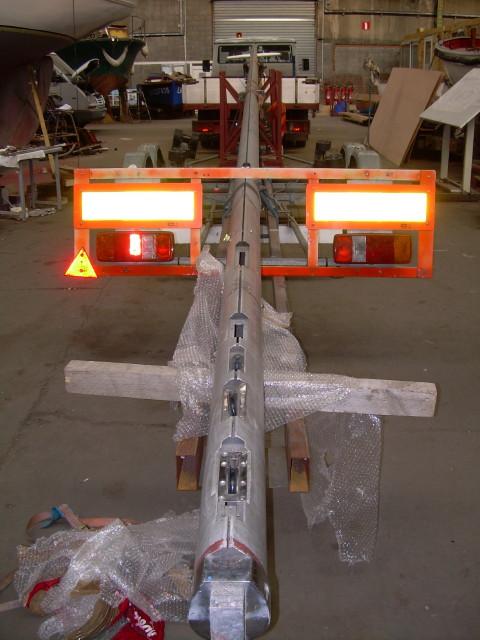
The mast provokes an animated debate, because it doesn’t exist any more. What to do? Making a new one is technically possible at the CMH, however Patrick explaining the technique makes us realise that this measures 14.70 metres to a top like the head of a lightbulb. “Look, we’re restoring a regatta boat and we’ve only got ten months to get the whole job done and try out the complete boat on the water.”

The decision is made, we’ve got to find a mast, a task given to Ronan, an active member of the Association.
http://idata.over-blog.com/3/23/33/42/N1550_1.jpg

http://idata.over-blog.com/3/23/33/42/S6300291_1.jpg


Kyla Act 6 : Completion


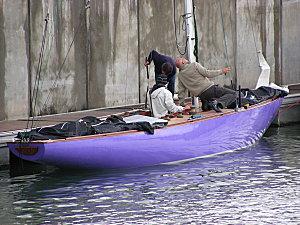
The project goes ahead full tilt, the restoration goes forward fast, the helm, the furniture, the fittings are put in place.

The first coat of paint goes on, the colour surprises us but gives a touch of originality. Why mauve? To give a nod to the the Swiss, whose waters we are sailing on, the colour of MILKA chocolate bars!
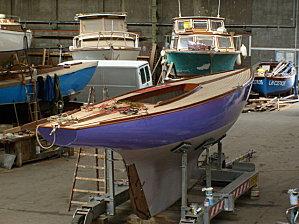
S6300214 1

S6300282 1

S6300270 1


Kyla Act 7 The Big Day


It’s arrived, the big day! An official presentation and presentation to the public, everyone is there, friends, families, participants.

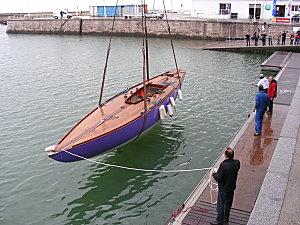
The trip from the yard to the launch site is a great moment, it rains but who cares because we’re all overheating.

The boat touches the water, bravo to everyone! Kyla is beautiful and floats, now we just need to sail her.
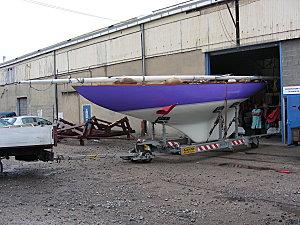
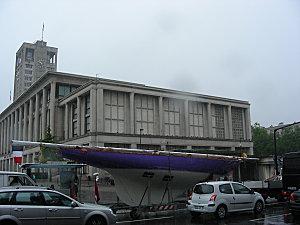
mise à l'eau KYLA 007


mise-a-l-eau-KYLA_051.JPG


mise-a-l-eau-KYLA_144.JPG


mise-a-l-eau-KYLA_168.JPG

Kyla Act 8 : Handing over


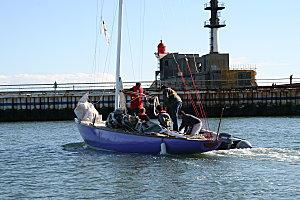
Busy with the final preparations for another big day with Kyla under sail.

Sadly we’re sorry to miss out on this premiere. Well, one is doing well just getting a boat like this to go, as it’s not at all evident!
IMG_0781.JPG

IMG_0786.JPG


IMG_0802.JPG


IMG_0854.JPG

Kyla Act 9 : Welcome to Switzerland


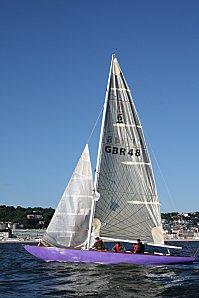
This part of the story consists of us arriving at Lake Geneva just before the historic boat regatta.

It’s lovely to see our Six with all the other classics. What a welcome we got from the Cercle de la Voile Vevay - la Tour

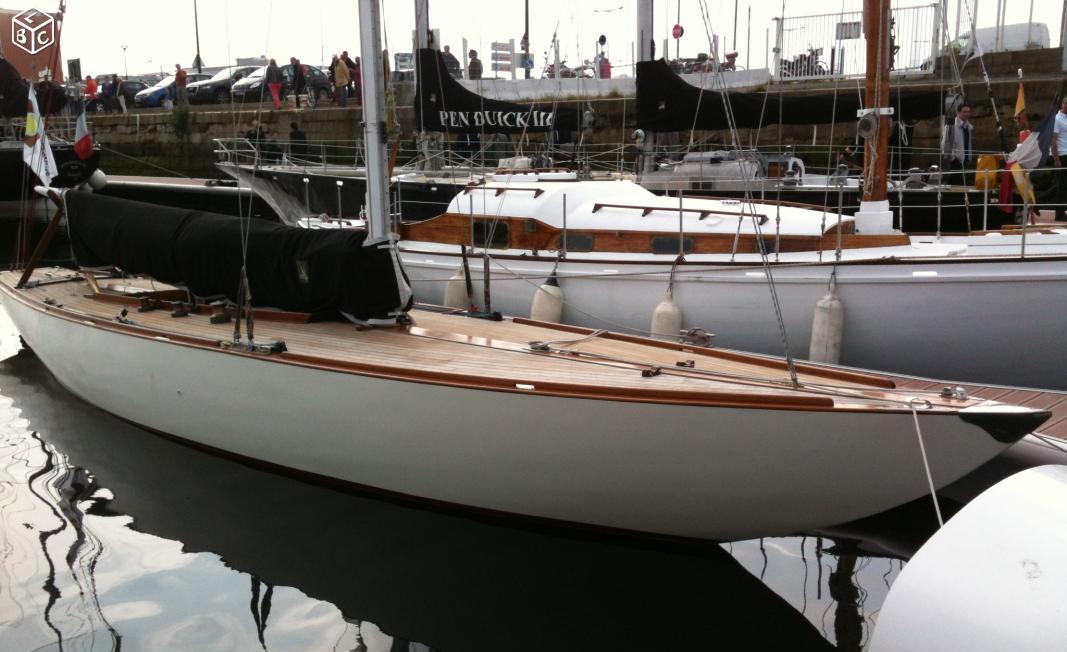
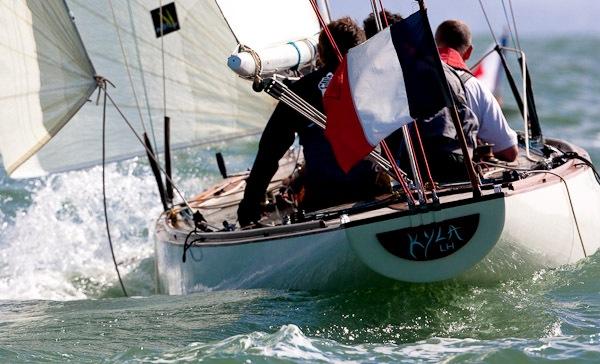
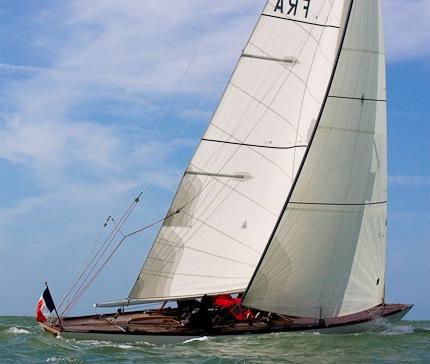
Kyla Act 10 : The boat is acquired in 2003 by Gilles Piette


She is repainted white and re-equipped with racing hardware. She takes part in several regattas at le Havre and Deauville until 2015, when her owner throws himself into the restoration of the Eight Meter Silk …


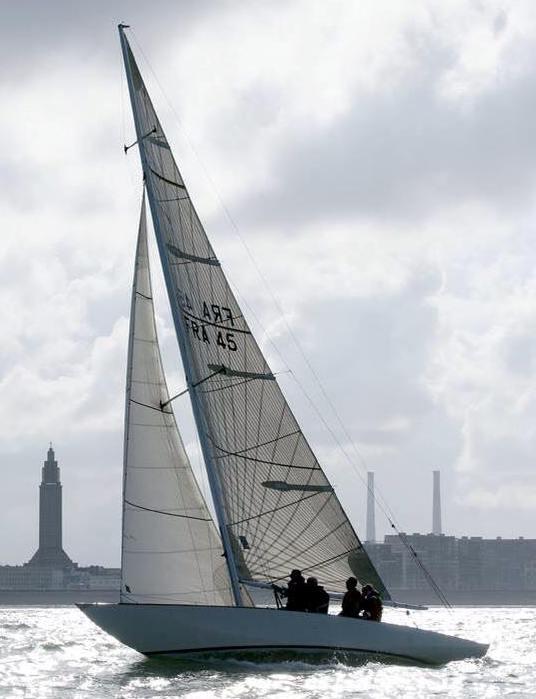


Kyla Act 11 : Stop Press September 2017

A band of comrades from Noirmoutier buy the boat from Gilles, beefing up the fleet of Sixes at the Cercle de la Voile du Bois de la Chaize .

The latest episode in the story of ten years in the recent history of Kyla happens one Monday in September, when after spending the whole weekend in discussions with Olivia and Valerie, Vincent and Jeff go to le Havre in torrential rain to see the boat.

The charm works at once. The decision to buy Kyla takes a few hours! With Christophe and Geoffroy having joined in the adventure by, the boat will join Noirmoutier in Spring 2018 with a view to the Metric Challenge 2018 Metric Challenge 2018 and the European Six Metre Championships European Six Metre Championships starting in September at La Trinite …

watch this space!


Wednesday, 5 September 2012

On the Clyde with Spratt and McGlurg - A Story from the Past


Looking back today, with only a few months until with any luck a grateful government will start to pay my pension, 1995 seems like yesterday. It was the year the troops came out of Northern Ireland, Nick Leeson broke the bank (the first of many to do so) and team NZ won the Americas Cup for the first time. In 1962, when the events I'm about to describe took place the main characters Spratt and McGlurg must have had the same feelings about the end of the war in Europe (they always addressed each other and the world by surname only and I will do likewise). To me that was prehistory, my mother having kindly delayed having me until a year or so after my father got back from the Far East.

To the fourteen-year-old me Spratt and McGlurg were human dinosaurs, with their heavy harris tweed jackets, faded checked cotton shirts, the frayed collars held together with thin regimental ties, wide bullet-proof corduroy trousers and ancient brogue shoes. Going sailing the only concessions were the addition of tattered yellow oilskin jackets when the seas started coming over, a yachting cap and of course  the shoes. The latter got changed for faded porous deckshoes with treacherous "non-slip" soles guaranteed to slide you over the side in an instant and moth-eaten uppers bleached through years in the open. As I was to learn, in order to leave all grit and sand behind they only got changed in the tender, a highly varnished clinker-built rather tippy shell, adding an interesting dimension to the risky enough operation of getting aboard. Looking back these survivors from a former age were probably approaching fifty.

I blame my parents for my obsession with boats, as from the earliest age I was deposited at St Abbs for a summer month and there was nothing else to do but go on the water (I was actually there in utero, but recreational options are limited in that soggy environment). It was also one of the tragedies of my early life that my parents quite forgot to manage my condition by acquiring a yacht, or indeed any other kind of floating object. I was reduced to watching with envy as local boys went to sea in their tiny home-built square-riggers, about which I've already written here:- learning-about-sea-at-st-abbs
 
Back home I would scour papers and magazines to find affordable ways of getting afloat, cut out the advertisements and leave them lying around as rather unsubtle hints. One such clipping which depicted an ugly bulbous inflatable contraption made from rubberised canvas with a tiny sail hoisted on an aluminium tripod surrounded by a smiling suntanned superfit family about to climb aboard, photographed on some lake in the Black Forest, was selected only on the basis that it seemed  very affordable. Leaving this out on the kitchen table proved a serious mistake when I got a lecture on how Britain was missing out on the Wirtschaftswunder.

My nagging eventually did get a result. Probably through some business connection of my father's Messrs Spratt and McGlurg got to hear of my existence and must have decided to assess my potential value as an item of foredeck fodder. They were co-owners of a pre-war racing machine, the Griselda, which lay half a mile offshore at the entrance to a sea-loch twenty miles from Glasgow. As they had not tangled with Emperor Hirohito their respective children were a few years older than I was. This had enabled them to stage a mutiny, leaving their fathers somewhat crewless and sparking their interest in me.

Thus early one grey Saturday morning I walked round to McGlurg's grand residence. Soon we left the West End in his Rover, picked up Spratt and travelled westwards, me sitting in the back clutching a luridly bright brand-new pair of navy blue sandshoes with white "non-slip" soles as described above. Plainly my mother wanted me back alive. Apart from this my attire was precisely the same as normal shoreside, namely "short" trousers that descended to just above the knee, fabricated by Mother on her hand-driven Babcock machine from some heavy-duty grey flannel to a prewar pattern, knitted hose rising to the knee, shirt from some similar fabric to the "shorts" but marginally lighter, school tie and sweater. Of course in those days no-one even contemplated wearing any form of buoyancy aid.

During the journey Spratt and McGlurg conversed on sundry matters, ignoring my presence but occasionally referring to me as "the boy". We travelled at great speed, the trip punctuated by near accidents with other vehicles, eliciting occasional outbursts of strong language. (I did discover, however, that McGlurg had learned at some stage not to mess with the Glasgow tramcars, then in their last days. One of those would have made easy meat of the Rover.)

Soon we were parked outside the enormous stone exterior of the Royal Something Yacht Club, home to hundreds of lovely models (of yachts I mean) and oil paintings of past lovelies (more yachts). I got a glimpse into a dark, wood-panelled bar where a couple of denizens were contemplating the day over a post-breakfast gin.

The tender was launched, Spratt took the oars and pulled us out against a stiff easterly setting up a nasty short chop. The shoes were changed, then we climbed aboard the Griselda, a slender rule-beater from the early days. I knew nothing of the history then and no-one enlightened me, she was just a little floating world apart, a living thing still pretty despite her brightwork being not-so-glossy, and her metalwork rather green.

Any interest in the condition of the Griselda or her provenance soon vanished. Spratt and McGlurg were deep in animated conversation about "some ******* fool" who had left the main halyard at the top of the mast and how it could be recovered. Firmly gripping the shrouds it was possible to squint upwards and catch a glimpse of the mast truck swinging widely as the Griselda rolled, every movement at deck level magnified about thirty times at a height of forty feet, the errant shackle flying to and fro in crazy arcs against a backdrop of clouds scudding past. Within a minute or two the discussion turned to "the boy" and my hosts decided send me up for it.

Even bloggers must sometimes tell the truth and I cannot say that this was the day of my self-discovery as a top-mast man. In fairness I did make a few, rather feeble attempts, getting a foot on the boom, but hadn't a clue how to rise further. To make matters worse I was always hopeless at gym and have never had a head for heights. This probably saved my life, because so tragically wanting were my efforts that Spratt and McGlurg were soon discussing alternative plans, including towing the Griselda to a naval base some miles away, where there was a suitable dock.

Then inspiration struck and one of my tormentors announced "Jonny Brinkman will have arrived at the Club by now, let's get one of his boys to fetch it." Off went Spratt in the tender, rowing like an olympian and a little while and doubtless a couple of shoe changes later returned with a boy a couple of years older than me, built like an ape, who heaved himself up like it was part of his normal morning's exercise (and it may have been, for all I know), then sliding back down. When Spragg prised the shackle from his teeth he was able to give me a rather patronising sneer.

By comparison the rest of the day didn't feel too fraught with danger, although it could hardly be described as sedate. It was probably the first time I experienced that mild sense of panic before one gets underway as the sails whip and flap and the wind seems much stronger than it really is. Once freed from her chain the Griselda was off like the old thoroughbred she was, lying over and slicing the waves, spray and occasional lumps of solid sea coming over as the day progressed and the wind got up.

My second and thankfully final terror of the day was being ordered forward to catch the mooring, with a warning as if I needed it that the aforesaid denizens, no doubt now on their twentieth or thirtieth gins and suitably critical, would be watching. Suitably terrified I crawled forward along the foredeck and managed somehow to hang onto both yacht and mooring bridle long enough for Spratt to recover it and bring our adventure to a safe end.

Post Script

Strangely I did get invited back a few times and eventually got to like Spratt and McGlurg quite a lot. Spratt had been to the States a few times in the thirties with the Scottish sixes, but I didn't know that in time to ask him about it. Nor would either ever speak about what he'd done in the War and as they're both long dead now we'll never know. There's a lot of recent history that is in serious danger of being lost for ever if we don't take steps to preserve it, which is one of the reasons for this blog.

The image at the top of this post is by my talented nephew Paul Kennedy, whose website can be visited here, www.paulkennedyart.com

The Wherrymen

The Wherrymen
Two old friends on the water