Featured post

The Scottish Islanders

  Get your copy from  www.shop.yachtarchive.scot  !

Showing posts with label Willie Russell. Show all posts

Sunday, 17 December 2017

Kyla Sails Again!


Earlier in this blog I've posted the saga of the Kyla and the struggles by the Russells to bring back a trophy from the United States, here : Scots in Oyster Bay I'm delighted to report that I've heard from Kyla's new owners and one of them, Jean-François THAU, President of the Cercle de la Voile du Bois de la Chaize has contributed the following guest post. Blogging has very few direct rewards and this is one of them!

Act One : The Boat

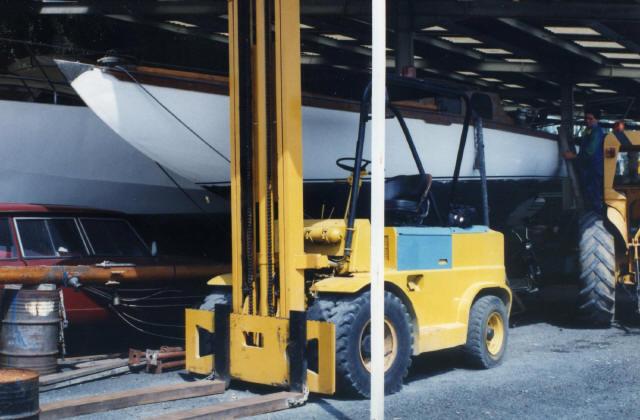
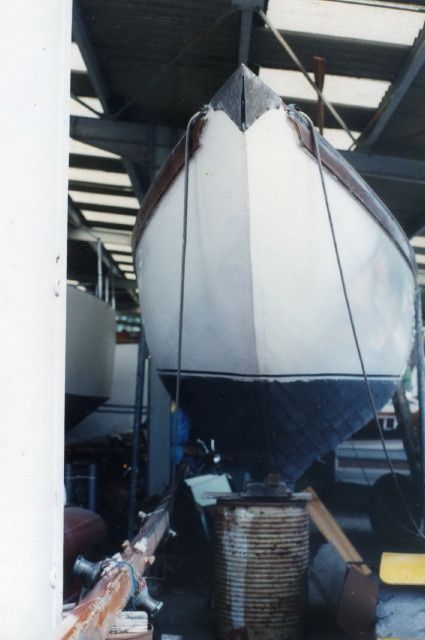
Cornered by machines, a boat of traditional construction sits on her shores. A quick look shows that she’s definitely a six metre that’s undergone a less than aesthetic modernisation. Her name is Blue Monday, date of construction 1934, origin Scottish. Acquired by three pals in 1992, the Blue Monday had seen the start of a restoration that sadly hadn’t been finished by the trio.

In 2006 the Blue Monday is donated to the Conservatoire Maritime du Havre, an organisation that takes on classic yachts and boats, supports their restoration and sells them on.

At the lecture celebrating her acquisition we learn that her original name was Kyla. The first step in her restoration is the decision by the CMH is to give her this back.
http://idata.over-blog.com/3/23/33/42/img289_1_1.jpg

http://idata.over-blog.com/3/23/33/42/img285_1.jpg

Kyle Act Two : Searching for origins


Following some deep research by Dany, the official in charge of acquisitions, the plans are recovered from Scotland. Receipt of these is a great moment for us, because they enable us at last to know Kyla’s true physiognomy. That moment settles some things for us, the helmsman’s cockpit was identical, but we have a different arrangement for the backstays and will have to add two winches.

A visit from Tim Street, the Honorary President of the British International Six Metre Association brings us a whole complement of precious information.

The renaissance has begun!

http://idata.over-blog.com/3/23/33/42/100_0788_1_1.jpg


http://idata.over-blog.com/3/23/33/42/100_0813_1_1.jpg


Kyla Act Three : The Boatyard


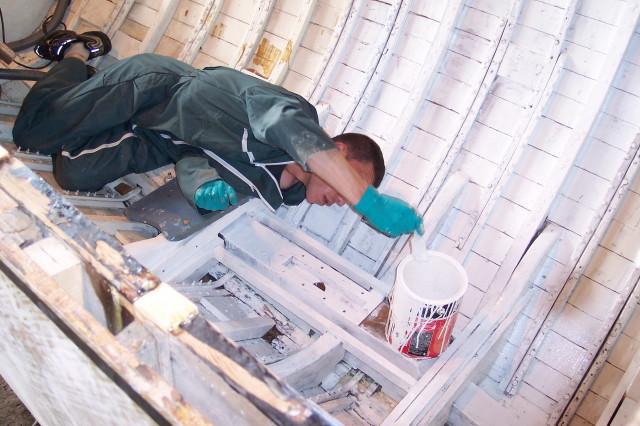
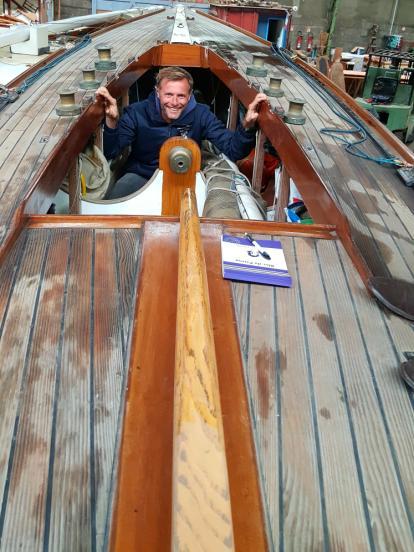
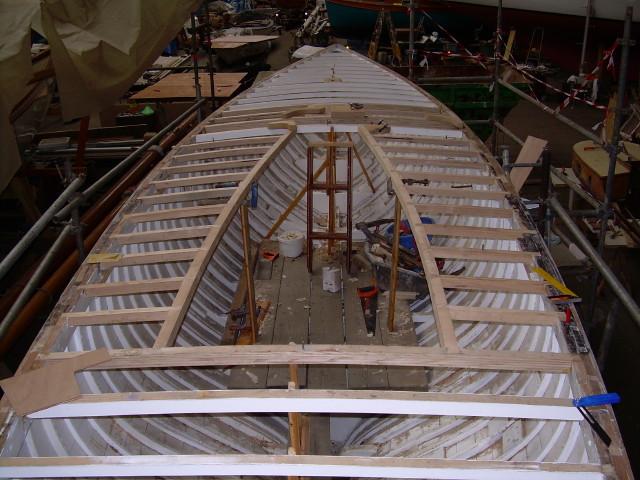
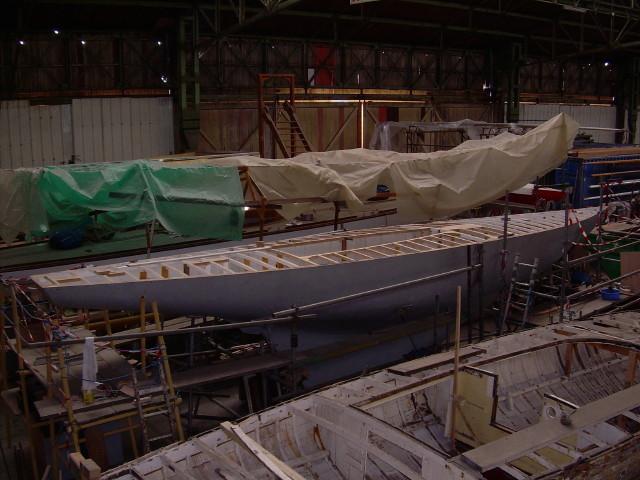
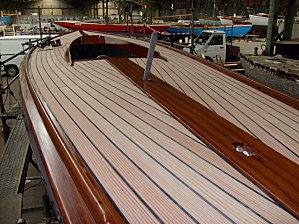
Once the transfer to the yard is done, the work of assessing the real state of the boat and producing an accurate survey follows. This defines the various tasks and how to do them, make provisions, form teams and distribute the work, always remembering that Kyla herself will guide our professional efforts.
http://idata.over-blog.com/3/23/33/42/N1493_1.jpg

http://idata.over-blog.com/3/23/33/42/N1506_1.jpg

http://idata.over-blog.com/3/23/33/42/N1588_1-copie-1.jpg


Kyla Act Four : The Group Dynamic

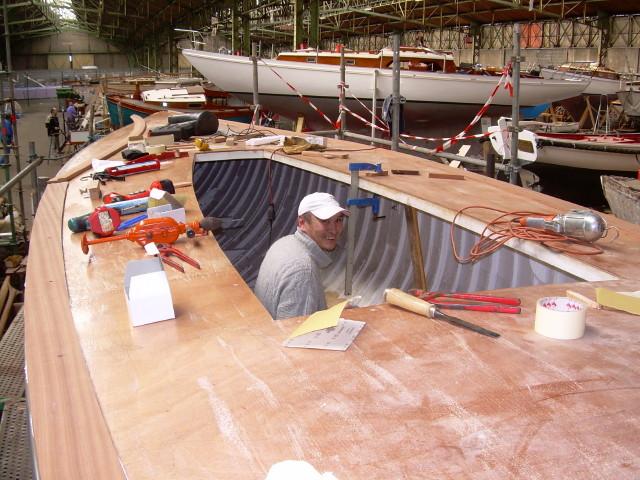
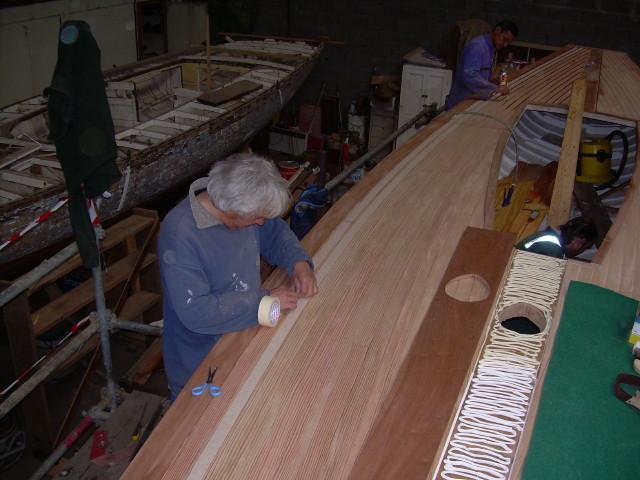
The work proceeds, Kyla’s silhouette takes shape, problems are resolved, such as our blacksmith quickly realising that he has seriously underestimated how much he will have to do on a wooden boat. The dynamic of the group grows in strength, everyone knows his role, every piece of wood has to be perfect, all metal parts solid, aesthetic and brilliant, filling and sanding perfect, the masters words in our ears 

“no shitty painting or varnishing, everything solid and lovely”

http://idata.over-blog.com/3/23/33/42/2007_07190389_1_1.jpg

http://idata.over-blog.com/3/23/33/42/N1883_1.jpg


Kyla Act Five : The Rigging


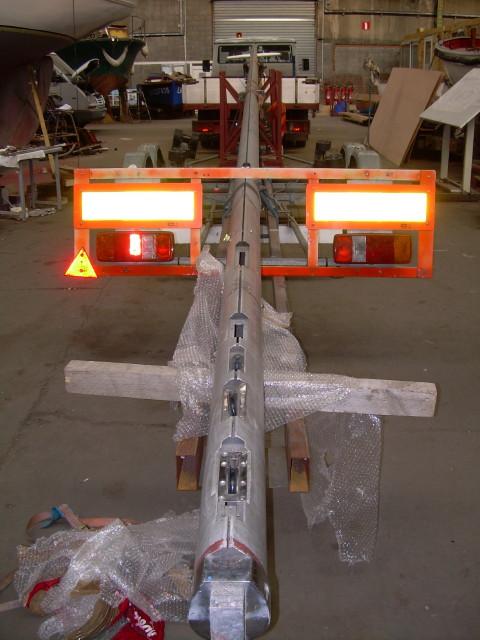
The mast provokes an animated debate, because it doesn’t exist any more. What to do? Making a new one is technically possible at the CMH, however Patrick explaining the technique makes us realise that this measures 14.70 metres to a top like the head of a lightbulb. “Look, we’re restoring a regatta boat and we’ve only got ten months to get the whole job done and try out the complete boat on the water.”

The decision is made, we’ve got to find a mast, a task given to Ronan, an active member of the Association.
http://idata.over-blog.com/3/23/33/42/N1550_1.jpg

http://idata.over-blog.com/3/23/33/42/S6300291_1.jpg


Kyla Act 6 : Completion


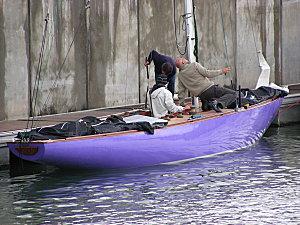
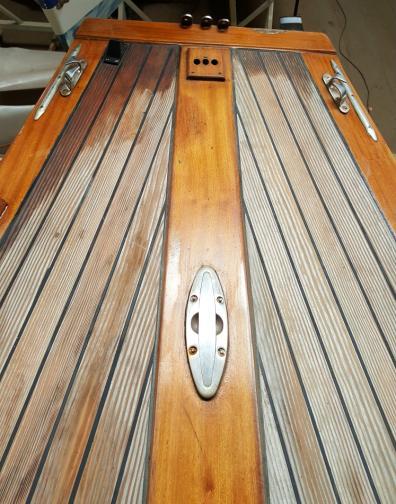
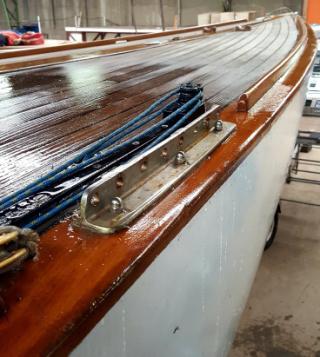
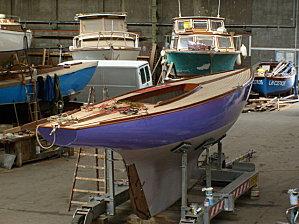
The project goes ahead full tilt, the restoration goes forward fast, the helm, the furniture, the fittings are put in place.

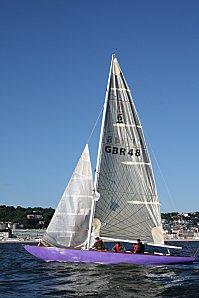
The first coat of paint goes on, the colour surprises us but gives a touch of originality. Why mauve? To give a nod to the the Swiss, whose waters we are sailing on, the colour of MILKA chocolate bars!
S6300214 1

S6300282 1

S6300270 1


Kyla Act 7 The Big Day


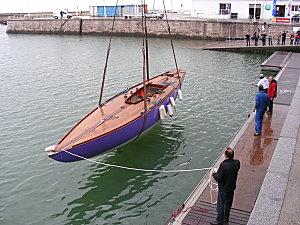
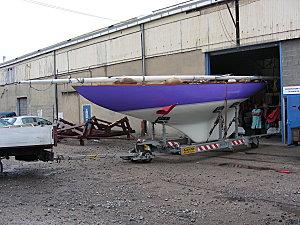
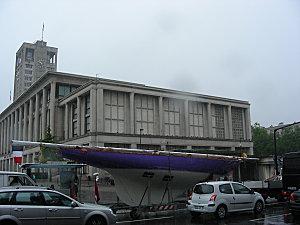
It’s arrived, the big day! An official presentation and presentation to the public, everyone is there, friends, families, participants.

The trip from the yard to the launch site is a great moment, it rains but who cares because we’re all overheating.

The boat touches the water, bravo to everyone! Kyla is beautiful and floats, now we just need to sail her.
mise à l'eau KYLA 007


mise-a-l-eau-KYLA_051.JPG


mise-a-l-eau-KYLA_144.JPG


mise-a-l-eau-KYLA_168.JPG

Kyla Act 8 : Handing over


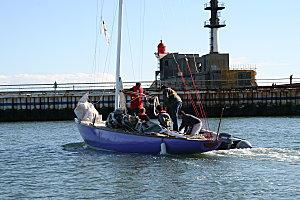
Busy with the final preparations for another big day with Kyla under sail.

Sadly we’re sorry to miss out on this premiere. Well, one is doing well just getting a boat like this to go, as it’s not at all evident!
IMG_0781.JPG

IMG_0786.JPG


IMG_0802.JPG


IMG_0854.JPG

Kyla Act 9 : Welcome to Switzerland


This part of the story consists of us arriving at Lake Geneva just before the historic boat regatta.

It’s lovely to see our Six with all the other classics. What a welcome we got from the Cercle de la Voile Vevay - la Tour

Kyla Act 10 : The boat is acquired in 2003 by Gilles Piette


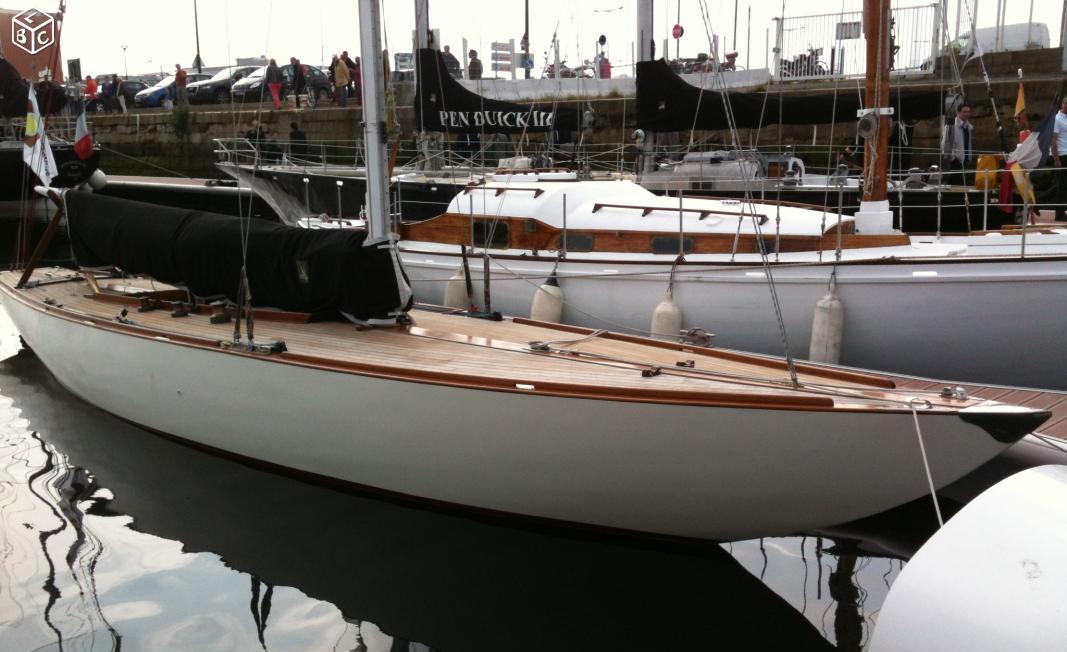
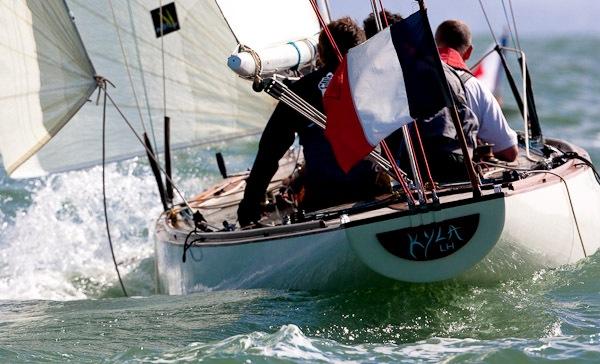
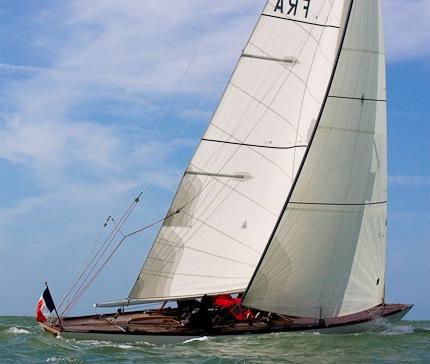
She is repainted white and re-equipped with racing hardware. She takes part in several regattas at le Havre and Deauville until 2015, when her owner throws himself into the restoration of the Eight Meter Silk …


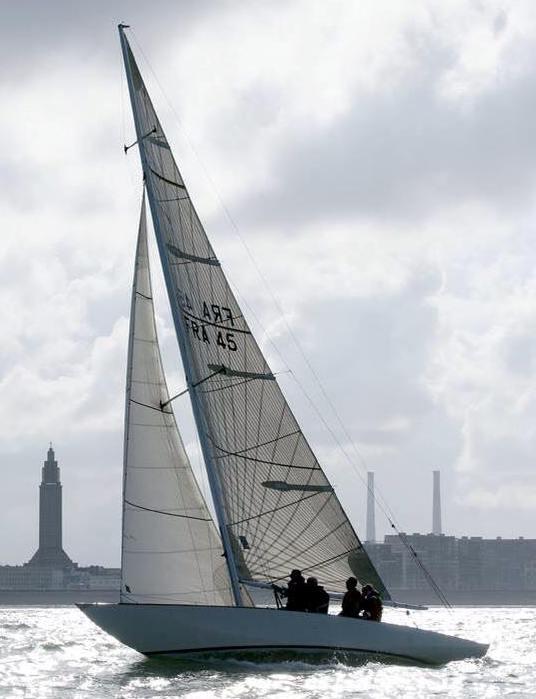


Kyla Act 11 : Stop Press September 2017

A band of comrades from Noirmoutier buy the boat from Gilles, beefing up the fleet of Sixes at the Cercle de la Voile du Bois de la Chaize .

The latest episode in the story of ten years in the recent history of Kyla happens one Monday in September, when after spending the whole weekend in discussions with Olivia and Valerie, Vincent and Jeff go to le Havre in torrential rain to see the boat.

The charm works at once. The decision to buy Kyla takes a few hours! With Christophe and Geoffroy having joined in the adventure by, the boat will join Noirmoutier in Spring 2018 with a view to the Metric Challenge 2018 Metric Challenge 2018 and the European Six Metre Championships European Six Metre Championships starting in September at La Trinite …

watch this space!


Wednesday, 26 June 2013

SCOTS IN OYSTER BAY - Chapter One - One-design Battles on the Clyde


One-Design Battles on the Clyde

By the 1920s the Clyde racing season was well developed, with the organisation shared among a number of yacht clubs. The area must be one of the finest stretches of water anywhere for tactical yacht racing. It contains a network of sea lochs and some lovely islands against a mixed backdrop of hills and coastal towns. While relatively sheltered the Firth has to be treated with respect, as the hills cause plenty of wind shifts and squalls, while the tide creates interesting sea conditions and has been responsible for many races being won and lost.

There was a new enthusiasm for one design racing which resulted in three new classes, the McGruer designed and built Garelochs in 1924, Johan Anker’s Dragon in 1928 and then Alfred Mylne’s scottish Islanders in 1929. 

from the Glasgow Herald

The Islanders had significantly more displacement than the other boats, a bit like “sawn off ” six metres, had a little accommodation inside and the class encouraged fitting an engine, because if you didn’t want one you had to carry equivalent weight and fit a dummy propeller.

Of these new classes the most competitive were the Islanders. From their first outings they established a tradition of racing whatever the weather with close finishes, the fleet generally all home within a few minutes of each other.


The Islanders attracted experienced yachtsmen looking for level racing in a strict one-design environment. Of the first batch Number 5, Sanda, was picked by the brothers Willie and Tommy Russell. Willie and his daughter Udy were the competitive members of the family. Tommy preferred the luxury of a larger boat and eventually went on to commission the lovely Eilidh from Alfred Mylne.

In 1931 the fleet was joined by the almost unbeatable John Herbert Thom, who moved over from the William Fife six metre Susette, formerly Lucille, a design from 1928, in which he was the class champion. He had decided against a Dragon because of its being a foreign design and the engine rule had initially disposed him against an Islander, but the opportunity for keen racing won him over.


It didn’t take long for tense and sometime aggressive competition to develop between the Russells and Herbert Thom. All were people of their time, when the vibrant and rapidly-growing city of Glasgow was producing a new breed of talented industrialists inventing and making things, taking risks and enjoying challenges in their recreations as well as in their working lives. There the comparison between the Russells and the Herbert Thom ended, for their personalities were very different.

Willie and Tommy Russell were a pair of talented, sociable and hard-working engineers whose antecedents had operated the Saracen Iron Works in Springburn. By the late 1920s they had moved from mechanical to civil engineering and were dividing their time between design work throughout the country and yachting and very convivial socialising at Colintraive in the Kyles of Bute, where Willie had a sizeable house overlooking the water. At the time Colintraive was a secluded little enclave of enormous villas and home to numerous Glasgow industrialists, such as the Connel shipbuilding family, a group of mainly unmarried siblings who commuted from their Scotstoun yard in their own fast steam-yachts.

John Herbert Thom was born in Glasgow in 1890 but he had the sea in his blood, coming from generations of Clyde fisherman. Herbert’s father, John, had progressed from a training at the cutting edge of steam technology in the drawing office of Scott & Co in Greenock to become the chief engineering draughtsman at the Barrow Shipbuilding Company. 

Hard work broke his health down and he returned eventually to Glasgow and worked as a consulting marine engineer and naval architect. He became associated with George Lennox Watson in designing engines for the latter’s elegant steam yachts. He also acquired the pump-making company Lamont & Co Limited and renamed it Thom, Lamont & Co Limited, where in due course Herbert would spend his working life.

From his earliest years Herbert was sailing dinghies and taught himself the principles of steering and tacking without a rudder, by weight distribution alone. He never forgot these lessons and later applied what he had learned in boats right up to 12 metre size to ensure correct trim. By the age of seven he was sailing with his father and at the age of thirteen, in 1903, he won his first yacht race aboard Rose, one of the Royal Clyde yacht Club fleet.


In 1925 Herbert bought the 19/24 footer Sunbeam, designed by Alfred Mylne and built by Alexander Robertson & Son in 1904 and immediately began to make an impact, finishing second in the class with 14 first places and seven seconds, out of 36 starts. In 1926, 1927 and 1928 he was class champion, ending up with a grand total of 108 placings out of 143 starts. 

He had to look for a new challenge and bought the Fife 6 metre Lucille, renamed her Susette, came third in 1929 and became champion of the sixes in 1930. By the end of 1930 the sight of close competition in the Islanders won him over and he commissioned yacht Number 9, Gigha, built by Alfred Mylne’s own yard at Ardmaleish.

Herbert Thom brought yacht racing in Scotland into the modern age. He brought the same dedication to his sport as he had done when learning his business after the early loss of his father. He studied every aspect. The major significance of trim we have already noted. He carried this to extremes by requiring crew members to lie down below in calm weather, which must have been hell as such weather would also have been very hot. He let it be known that he carried only a minute amount of petrol aboard, just enough to get to the start and home after the finish.

Some of this was pure psychology. An example was his racing flag, the red, white and blue Tango, naval code for “Do not pass in front of me.” Far more important was his habit of meticulous note-taking, which involved recording the courses taken by other boats and their positions at different stages. He also spent time studying the tidal currents and wind patterns in the Firth of Clyde, sometimes from the slopes of the hills behind Gourock and Hunters Quay.

Competition between the Russell’s McGruer-built Sanda and Thom’s Bute-built Gigha at the top of a closely packed fleet became increasingly intense. Thom’s gamesmanship and steely aggression on the water eventually soured relations with the sociable Russells who enjoyed the sailing as much as the competition. Inevitably there was speculation that the yachts were different. At the end of 1933 Thom announced that to end this he had bought Westra, the oldest boat and put Gigha up for sale.


However, Willie Russell had another idea altogether.

To be continued…..


The Wherrymen

The Wherrymen
Two old friends on the water