Featured post

The Scottish Islanders

  Get your copy from  www.shop.yachtarchive.scot  !

Saturday, 8 December 2012

Bilderglug Fleet Summer Manoeuvres 2012


In which “looks like light winds for the weekend” joins the pantheon of famous last words.

Today mid-Argyll is dreich and grey and with the boats safely ashore there are only memories of the best moments of Summer. The words above come from the briefing from the Supreme Commander of the Bilderglug Fleet, who had commissioned a force to explore mutually supportive open dinghy sailing in an area of strong tides, rocky shores and unpredictable weather, just for fun.
 

Thus at the end of July ten mariners in five craft set out on a short morning shake-down to Bagh na h-Aird at the South end of Luing to wait for the South-going stream. 


The target for the first night was the harbour of Kinuachdrachd a couple of miles down the East coast of Jura. Pronounced sort of Kyanooachrach I’ve heard that its English owners call it KiloDelta.

We got a good stiff WNWly wind across the rather neapy tide, by no means the worst you could get but still a bit lumpy in the whirlies near the Corryvreckan. A few minutes after clearing the point I decided that the jib was a bad idea, got it off and made sure that the tent and all the gear and food were safely stowed and covered, then settled down for a wet crossing.

Some took a port tack just North of West towards Scarba and slightly against the tide, to get closer to the Jura shore they would eventually beach on, whereas I decided on a long leg on starboard tack with the tide, but began to worry how I could eventually get across. The tidal stream strengthens as you get further South and runs like a river quite close to the shore. In the end it didn’t seem to make much difference and we all arrived off KD more or less together.

As we closed the shore the Kelpie was swept half a mile or so past her intended landfall, but a quick tack brought her inshore of the tide, then there were a number of short tacks to get back up-tide to the harbour. Just as we were gathering way after one of these we got knocked down in a squall and a good load of solid water came aboard, a bit annoying when everything had stayed dry so far.


The idea behind the excursion was co-operation, so everyone had brought something to the party with no duplication. Thus the Bilderglug Fleet was well provided with plenty of food and drink, as well as our communal rain shelter. The accumulation of outdoor skills meant that we were soon warm and fed and ready for a good night’s rest on the heather.


Next morning I was pleased to find the Jura ticks had not found me wholesome, but others hadn’t been so lucky. Maybe Highland ancestry has some benefits.


On Day Two we had a splendid sail. Some were worried about being carried on the flood into the Corryveckan, which can happen if you don’t have enough wind to drive you across it, so they started Eastwards towards Carsaig Bay. I reckoned there was enough wind and had a fast reach North, although those whirlies and eddies were at it again and you’re very close to them in a wee open boat.


All made it safe and well to a lovely bay under the North-east corner of Shuna. At least the bay itself is lovely; the outlook is ruined by one of a number of gigantic industrial fish farms that Her Majesty’s Commissioners and Argyll & Bute Council have conspired to allow in this area of great tourist potential and scenic amenity.


We were ashore in good time for rest and reflection, also for some to dream of future voyages.


And future ships to do them in.


Once again a good sail was followed by a congenial and warm evening by the fire, although the  Kelpie’s master and commander went to sleep and missed the DIY pyrotechnics.


On the third day the Kelpie had a fast run home before a gathering breeze, while for the rest of the Bilderglugs there was a hill climb above Arduaine followed by a challenging beat back to Luing.

Altogther it was an entertaining and enjoyable weekend, once again proving the seaworthy nature of little traditionally shaped boats and that by sticking together and sharing resources one can safely achieve things that would be tricky and miserable done solo.

Friday, 7 December 2012

Wonder of the Modern World


The Bell Rock Lighthouse is about 200 years old, depending on your choice of start date, an outstanding piece of engineering overseen by Messrs Stevenson and Rennie, the former of course the grandfather of RLS. The light has an interesting history and its own website, www.bellrock.org.uk

It's only appropriate in the modern world that she should have her own tartan too and today the Commissioners of Northern Lights have announced that they are adopting as their official tartan The Bell Rock 200th Anniversary, designed by the talented Steven Sim of Arbroath.

   
Until talking to Steven recently I hadn't understood just how intellectual tartan design actually is, with the patterns full of references. Here in his own words are some of the meanings buried in this one.
"The tartan design reflects the flashing lights of the lighthouse: white for the primary, white light, and red for the secondary, red light (when first put into operation the lighthouse flashed an alternating white and red light). The muted dark blue and black shades represent the treacherous dark North Sea at night. Solid black commemorates the 1000s of lives lost on Inchcape Rock as well as the men who died during the construction of the lighthouse. The geometry of the tartan creates two different impressions of the lighthouse on the horizon: when flashing white and when flashing red. When flashing white, 90 threads between the black and white represent the 90 courses of stone blocks that make up the tower. When flashing red, the lighthouse is represented at a greater distance, standing on the horizon." 
Over the years the finest artists have been attracted like moths to the Light. Methinks the skipper of the yacht in Mr Turner's effort at the top of this post should have been down to a trysail well before the storm got to this stage. There's also a wonderful image of the Light, but without the accompanying vessel, done by Scotland's very own Jolomo, which the Commissioners will even supply as a Christmas card.

Tuesday, 4 December 2012

More Marine Painting


I am humbled by the fact that my blog derives as many hits from browsers looking for maritime images  as from my own efforts. Truly pictures speak a thousand words.

The late John Gardner was an inspirational fellow seaman, drinking companion, loyal and generous friend and not least one of the finest maritime artists of the last century. I publish his work with the consent of his family, as they are happy for John to be remembered and his work shared, just as he himself enjoyed it being shared through his calendars. Having said all this it’s always nice to be asked, rather than have permission taken for granted and I think it would be appropriate if anyone using an image took the time to send a wee acknowledgement to me for forwarding to the family.

John's images can be found throughout this blog, as you'll see in the list opposite.

Now, continuing my habit of getting a hurl for nothing, I’m moving back to the Nineteenth Century.

The McLean Museum in Greenock houses a treasure trove of art, much of it maritime in nature in keeping with a town that lived on shipping and shipbuilding. They include some great paintings by the town’s William Clark and I  asked the Museum for their consent to republish the following images. They’re happy, subject of course to their involvement being acknowledged. I’m adding their blog to my links list and suggest that any fellow maritime and historical bloggers should consider likewise. I hope that if you decide to republish anything you will extend this great public asset the courtesy of a similar acknowledgement. There are some very interesting articles on their blog and they deserve a lot more followers than they presently have.


William Clark lived from 1803 to 1883 and so his work covered most of the Victorian age. 

The image at the top of this post is of the Eldon, which I suspect was in the Australia trade around the 1840s. The first and second images below have the museum’s own captions added. Many thanks are due to the Leggy Prawn, who alerted me to the Museum's  great archive in the first place.


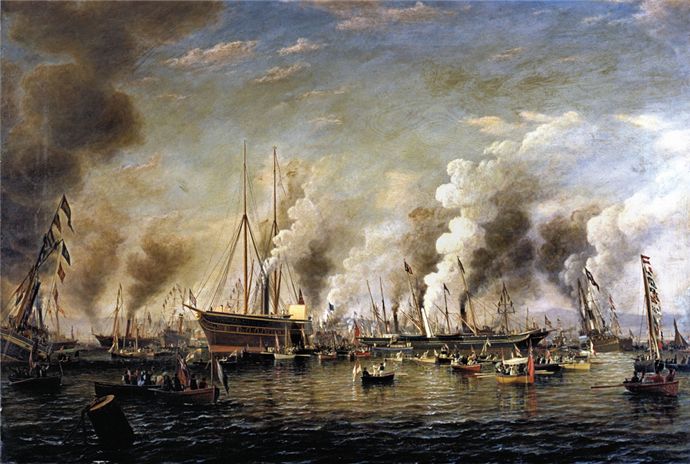
A mid nineteenth century oil painting on canvas entitled 'The Queen's Visit to the Clyde 17th August 1847' by William Clark (1803-1883), showing a view of Queen Victoria's visit to the River Clyde in 1847. The scene is on the River Clyde with a group of large and small vessels decked in flags with many smoke plumes visible. The participating vessels are left to right, Hercules, Chieftain, Fire, Queen, Conqueror, Admiral Garland, Victoria & Albert, Mars, Scourge, Undine, Fairy, Thetis, Sovereign, Premier, Craignesh Castle. Signed and dated 'W. Clark 1847' at the lower left by the artist.


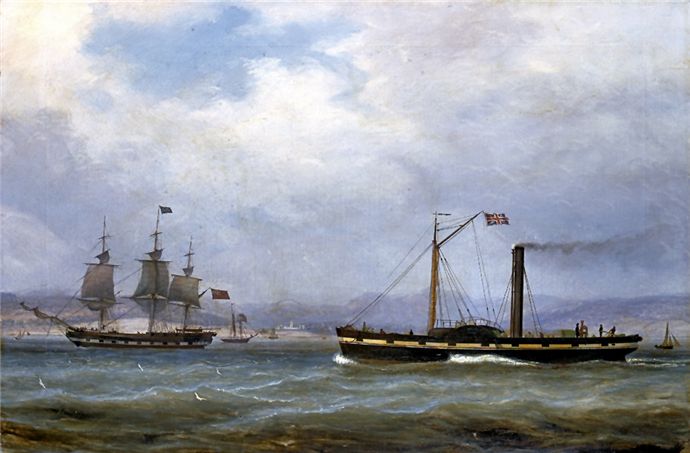
A mid nineteenth century oil painting on canvas entitled 'The Tug Conqueror' by William Clark (1803-1883), showing a scene on the River Clyde off Greenock with a wooden hulled paddle tugboat on the right and sailing vessel on the left. In the background the building popularly known as the 'Duke of Argyll's stables'. Unsigned by the artist.


Next we see some shipping becalmed off the Cloch - how often have we been there? And finally the visit of the Fleet.


Tuesday, 13 November 2012

Bending the Rules


As is well known, the good people of the Slate Islands have a reputation for the utmost integrity. Never in their history have the residents of Easdale, Seil or Luing even contemplated taking an unfair advantage, not only in their working lives but also in their moments of leisure and recreation.  

For example it’s well known that when the sailing ship Norval struck the South end of nearby Insch on 20 December 1870 and broke up a fortnight later, not a single match-stick from her a cargo of fine Canadian housebuilding timber found its way into any of the residents’ modest cottages. You can read the story here, Report from Easdale

Now, one and a half centuries later, the islanders have been presented with a moral dilemma and like their forebears have decided to close their ears to the sea-nymph’s call.


The weekend just passed saw the island residents turning over the Seil Skiff, one of the latest additions to the growing Scottish Coastal Rowing fleet . The build is of course nowhere near finished, but we’ve got a lovely fair hull and know for sure that we’ve got a great foundation to  build on. More important for those of a competitive nature is the simple fact that fairness and smoothness of line are essentials for a fast boat, as the less disturbance caused the better. This much is plain to a layman like me, but other aspects are less obvious.

The moral issues have come as the building work has proceeded. Everyone knows that boat-building is at least 90% sandpapering and doing mindless work as a group allows time for discussion. On Seil our team includes a diverse range of talent with a heavy emphasis on science, engineering and design.  Coming as I do from the law’s dusty purlieus I have been able to contribute nothing, but have listened as various potential contributors to boat speed and manoeuvrability have been analysed.

I’m not going into too much detail unless I give people ideas, but it’s relevant to share the exchange of emails I’ve had with two of the main people in the project

Ewan’s email to Topher and Robbie

“There are a few practical matters that I'd like to run past you …. It seems that rudder design is uncontrolled and we are free to plan what we want in terms of the size, shape and angle of incidence of the rudder blade.  It also seems that there's no problem with an open inwhale, which we see in the photos of other boats and would like to adopt.     We're considering moving the thwart positions a wee bit forward, as we see that some skiffs are squatting especially when they have a heavy cox aboard. I think some teams have done this already. Finally I'm thinking of introducing a small amount of rocker, possibly reducing the depth of the external keel at the ends by an inch or so from Iain's construction drawing. It's difficult to be sure from the photos online, but it looks as if there are some variations already in keel profile.”

Topher’s Reply

“Well done for getting the planking finished, and I look forward to seeing the finished boat. The rudder does seem to be as you say, uncontrolled, and there are many variations on a theme. Slotted gunwales are also OK and we have gone down that route (without reducing weight) for reasons of strength and drainage.  If you move the thwarts my advice would be to keep the number 3 seat centred on the frame, move the stroke seat 2 inches aft, number 2 seat 2 inches forward and the bow seat 4 inches forward, thus increasing the space for each rower by 2 inches and moving the rowers forward, on average, by an inch. We did this on our second boat and so did the Sailing club here. Although oars are many and varied, a consensus does seem to be forming that the oars are better restrained in some way from floating in or out at the oarlock. My advice which you are well experienced enough to ignore would be to make the cheap oars on the oar tab of the SCRA website, and then using those as a datum make better ones when you know what you want. I'd be a bit uneasy about introducing rocker or reducing the outboard part of the keel, because of the advantages to speed and turning which this departure from the plans would introduce. I'm aware as I write this that the same could be said of changing the seat spacing or fiddling with the rudder, but somehow the outside of the hull is sacrosanct, and I would not like to see people cutting their outside keels down to reduce drag. As you say this may already be happening and so far we have not done anything about it, but it could get out of hand. We may have to issue guidance on this, what do you think, Robbie?”

Robbie’s Reply

“Agree absolutely with Topher.  In the measurement rules there is a difference between hulls and fittings (including thwarts).
For Hulls the rule is:
2.1 The hull is to be constructed as faithfully as possible to the St Ayles Skiff plans produced by Mr Iain Oughtred. The hull may be constructed from a kit from the approved kit supplier or may be built entirely from the plans.  That to me excludes varying keel shape by introducing rocker.  For fittings the rule states:
4.1 While the plans show how Rudder, Tiller, Oarlocks, Thwarts, and Seats can be constructed, it is open to the builders to innovate and experiment with these fittings.
4.2 Oarlocks must be at the gunwale. Outriggers are not permitted.
Innovation to me includes spacing the thwarts slightly differently, and that has improved the trim of some boats.  
IO introduced extra buoyancy in the hull shape after the prototype to try to sort out the fat cox problem, but the boats do still tend to sit rather heavily by the stern. It can be helped a little bit by the fat cox sitting forward to shout in the stroke's ear, rather than sitting back and relaxing.
Full measurement rules are here:  St Ayles Skiff Measurement Rules
We need to form a sub committee to review the measurement rules at some point.”

With nearly a hundred boats built or building there is definitely a need for more precise rules.

Oddly amongst the existing generalities there is one rule which is very prescriptive and has no obvious purpose, other than to challenge ingenuity. It is laid down that rowlocks must be made of timber, rather than of metal, which has been the preferred material for several hundred years. This would be understandable if the boats had to be constructed of solid timber, rather than glued plywood. Then the whole project could be seen as an historical pageant, rather than community sport. 

On Seil we’re hoping that this may be something that the promised rules sub-committee will look at early on. 

Update at 19 November

Topher comments:-

I am glad to read your assurance Ewan that the Slate Islanders would not dream of taking unfair advantage of any loopholes in the rules of the St Ayles Skiff. It fans the flames of patriotic pride in my country to hear of the upright probity of these new entrants to skiffdom. Nevertheless we in the SCRA will deal severely with any club found to have used helium filled plywood, and indeed have invested in a helium detector to stamp out this pernicious practice.

We look forward to hosting you in Ullapool in July next year at the World Championship, and if there are any pipers or drummers in your number we especially invite them to take part in the St Ayles Skiff World Championship Pipe Band. 

Well done for getting to the turning over stage and enjoy the fitting out and painting. It is a great moment when you have the first row in your new boat!

Sunday, 4 November 2012

The Designer Unconstrained


As is well known the major challenge for any designer of racing yachts is exploiting the rating rule. Whether we are talking about America's Cup boats or small restricted design classes whichever yacht goes faster through the water will have a better chance of the gold. Such boats can have great disadvantages, sometimes being quirky and even unsafe. Once outclassed, as they inevitably are, they may have little residual value.

It must come as a welcome relief, therefore, to be asked to design something that is unconstrained by a rule. The designer can then apply his creative ability and experience purely to achieve the requirements of his client.

The picture above shows examples of the work of the three greatest Scottish yacht designers (in my opinion) of all time.

At the top is Thistle, George Lennox Watson's 1887 design for a syndicate of members of the Royal Clyde Yacht Club to challenge for the America's Cup. She was the only one of the three to be built to a rule, the YRA rule of the same year, which was intended to encourage greater beam to produce stiffer yachts than previously. She was 86 feet 4 inches on the waterline.

The designers of the other two did not require to comply with a rule.

The middle yacht is Rosemary IV, designed and built by William Fife III of Fairlie in 1928, when his yard was without an order, to keep the workforce busy. She is 36 feet on the waterline. Having no client to please allowed Fife even more freedom and the design is in my view one of his best, having significantly shorter overhangs than his normal productions.

The yacht at the foot is Alfred Mylne's Islander, also designed in 1928. Not only are the ends much shorter than the designs that Mylne did to a rule, she has much firmer sections than either of my other examples.

When the Clyde Clubs Conference were considering a new design in 1928 Alfred Mylne would have been extremely keen to become involved. The new design was intended to replace the 19/24s, nineteen feet on the waterline, twenty four feet overall, sail area massive, which had in turn replaced the 17/19s, governed by a similar rule.There was a general recognition that rules like these had resulted in some pretty extreme boats and several accidents and should be replaced with a new more wholesome boat.

Most importantly, the new boat would be  strict one-design.

The Conference considered various existing designs, such as Westmacott's Sea View Mermaid and Solent Sunbeams and Alfred Mylne's own Belfast Lough River Class of 1921. They probably wanted something slightly larger, because of the better opportunities for short cruises on the Clyde and the Scottish West coast.

Alfred Mylne had recently produced a new design for the Royal Bombay Yacht Club and this duly became the Scottish Islands Class One Design, but with a Bermudian rig as opposed to the Indian boats’ gunter.

The Islander would be 20 feet on the waterline as opposed to the Rivers 18, with the same overall length of 28 feet 6 inches. The sail area would 420 square feet, against the River's 350.

In February 1929 The Yachting Monthly reported that

"The new class has one feature which is a sign of the times, in that the boats will be fitted with auxiliary power and side propellers, those owners who do not wish to carry an engine being required to fit the propellor and carry a weight equivalent to that of the engine."

The view was also also expressed that

"fitted with auxiliaries the new boats will not be very fast, particularly in view of their moderate sail spread..."

There is no doubt that with modern sailcloth the boats are nowadays not under-canvassed. The seas are timeless and the short overhangs, buoyant ends and firm sections are still as valid for safe sailing in a small boat as they ever were.

In order to preserve the one-design principle to the letter and not just to the spirit various rules were enforced. The first five boats were built on a mass-production principle by the McGruers, who worked closely with Mylne and could deliver on a price, having just built the identical Indian boat.

On completion the first owners selected their hulls by lot.

The dummy propellor rule was another example.

Later on the owners were to agree that new sails would only be ordered by a vote, unless for a blown-out replacement, limits were placed on yachts being hauled out for scrubbing and so on. Occasionally owners would compete in each others' boats too.

I've researched the history of this class and published the results on sister website www.scottishislandsclass.blogspot.com. While doing this I was struck at how owners would sell their Islander only to buy another one, to the outside world identical in all respects. The extreme case was the sale by Herbert Thom of his Gigha, the newest boat and buying Westra, number one, following mutterings about an unfair advantage. Underlying all this must have been a reluctance to believe that it was the helmsman who was making the difference.

Herbert Thom did get an advantage in one respect however. It's often been remarked that the Islanders had a rule that each yacht should have a different hull colour and a lot of rather pointless research has been done, admittedly some of it by me before I learned better, to identify the "original" colours. The rule is contained in the 1959 edition, but until I find the earlier one I won't accept it existed earlier. Instead I've had access to personal papers, currently top secret, confirming that all the original fleet were white, apart from Sanda, which was light blue and Thom's current yacht, be it Gigha, Westra or, later Canna, which was always varnished.

It has been suggested by one apparently authoritative commentator that this led to litigation, a judge ruling that varnished was "brown" but there's no evidence of an actual case. From what I've learned of the original owners they were a dignified bunch with better things to do than waste time and money in the courts.

What is certain is that, like everything else he did Thom was exploiting a rule. Traditional varnish could easily be scraped off at the end of each season and the minimum number of fresh coats applied at the start of the next to keep the topsides light, whereas paint would just be abraded to give a sufficient key for a fresh coat, composed of course mainly of lead.

All this suggests that new poachers will soon arrive on any hillside and the gamekeepers will find it hard to keep up. There are lessons in this for our friends in Scottish Coastal Rowing, who have their first World Championships in Ullapool next year.


This is a repost from my  Scottish Islands website, where my friend Hal Sisk posted the following interesting comment

“In 1893, John Coats Jr.commissioned the great G L Watson, at the height of his career, to create two identical 36ft cutters purely for match racing. These were specifically not to be influenced by any rating rule, truly unconstrained. The result was the delightful clipper-bowed pair Gypsy and Brunette.
In his extraordinary busy period,also designing the America's Cup challenger Valkyrie and Britannia II and a steam yacht of 1025 tons for Arthur H E Wood, he also managed to find time to occasionally helm one of the pair in their frequent Saturday races.
My beautiful Peggy Bawn, built the following season as a "fast cruiser" which could also race as a 2.5 Rater, is almost a sistership to the match racers. So she also represents an unconstrained design, from the Golden Age of Yacht design. Indeed her hull shape and hydrostatic parameters conform closely to the "Britannia Ideal" which, for a sea-kindly sailing craft, persisted as a type right up to the late 1960s, until more powerful auxiliary engines caused sailing yacht design to move in the direction of quasi motor sailers.
See also my foreword to Martin Black's "G L Watson--the Art &
Science of Yacht Design".
Hal Sisk 
PS Yachtsmen are slavish followers of fashion and most one designs reflected the style of recent racing craft. An classic example is the Dragon class, with unnecessary long U-shaped overhangs, looking backwards to racing rules which primarily measured waterline length." 
It's possible that Hal may hold the key to the identity of the mysterious Leggy Prawn.

Ace Marine now own the Mylne archives and can be found here:- www.mylne.com

G L Watson can be found at www.glwatson.com

Successors to the Fife dynasty can be found at www.fairlieyachts.com

Friday, 2 November 2012

Leggy Prawn is blogging

But who is at the helm?

Since this blog started we’ve had occasional gems of wisdom from a strange sea-creature, who styles him(her?)self the Leggy Prawn. Time after time he(she?) has come up with solutions to the mysteries and uncannily accurate information, suggesting that among the seabed’s dark rocky nooks and weedy fronds there is a good old-fashioned library of the type never seen nowadays on shore. Perhaps one of our modern politicians, who value nothing other than saving money, has simply tipped a maritime archive into the deep.

Anyway, this strange, articulate and erudite resident of the seabed has now started blogging and the early results look promising. You can visit the new blog here:-  


I'm adding the new blog to my list below and recommend our other blogging friends to do the same.

The Wherrymen

The Wherrymen
Two old friends on the water