Paul can be contacted on paulkennedyart@googlemail.com.
Sunday, 13 January 2013
New Marine Images from Paul Kennedy
Sunday, 6 January 2013
Lang Skiff Spotted
Just after Hogmanay phones started ringing on the shores of Seil
Sound as recovering residents tried to find out exactly what had just passed
their windows. Those of us in the know were able to tell them that the long
double-ended boat now speeding under the bridge at Clachan Seil was Chris
0’Kanaird enjoying his first trip of 2013. He (she?) had come over from
Anstruther for the holidays.
The long-awaited Kilmelford Rowing Club has now been formed and hope
to start on their kit later this month. Babs and Alan kindly brought Chris
round to Loch Melfort and the weather kindly allowed some of the team to
get out on the water. We had a good few circuits of the top end of Loch na
Cille and got a nice introduction to skiffing.
Personally the thing that struck me most was finding how little
resistance there is as the skiff gathers speed. There was probably less effort
involved than in sculling about in a much smaller dinghy. One minute we were at
the edge of the moorings, the next right up at the head of the loch, so fast
that the photograph Iain B took of us is a wee bit blurred.
Thursday, 27 December 2012
Sea Lice get nastier
It’s not an everyday
occurrence, anywhere, to find a prominent, highly respected and much awarded
professor accusing an ancient university of scandalously misleading the nation,
but it happened here in Scotland last month.
The professor’s outburst
was prompted by the publication of a study in the publishing arm of the Royal
Society, itself a respected institution one would have thought, based on
research by an international group of scientists, who suggested that sea lice
are responsible for 39 per cent of the mortalities amongst salmon in the
Northeast Atlantic Ocean. The press release issued by St Andrews University to
accompany publication included
“This high per cent mortality attributable to sea lice was
unexpected. The salmon aquaculture industry has long placed a high priority on
controlling sea lice on their captive salmon – but these results do emphasise
the need for the industry to not only maintain the health of their own stocks,
but also to minimise the risk of cross-infection of wild fish.”
It can be read in full by clicking here
A response from the
aquaculture industry was to be expected, but the ferocity with which it was
delivered perhaps wasn’t. Professor Phil Thomas, the chair of the Scottish
Salmon Producers Organisation said
“This story has now been
exposed as a scandal – it is a major blunder by the University of St Andrews.
The institution has misled the nation.
“For a prominent
Scottish University like St Andrews to behave in this way is inexcusable,
whatever its need for publicity. To make these wholly incorrect and
unjustifiable claims damages both the scientific reputation of the individuals
concerned and the institution.
“But worse, it erodes the already shaky public confidence in
science and scientists, and that is ultimately to the detriment of Scotland.”
The
researchers did not wither under this fire and did not withdraw the study
findings. They did clarify that the study did not actually state that fish
farms were the sole source of the sea lice that were killing the wild fish. The
inference remained that fish farms could be a contributory cause however.
Fast
forward a few weeks and we find Professor Thomas giving evidence to the Rural
Affairs, Climate Change and Environment Committee of the Scottish Parliament
(RACCE) and returning to his theme. The exchange is worth quoting in some
detail
“…..One
tricky issue that is often lost in the debate is that there seems to be an
assumption that sea lice come from fish farms. Sea lice are already there. For
many fish farmers, the most problematic issue is when a run of mature wild fish
come in, as they bring in sea lice—there is a sea lice strike on farms. In that
situation, there can be rapid increases in sea lice numbers….
The
difficulty is that, when wild runs of salmon come in from the sea with heavy
infestations of lice, the transfer of lice from the wild salmon to the farmed
salmon tends to be a mixture of lice of different stages, including lice that
are quite close to mature as well as lice that are at the free swimming stage.”
Nigel Don: “Up to now, I understood that lice did not
transfer except when they were in their first stages, when they are so small
that they get out and about—the idea of a bloom was mentioned. However, Phil
Thomas is suggesting that mature fish coming
back from the sea bring lice at different stages and that lice at later
stages in their development might transfer at that point. That is not what I
thought that everybody else had told me. I thought that a mature louse would
not transfer. Was I wrong?”
Professor Thomas: “Without getting too complicated, there are
two different types of sea lice, one of which often comes in not on salmonids
but on other fish species. It can transfer in a range of ways. However, you are
right in thinking that the predominant route of transfer is through the free
swimming stage.”
It’s a
pity that the RACCE Committee didn’t explore this further, as a few short
sentences are barely enough to explain something obviously complicated.
For those
of us like myself, a non-scientist member of the public who wants to understand
why our wild salmon are disappearing, this conflict is most unhelpful, falling
far short of constructive debate. It cannot be helpful to those, like the MSPs
on the RACCE Committee, who have to produce a report to the Scottish
Parliament, either.
The ways
of nature are of course a mystery to most lay people. At the risk of being
accused of anthropomorphism it seems to me inherently improbable for a mature
sea louse, firmly attached by suction to a returning salmon, travelling at speed, suddenly to decide to jump ship in
the vicinity of a fish farm and make a break for it to another host. For this
to happen to such an extent that it would represent a major threat to the farmed
fish seems even more unlikely.
Before the recent exchange I had tried to educate myself about sea
lice and had learned, as had Nigel Don MSP, that sea lice were a form of tiny
marine crustacean that went through a number of changes in their lifecycle, and
that only in two or three of these stages were they capable of travelling about.
Further reading and discussions with some marine biologists of my acquaintance
have only confirmed that this is correct. In their earliest stage as
plankton they are propelled by water movements until if successful in finding a
host they become anchored to it by a filamentous thread. In later stages they suck onto the surface of
the fish only through being dorso-ventrally flattened. Although the pre-adult and adult stages are
called “mobiles” that word refers to their grazing
activity on the host fish and not their ability to swim around at liberty.
They are very weak swimmers and stand more chance of being eaten by big
fish than getting aboard them. It has also been shown that mature sea lice only
survive in sea water for very brief periods after being separated from the
host.
In the
final paragraph quoted above Professor Thomas seems to be saying that of the “two types of sea lice” it is the one
that infects fish other than salmon that brings in the mature lice. This would rather
contradict the earlier statement that the wild salmon rather than those other
fish bring them in.
In
European waters there are indeed two types of sea louse, Lepeoptheirus salmonis (Leps) and Caligus elongatus (Caligus), the former specific to salmon and the
latter usually found on non-salmonids. There seems to be no evidence at all of
Leps transferring from wild salmon or salmonids to caged fish. There are
apparently some reported instances of Caligus suddenly appearing on caged
salmon when
shoals of mackerel, herring, saithe or other shoaling fish swim past
(Costello, paper published by the Royal
Society B on 8 July 2009). Often these fish are attracted into the area by
the presence of food and surround the cages.
A useful information resource is at the University of Prince Edward
Island (www.upei.ca) where academics partly funded by
Canada’s massive fish farming industry are researching how to deal with the
threat to caged fish from sea lice. It’s instructive that their work
concentrates exclusively on Leps rather than Caligus and I found no reference
to sea lice strikes.
This suggests both that “sea lice
strikes” if they happen at all do not involve wild salmon and that any that
do happen are probably rather minor and do not involve Leps.
Most biologists believe that the primary seat of infection of salmon and
sea trout with lice is by juvenile infective stages when the smolts leave the
rivers in the Spring to enter into the salty coastal waters for the first time.
Before the arrival of fish farms on the aquaculture coast of West Scotland there
would always have been some wild salmon and sea trout along the coast to ensure
supplies of sea lice larvae to infect them.
Arguably the arrival of fish farms on an industrial scale has changed
all that, with enormous populations of mature salmon present all year round in
coastal areas. It seems logical to infer a connection between these and the
high death rate of wild salmon from sea lice infestation identified in the
Royal Society B study.
Whatever the cause there is no dispute over the seriousness of the
problem. It is made worse by the fact that sea lice are now developing an
immunity to the pesticide that has mainly been used to kill them in recent
years, Emamectine Benzoate, otherwise known as SLICE. In a recent talk Dr
Mark Fast of the University of Prince Edward Island said
“1999 was the year the aquaculture industry gained what would be
its most powerful tool in the fight against sea lice. It’s called SLICE…. It’s
an in-feed treatment that, for a time, acted like a silver bullet. It was so
effective that as a researcher studying sea lice, I found it difficult to
harvest sea lice from salmon in an aquaculture environment. I just couldn’t
find them. It worked that well….SLICE’s effectiveness started to seriously wane
around 2008. The sea lice were adapting. The previous two summers had been
worse than ever. Sea lice were partying even harder than they were in 1999.”
The full talk can be found by clicking here
Dr Fast predicts that the industry will develop effective
vaccines to replace SLICE in seven to ten years and cocktails of other less
effective solutions before then, but none of this will directly benefit the
native fish.
For environmentalists the main worry in all this is for
the future of the native salmon and sea trout that are native to Scotland, the
wonderful wild creatures that contribute to our national image and that also
spearhead the marketing effort of the caged fish industry that may be harming
them. There is an urgent need for less invective and more research to find out what
is truly going on.
This article is largely the work of two prominent scientists, who prefer not to be named. The image of a sea louse at the top is borrowed from Dr Larry Hammell of UPEI.
Saturday, 22 December 2012
The Best Christmas Present Idea Ever
What an utterly lovely, beautifully built wee boat, offered for sale at £3,000, unbelievable.
This isn't an ad by the way; this blog doesn't carry them. I just feel that I have a duty to bring her to the attention of the boating world. She's a wonderful memorial to her builder Stuart Mann, who sadly hasn't lived to enjoy her.
She'd be a fantastic addition to the Bilderglug Fleet, although I'd have to hide my own efforts to avoid critical looks at my (lack of) workmanship.
Full details can be found on Port na Storm's Blog
Saturday, 8 December 2012
Bilderglug Fleet Summer Manoeuvres 2012
In which “looks like light winds for the weekend” joins the
pantheon of famous last words.
Today mid-Argyll is dreich and grey and with the boats safely
ashore there are only memories of the best moments of Summer. The words above come
from the briefing from the Supreme Commander of the Bilderglug Fleet, who had
commissioned a force to explore mutually supportive open dinghy sailing in an
area of strong tides, rocky shores and unpredictable weather, just for fun.
Thus at the end of July ten mariners in five craft set out
on a short morning shake-down to Bagh na h-Aird at the South end of Luing to
wait for the South-going stream.
The target for the first night was the harbour
of Kinuachdrachd a couple of miles down the East coast of Jura. Pronounced sort
of Kyanooachrach I’ve heard that its English owners call it KiloDelta.
We got a good stiff WNWly wind across the rather neapy tide,
by no means the worst you could get but still a bit lumpy in the whirlies near
the Corryvreckan. A few minutes after clearing the point I decided that the jib
was a bad idea, got it off and made sure that the tent and all the gear and
food were safely stowed and covered, then settled down for a wet crossing.
Some took a port tack just North of West towards Scarba and
slightly against the tide, to get closer to the Jura shore they would
eventually beach on, whereas I decided on a long leg on starboard tack with the
tide, but began to worry how I could eventually get across. The tidal stream
strengthens as you get further South and runs like a river quite close to the
shore. In the end it didn’t seem to make much difference and we all arrived off
KD more or less together.
As we closed the shore the Kelpie was swept half a mile or
so past her intended landfall, but a quick tack brought her inshore of the
tide, then there were a number of short tacks to get back up-tide to the harbour.
Just as we were gathering way after one of these we got knocked down in a
squall and a good load of solid water came aboard, a bit annoying when
everything had stayed dry so far.
The idea behind the excursion was co-operation, so everyone had
brought something to the party with no duplication. Thus the Bilderglug Fleet
was well provided with plenty of food and drink, as well as our communal
rain shelter. The accumulation of outdoor skills meant that we were soon warm
and fed and ready for a good night’s rest on the heather.
Next morning I was pleased to find the Jura ticks had not
found me wholesome, but others hadn’t been so lucky. Maybe Highland ancestry
has some benefits.
On Day Two we had a splendid sail. Some were worried about
being carried on the flood into the Corryveckan, which can happen if you don’t have
enough wind to drive you across it, so they started Eastwards towards Carsaig
Bay. I reckoned there was enough wind and had a fast reach North, although those
whirlies and eddies were at it again and you’re very close to them in a wee
open boat.
All made it safe and well to a lovely bay under the
North-east corner of Shuna. At least the bay itself is lovely; the outlook is
ruined by one of a number of gigantic industrial fish farms that Her Majesty’s
Commissioners and Argyll & Bute Council have conspired to allow in this
area of great tourist potential and scenic amenity.
We were ashore in good time for rest and reflection, also for some to dream of future voyages.
And future ships to do them in.
Once again a good sail was followed by a congenial and warm
evening by the fire, although the
Kelpie’s master and commander went to sleep and missed the DIY
pyrotechnics.
On the third day the Kelpie had a fast run home before a
gathering breeze, while for the rest of the Bilderglugs there was a hill climb
above Arduaine followed by a challenging beat back to Luing.
Altogther it was an entertaining and enjoyable weekend, once
again proving the seaworthy nature of little traditionally shaped boats and
that by sticking together and sharing resources one can safely achieve things
that would be tricky and miserable done solo.
Labels:
argyll,
bilderberg conference,
Jura,
luing,
open boat sailing,
Shuna,
ticks,
toberonochy,
traditional small boats
Friday, 7 December 2012
Wonder of the Modern World
The Bell Rock Lighthouse is about 200 years old, depending on your choice of start date, an outstanding piece of engineering overseen by Messrs Stevenson and Rennie, the former of course the grandfather of RLS. The light has an interesting history and its own website, www.bellrock.org.uk
It's only appropriate in the modern world that she should have her own tartan too and today the Commissioners of Northern Lights have announced that they are adopting as their official tartan The Bell Rock 200th Anniversary, designed by the talented Steven Sim of Arbroath.
Until talking to Steven recently I hadn't understood just how intellectual tartan design actually is, with the patterns full of references. Here in his own words are some of the meanings buried in this one.
"The tartan design reflects the flashing lights of the lighthouse: white for the primary, white light, and red for the secondary, red light (when first put into operation the lighthouse flashed an alternating white and red light). The muted dark blue and black shades represent the treacherous dark North Sea at night. Solid black commemorates the 1000s of lives lost on Inchcape Rock as well as the men who died during the construction of the lighthouse. The geometry of the tartan creates two different impressions of the lighthouse on the horizon: when flashing white and when flashing red. When flashing white, 90 threads between the black and white represent the 90 courses of stone blocks that make up the tower. When flashing red, the lighthouse is represented at a greater distance, standing on the horizon."Over the years the finest artists have been attracted like moths to the Light. Methinks the skipper of the yacht in Mr Turner's effort at the top of this post should have been down to a trysail well before the storm got to this stage. There's also a wonderful image of the Light, but without the accompanying vessel, done by Scotland's very own Jolomo, which the Commissioners will even supply as a Christmas card.
Tuesday, 4 December 2012
More Marine Painting
I am humbled by the fact
that my blog derives as many hits from browsers looking for maritime images as from my own efforts. Truly pictures speak a thousand words.
The late John Gardner was an inspirational
fellow seaman, drinking companion, loyal and generous friend and not least one
of the finest maritime artists of the last century. I publish his work with the
consent of his family, as they are happy for John to be remembered and his work
shared, just as he himself enjoyed it being shared through his calendars.
Having said all this it’s always nice to be asked, rather than have permission
taken for granted and I think it would be appropriate if anyone using an image
took the time to send a wee acknowledgement to me for forwarding to the family.
John's images can be found throughout this blog, as you'll see in the list opposite.
Now, continuing my habit of
getting a hurl for nothing, I’m moving back to the Nineteenth Century.
The McLean Museum in
Greenock houses a treasure trove of art, much of it maritime in nature in
keeping with a town that lived on shipping and shipbuilding. They include some
great paintings by the town’s William Clark and I asked the Museum for their consent to
republish the following images. They’re happy, subject of course to their
involvement being acknowledged. I’m adding their blog to my links list and
suggest that any fellow maritime and historical bloggers should consider
likewise. I hope that if you decide to republish anything you will extend this
great public asset the courtesy of a similar acknowledgement. There are some
very interesting articles on their blog and they deserve a lot more followers
than they presently have.
William Clark lived from
1803 to 1883 and so his work covered most of the Victorian age.
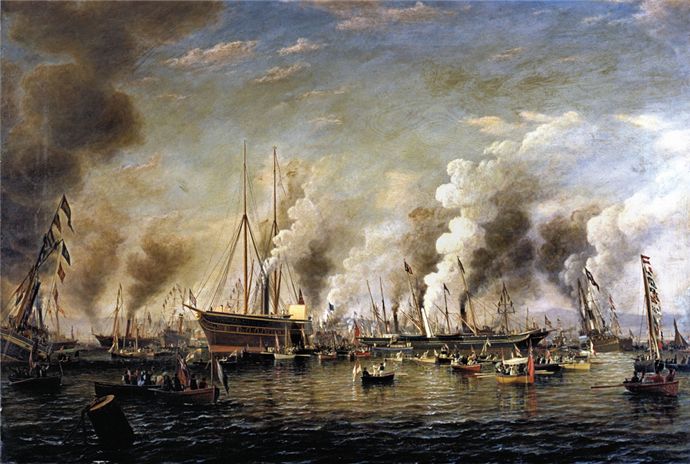
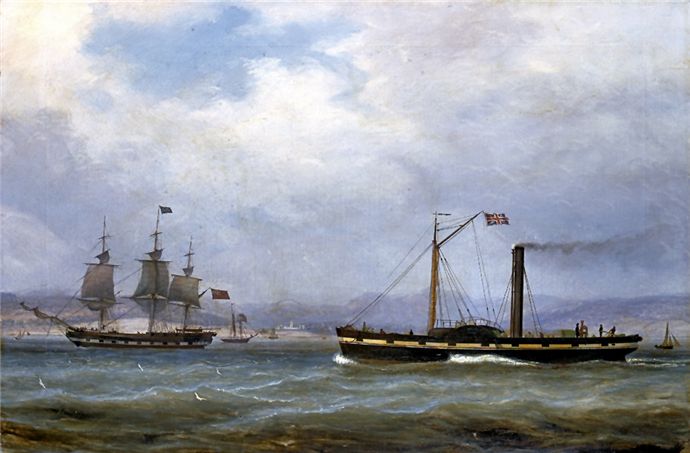
The image at
the top of this post is of the Eldon, which I suspect was in the Australia
trade around the 1840s. The first and second images below have the museum’s own
captions added. Many thanks are due to the Leggy Prawn, who alerted me to the Museum's great archive in the first place.
A mid nineteenth century oil painting on canvas entitled 'The Queen's Visit to the Clyde 17th August 1847' by William Clark (1803-1883), showing a view of Queen Victoria's visit to the River Clyde in 1847. The scene is on the River Clyde with a group of large and small vessels decked in flags with many smoke plumes visible. The participating vessels are left to right, Hercules, Chieftain, Fire, Queen, Conqueror, Admiral Garland, Victoria & Albert, Mars, Scourge, Undine, Fairy, Thetis, Sovereign, Premier, Craignesh Castle. Signed and dated 'W. Clark 1847' at the lower left by the artist.
A mid nineteenth century oil painting on canvas entitled 'The Tug Conqueror' by William Clark (1803-1883), showing a scene on the River Clyde off Greenock with a wooden hulled paddle tugboat on the right and sailing vessel on the left. In the background the building popularly known as the 'Duke of Argyll's stables'. Unsigned by the artist.
Subscribe to:
Posts (Atom)
The Wherrymen
Two old friends on the water