Featured post

The Scottish Islanders

  Get your copy from  www.shop.yachtarchive.scot  !

Showing posts with label Helmut Scharbaum. Show all posts

Thursday, 24 November 2011

Some Thoughts on Model Boats

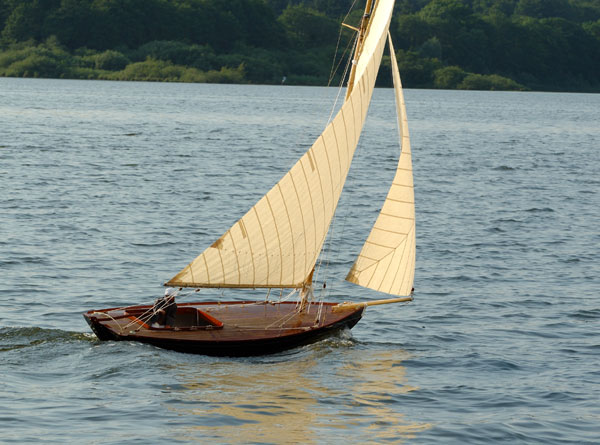
8 metre yacht Fulmar, photo Gisela Scharbaum
The models made by Gisela and Helmut Scharbaum are virtually perfect reproductions of the originals, evidence of a search for authenticity which eventually led them to build the 1:1 model of Tringa featured in my last post.

But their models are more than this. Apart from representing the prototype in all respects these incredible creations are also meant to sail. It seems to me that this inevitably leads the Scharbaums into areas of technical difficulty which lesser mortals would do well to avoid.

Firstly there are problems of scale. At anything smaller than full size the exact scale model will inevitably lack sufficient displacement to carry her full canvas. In other words what is a nice Force Three breeze to the full sized ship becomes a terrifying Force Six or Seven for her quarter or sixth scale model sister. It seems a pity to have to limit one's sailing of the model to days of gentle winds (are there any anymore?) or to have to devise a way of reefing down.

Secondly there are problems associated with keeping water out of the lovely open cockpits of these models and keeping the radio control equipment, batteries and servos dry.

For these reasons most conventional model-builders go down one of two distinct routes, building either full or half models for display or working models for sailing. However one also shouldn't lose sight of the original purpose for which ship models were built, to assist with the design process.

The earliest builders of full-sized vessels would start by carving a model out of solid. Once a shape acceptable to builder and client had been produced it would be sawn apart crosswise to produce sections, which would then be scaled up to produce the shape of the building moulds. Even in the computer age models still feature large in the design process, as the dynamics and variables involved when a hull passes through water at various angles of heel are far too complex for predictive modelling. Tank testing was first developed by the English mathematical genius William Froude, who persuaded the Admiralty to build the first one in 1871. Dennys of Dumbarton were impressed and built the first commercial tank in the world on the Clyde in 1883. Today tank testing is in use world-wide and the makers of the finest models in the United Kingdom are probably R F H Pierce & Associates of the Lake District. There is a fascinating insight into their thought processes and working methods here:-
www.jewelofmuscat.tv

Richard Pierce and his son James have occasionally built full-size yachts and sailing dinghies to order. After Richard completed the replica Scottish Islander Shona his client requested a display model for his house and James produced a first, "practice" one and a second, final version. Here is a photograph of the first one, which I took on a visit to Windermere before she was rigged.


Scotland's leading builder of static display models is undoubtedly David Spy, whose efforts are displayed world-wide. Here is his eight metre Anitra:-


David's website can be accessed here:- http://yachtmodels.co.uk/

Alongside these renowned experts I hesitate to portray my own efforts, which have been graced with enthusiasm rather than skill. I recently completed a six metre for radio control and it's been interesting to find that she actually floats. She's a John Lewis "Tern" design if anyone is interested.

The Wee Giff only took about thirteen years to build, off and on, and was completed with fittings from the English guru Graham Bantock, whose website can be found here:- http://www.sailsetc.com/


Tuesday, 15 November 2011

Tringa lives again - in more ways than one


I was totally astonished to receive the guest post which follows, with a digital album of photos. Blogging is a strange, solitary activity, which has to be seen as its own reward, especially one like this which makes no pretensions to be a money-spinner. Sometimes a bonus turns up, an unexpected gem of information or a story from another corner of the World from a kindred spirit.

I leave it to Gisela and Helmut Scharbaum to describe their obsession in their own words.

"Our interest in model making started sometime in the 1990s. I have always been interested in sailing and when we both saw a model of a wooden sailing ship during an exhibition of model makers, we decided to buy a model kit for Christmas. It was a modern plastic yacht, but since then we have been infected and many radio controlled models followed. We developed our interest in the classic wooden ones, which were not available as a kit. So we started to construct them completely according to the drawings, made everything for ourselves and thus we became more and more experienced.

One day in 1999 we saw the film "enchanted by the dragon" on TV,  a film made by Tom Nitsch, a German film maker with special interest in Fife and his yachts. He knows a lot of the history, the yard and the owners. Secondly the book about Fife, written by Franco Pace, an Italian photographer, confirmed  our wish to build a model of a Fife yacht.

We chose Fulmar, an 8mR and soon we found out that research was difficult and the drawings were hard to get. In the end we managed it with the help of the owner and since then things became much easier. Travelling around in Scotland and South England and the Mediterranean followed, and especially with the help of the RNCYC, especially Ian Broadley and May Kohn and all the other people in Scotland we learned so much about the Fife´s , found so many pictures and drawings which allowed us to build these models as close to the original as possible.


The first time we saw Tringa was in the book Fast and Bonnie, it is the  picture which shows her standing on an iron slip trailer at Robertsons Sandbank. It was the design of the hull which is so remarkable, that we fell in love somehow. After finishing the model and having seen her sailing in 1:4, we made another step further and decided to try 1:1.


5000 hours later Tringa is sailing at the Baltic. There was a lot of learning by doing and one of the most dificult problems was to get the fittings. In the end we visited Classic Marine in Woodbridge and Ording Blokken in the Netherlands to order the fittings for the deck and the mast. For the rest, for example the roller fairleads we made wood patterns and let them cast in Britain at Haworth Castings. Research, trying to find out what Tringa looked like is one of our most favourite jobs.


The Schlei area is nowadays an area for leisure activities like sailing. But it still exudes its own special charm. Our problem is Tringa´s draft which is about 6 feet, and the shallow waters of the Schlei are tricky. For example our first trial was stopped by a sandbank, but we managed to get  free again.


This year we left the Schlei for two weeks and crossed the Baltic towards Sonderborg and Aero. Tringa is seaworthy, she always lets you feel well and safe, she also forgives mistakes and is easy on the helm even in rough weather. She is always in a hurry, we logged 8 knots in fresh wind with a reef in the mainsail!


Sailing around with Tringa is like walking on a catwalk. Everyone is watching, asking, and taking photographs. We are faster than the Nordic Folkboats, which are especially designed for the Baltic. Addictive .


But the modern sail cloth induces a lot of power to the rig, therefore it was useful to add two more frames to fix the plates for the shrouds securely. This strengthens the forward hull and leads the force directly to the metal floors and keelbolts. Former designs were too weak at this point.


The runners are quite important for the same reason. We also have to get used to all the sheets and halyards, but after having made some experiments this summer, everything works better and better. "

Specifications:
Overall length: 24 ft
Length on waterline 19 ft
beam: 7,5 ft
draft : 6 ft
displacement 3 tons
ballast 2 tons  lead
sail area 45 qm (500 square feet)
main 37 qm
foresail 8 qm

frames 5x3 cm
planking 2cm cedar, and larch beyond the waterline, glued with Aerodux and covered with glass fibre (800g Biax)
deck plywood 8mm and 6mm teak/mahogany , the spars are of spruce
bow sprit is of Oregon pine

There's a short film about this talented pair that can be viewed online here:-

www.sailing-films.com

And there's a great deal more information about the old 19/24s here:-

www.clyde19-24.org.uk

The Wherrymen

The Wherrymen
Two old friends on the water