Featured post

The Scottish Islanders

  Get your copy from  www.shop.yachtarchive.scot  !

Showing posts with label William Fife III. Show all posts

Monday, 13 June 2022

The Fife Regatta 2022


With the regatta back for the fifth time and the fleet in Rothesay it's timely to share the article I wrote about the "Other Fifes"!

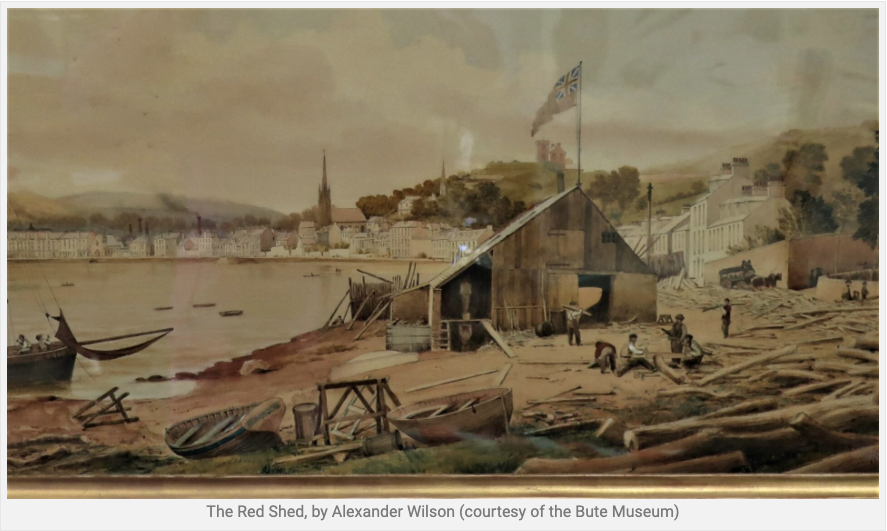
The Fifes of Bute

Saturday, 30 September 2017

Another Mystery Boat


I'm posting some photos taken by my friend John MacLean of Iona, of a lovely little sailing skiff that he rescued from certain destruction about sixteen years ago. He is anxious to trace her provenance and to learn about her history. I'm hoping that this post can set off a trail of detection among enthusiasts for our great Scottish designers and yards.

Right now, all the John knows about his skiff is that he thinks she was built in 1910 and before he found her at Crinan she had apparently been lying for many years beside a loch at Scammadale, up the road from me. There are several fishing lochs up there, miles from main roads, and one can imagine it being too much trouble for the estate owners to look after this lovely little work of art. It must have taken many years of total neglect to reduce a wonderful example of fine craftsmanship to her present pitiful state. It's a sad reflection that someone considered a craft obviously built for occasional sailing in salt water suitable for a fresh water fishing loch. 


The builder's plate looks pretty authentic and ties in with our  knowledge that Robertsons built lots of tenders and small craft, along with some pretty spectacular larger racing yachts and steam yachts. It doesn't help to confirm the date though, as although Alexander Robertson brought his sons into the business he didn't set up Alex Robertson & Sons Limited until August 1922.

In the middle of the plate is the top of the lifting ring, which pulls up to allow insertion of a hook, one at each end to hoist the boat aboard her mother ship after, we hope, a happy trip around the bay under an unstayed lug sail set in that mast partner braced to the forward thwart.

It's possible  that this wee treasure was built for one of the magnificent steam yachts that Robertson was building. But from the excellent Robertsons Wiki Entry, which was largely written by David Hutchison, a member of the family, it seems that yard didn't launch anything of this type in 1910. Candidates around that date could be Alfred Mylne's 60 foot Galma of 1909, or J A McCallums 65.2 foot Aroha (also Adana) of 1914. Yards wouldn't normally farm out the small craft, but if one of them had done Robertsons would have been a good choice. Towards the First World War Robertson was building mainly for the Admiralty and I doubt they would have required a lovely sailing tender.

If we assume that the neighbour would be a West coast yard we are looking at the McGruers of Clynder and William Fife III of Fairlie. 1910 rules out the McGruers, as it seems that they were just getting going then and didn't build larger yachts until later. May Fife McCallum's book Fast and Bonnie has a comprehensive list of Fife yachts, but 1910 seems again a fallow year for large steam yachts. The only candidate is the 83 ton Shaheen, built for a London owner, not very likely.

Two other possibilities occur to me.

Firstly, it's possible that one of the shipyards, such as Connel & Co, might have been building a steam yacht and commissioned Robertsons to produce a very special sailing tender. Directors of those yards did undertake these projects, often for themselves, but usually when work in the yard was slack.

Secondly, our pet might have been ordered by James Rennie Barnet of G L Watson & Co Limited to go with one of the magnificent steam yachts he was designing. He had a special interest in small sailing boats, having been an enthusiast for canoe cruising of the Rob Roy MacGregor type in his youth. You can read about one of his trips on the Forth Yacht Clubs Association website here: Cruise of the Kelpie

So, it's over to you, dear readers, to come up with some ideas!


Friday, 23 March 2012

The first Mystery Yacht's been found as well


Just after the start of my blogging career I posted the above shot of an interesting ship and her crew. My efforts can be read here:- "A Mystery Yacht"

Now a fine educated fellow named Leggy Prawn has found her and says she's a William Fife III. Mr Prawn posted a comment, which really deserves the status of a guest post, so here goes:-

"I'm trying to convince myself that she's on the Clyde, but suspect it could just as likely be Belfast Lough, in which case you're going to have to display your screen to a mirror; otherwise "flip horizontal" - the image that is. It was common for Victorian and Edwardian photographic prints to be the wrong way round.

Then that would be Carrickfergus behind the boom, with the steeple of its ancient St Nicholas' Church and the impressive Norman castle's keep both prominent. And therefore the yacht would be broad reaching past Cultra in the direction of Helen's Bay... more on that below.

If it must be the Clyde, then I think you have to remain in front of the mirror, or flipped, to see that the most likely town behind the boom is Largs, with the Cumbraes perhaps looming forward of the jib. But if there is indeed another conurbation hinted there - I can't see it on screen - then that theory is dashed. Then again, staying flipped, it could be Helensburgh; unflipped it could be Gourock if she was reaching along the Kilcreggan shore...

About the yacht I have less doubt. She is almost certainly one of the Belfast Lough No 1 (or 25ft lwl O.D. Class), designed by William Fife Jr., with all nine built in 1897 by John Hilditch of Carrickfergus. Sail no. 4 of that class was HALCYONE, owned for her first five seasons by Lurgan linen manufacturer and merchant, G. Herbert Brown, JP, of Helen's Bay, by Bangor, Belfast Lough.

The class, including Mr Brown's HALCYONE, did race at the Clyde Fortnight during their first few seasons, so the Clyde is still up for grabs as the location.

Beautifully fashioned iron tillers weren't the sole preserve of William Fife: the G.L. Watson designed 'Peggy Bawn' still sails with her original wrought iron tiller, fashioned by none other than John Hilditch's blacksmith, at Carrickfergus in 1894."


Mr Prawn has sent me an image of the fine tiller, courtesy of photographer David H Lyman


Tuesday, 15 November 2011

Tringa lives again - in more ways than one


I was totally astonished to receive the guest post which follows, with a digital album of photos. Blogging is a strange, solitary activity, which has to be seen as its own reward, especially one like this which makes no pretensions to be a money-spinner. Sometimes a bonus turns up, an unexpected gem of information or a story from another corner of the World from a kindred spirit.

I leave it to Gisela and Helmut Scharbaum to describe their obsession in their own words.

"Our interest in model making started sometime in the 1990s. I have always been interested in sailing and when we both saw a model of a wooden sailing ship during an exhibition of model makers, we decided to buy a model kit for Christmas. It was a modern plastic yacht, but since then we have been infected and many radio controlled models followed. We developed our interest in the classic wooden ones, which were not available as a kit. So we started to construct them completely according to the drawings, made everything for ourselves and thus we became more and more experienced.

One day in 1999 we saw the film "enchanted by the dragon" on TV,  a film made by Tom Nitsch, a German film maker with special interest in Fife and his yachts. He knows a lot of the history, the yard and the owners. Secondly the book about Fife, written by Franco Pace, an Italian photographer, confirmed  our wish to build a model of a Fife yacht.

We chose Fulmar, an 8mR and soon we found out that research was difficult and the drawings were hard to get. In the end we managed it with the help of the owner and since then things became much easier. Travelling around in Scotland and South England and the Mediterranean followed, and especially with the help of the RNCYC, especially Ian Broadley and May Kohn and all the other people in Scotland we learned so much about the Fife´s , found so many pictures and drawings which allowed us to build these models as close to the original as possible.


The first time we saw Tringa was in the book Fast and Bonnie, it is the  picture which shows her standing on an iron slip trailer at Robertsons Sandbank. It was the design of the hull which is so remarkable, that we fell in love somehow. After finishing the model and having seen her sailing in 1:4, we made another step further and decided to try 1:1.


5000 hours later Tringa is sailing at the Baltic. There was a lot of learning by doing and one of the most dificult problems was to get the fittings. In the end we visited Classic Marine in Woodbridge and Ording Blokken in the Netherlands to order the fittings for the deck and the mast. For the rest, for example the roller fairleads we made wood patterns and let them cast in Britain at Haworth Castings. Research, trying to find out what Tringa looked like is one of our most favourite jobs.


The Schlei area is nowadays an area for leisure activities like sailing. But it still exudes its own special charm. Our problem is Tringa´s draft which is about 6 feet, and the shallow waters of the Schlei are tricky. For example our first trial was stopped by a sandbank, but we managed to get  free again.


This year we left the Schlei for two weeks and crossed the Baltic towards Sonderborg and Aero. Tringa is seaworthy, she always lets you feel well and safe, she also forgives mistakes and is easy on the helm even in rough weather. She is always in a hurry, we logged 8 knots in fresh wind with a reef in the mainsail!


Sailing around with Tringa is like walking on a catwalk. Everyone is watching, asking, and taking photographs. We are faster than the Nordic Folkboats, which are especially designed for the Baltic. Addictive .


But the modern sail cloth induces a lot of power to the rig, therefore it was useful to add two more frames to fix the plates for the shrouds securely. This strengthens the forward hull and leads the force directly to the metal floors and keelbolts. Former designs were too weak at this point.


The runners are quite important for the same reason. We also have to get used to all the sheets and halyards, but after having made some experiments this summer, everything works better and better. "

Specifications:
Overall length: 24 ft
Length on waterline 19 ft
beam: 7,5 ft
draft : 6 ft
displacement 3 tons
ballast 2 tons  lead
sail area 45 qm (500 square feet)
main 37 qm
foresail 8 qm

frames 5x3 cm
planking 2cm cedar, and larch beyond the waterline, glued with Aerodux and covered with glass fibre (800g Biax)
deck plywood 8mm and 6mm teak/mahogany , the spars are of spruce
bow sprit is of Oregon pine

There's a short film about this talented pair that can be viewed online here:-

www.sailing-films.com

And there's a great deal more information about the old 19/24s here:-

www.clyde19-24.org.uk

The Wherrymen

The Wherrymen
Two old friends on the water