Featured post

The Scottish Islanders

  Get your copy from  www.shop.yachtarchive.scot  !

Sunday, 1 April 2012

Proposed Fish Farm on Colonsay


I was on Colonsay at the beginning of February at the request of some of the residents to take part in the discussion at a public meeting called to consider the issues surrounding the proposed Marine Harvest fish farm. I greatly enjoyed my visit to what was a new island for me, but one I had often seen tantalisingly on the horizon from the top of Dun Fada, the prehistoric vantage point at Degnish. Colonsay's situation out in the Atlantic with little shelter has always put me off attempting a visit in my small engineless boat. The summons was thus welcome, if a little daunting, as I understood that Marine Harvest folk were to be at the meeting in force. In the event everyone kept his or her cool and there was a mature and level-headed exchange of views.


I've already written about the non-political aspects of my trip on my blog, here :- Cool Colonsay As the debate is now hotting up, with an article in today's Sunday Herald, readable here:- £50,000 Bribe for Salmon Farm Site it's appropriate for me to set out what I said at the meeting, with some afterthoughts added.

For the avoidance of doubt (as lawyers often say) I am no eco-warrior and took an interest in fish farms only because the area of mid-Argyll where I live hosts more of them than the local environment can sustain and matters are approaching a crisis point. A year ago a group of our local residents formed ourselves into a campaign group to stop further expansion in our area. If you visit our website http://www.saveseilsound.org.uk you will see that we have tried to evaluate the various arguments raging around fish-farming. We have had a lot of professional input and have not just tried to educate ourselves by trawling the internet. For my talk on Colonsay I decided to present some of the arguments against fish farms, in order to give people a starting point for further research and discussion.

What follows is an outline of my talk, updated in bold text in the light of the discussion at the meeting.

First a few words about the historic background.

Fish farming in Scotland started in the late 1960s and soon came to be encouraged by central and local government as a low investment addition to rural economies. It was envisaged that crofting and fishing families would establish small scale operations in their localities, producing a healthy, easily-marketed product that would benefit from the fantastic reputation already enjoyed world-wide by Scotland's wild salmon. It was probably thought that these small units would add something to the tourist experience in giving people the chance to see wild fish close up. I certainly remember looking at a trout farm off the Inverary to Dalmally road early on and it had a small visitor centre next to it. 

As often happens with well-intentioned schemes this rather idyllic business model was never realised. From the beginning very few local families became involved in setting up farms and those who did quickly discovered that the levels of veterinary knowledge and new skills involved in rearing large quantities of fish in a confined space were too problematical and expensive to acquire. Soon a number of companies were formed, which have amalgamated and grown over the years, until today there is only a handful of which Marine Harvest is probably the largest.

I agree with Kenny Black's remark at the meeting that the original crofting model could have been ecologically damaging. A large company with careful management and a proper structure of training in fish management is a necessary, but perhaps not a sufficient condition for a safe operation.

Control of pollution

It was always known that even a small installation would result in waste matter such as uneaten food and effluent landing on the seabed, fish farms would cause pollution, so in line with the best scientific advice at the time leases were granted for ten year periods. At the end of the lease the cages would be moved to a different location in the same neighbourhood to allow the seabed to recover. In practice this never happened and the principle has now been abandoned.

In the years up to the early 1980s fish farms typically had a capacity of about 100 tonnes, representing a population of about 25,000 mature salmon, assuming 4 kg per fish. Figures collected by the then Scottish Office show that by 1986 the industry was producing 8,700 tonnes of salmon, and waste equivalent to that produced by the entire human population of the region where the farms were situated. Fast forward to 2012, we find that the Scottish industry claims to be one of the biggest in the World, set to produce about 150,000 tonnes of fish in the current year. To produce this the individual units have grown, so that SEPA will now licence biomass up to 2,500 tonnes per unit, about 600,000 mature fish.

No one disputes that fish farms pollute and it's obvious that large ones do so more than small ones. Because of this farms were always allowed to drop pollution onto the seabed within a defined area, the "Allowable Zone of Effects". Originally this was set at, I believe, twenty five metres from the edge of the cages, but later it was extended to much greater distances and a system of computer modelling known as Autodepomod was introduced, whereby an attempt is made to predict where all the uneaten food and fish waste will end up. How this works is difficult for lay persons to understand, but I think it is agreed by the industry that it all depends on the accuracy of the data about the strengths and directions of tidal flows and the seabed. For example a muddy or sandy bed will cope better than a rocky one, as the tiny marine animals that live below the surface are supposed to clean up the mess. Unfortunately we have evidence from divers that at some sites these creatures have themselves been asphyxiated, as conditions were totally anoxic.

In the course of the meeting we learned that the present limit of 2,500 tonnes results from the limitations of the current version of Autodepomod and that farms are likely to get even bigger when new software is developed and tested.

Right now the seabed round all of Colonsay is absolutely clean and people should think long and hard before encouraging a major polluter to come in, and on a permanent basis.

East versus West

The entire Scottish fish-farming industry has been accommodated on the West coast, which for obvious geographical reasons doesn't include the coasts of Ayrshire and Dumfries and Galloway, so effectively there is a sort of aquaculture coast from the far north west down to the Mull of Kintyre, with parts of the wider Firth of Clyde thrown in.

This is because it has been Government policy from the earliest days to spare the Big Four rivers, Spey, Dee, Tay and Tweed. Hypocritically Scottish planning guidelines state

"There is a presumption against development of marine finfish farm developments on the north and east coasts to safeguard migratory fish species. (my italics)"

absurdly implying that West coast salmon prefer to stay at home. A more likely explanation would be that the proprietors of these great fishing rivers, where a fortnight on a half mile stretch of bank sells for millions, possess more clout than those in the West.

One effect of this is to create by accident a sort of scientific experiment, with the East as a control group for the West. This is not lost on campaigners in both sides. The industry says that their farms have no effect on fish stocks; wild fish campaigners differ.

There's no doubt that a great deal of information and disinformation is being put about. Wild fishing interests historically had a lot to answer for, but now have very strict rules about returning catches. Also, netting traditionally devastated stocks, but most of the netting stations have been shut down, those in the West as they became unprofitable, those in the East through being bought out by fishing interests and closed. For me the clincher is the evidence from the River Ruel. The wild salmon there had become virtually extinct, but since the salmon farm in Loch Riddon was relocated to Ardmaddy in 2005 they have gradually been returning.

Possible types of interaction between caged and wild fish

Next let's have a look at how farmed salmon and wild fish interact with each other. The latter are of course not just wild salmon, but also sea trout. Not a lot of research has been done on sea trout, but it's known that they aren't migratory like salmon. There are no salmon rivers on Colonsay, but they must migrate past the island. There are sea trout in abundance.

The main issues are (a) possible interbreeding when caged fish escape, (b) infectious diseases and (c) sea lice. The first of these is very contentious and to explore it here would get us into very technical territory. Infectious disease is a serious risk where any large populations, be they battery hens, cattle or whatever are kept in factory conditions. Infectious salmon anaemia resulted in the entire Chilean fish farming industry being closed down. There was widespread human misery when everyone got sacked without compensation. There is no doubt that if disease breaks out it will infect local wild fish populations. The third threat, which is most immediate, is sea lice.

The sea-lice menace.

Sea-lice are an absolute menace to both farmed and wild fish. But what are they? Sea-lice is the common term used for one group of small parasitic crustaceans which occur naturally on fish world-wide. They are akin to other crustaceans such as lobsters, prawns and crabs. At an early stage in their development they can be carried long distances until they find a host fish, after which they fasten to it and mature to spend the rest of their life feeding on it. When fully grown they are about 1cm long and can easily be spotted clinging on to the body of the fish. A sheep tick is very small by comparison.

Sea-lice have been around for millennia and in numbers are devastating to fish. They die in fresh water, affording some relief to migratory species such as salmon, but very little research has been done on sea trout. It's beyond argument that the huge populations of caged fish in large industrial farms are sea-lice paradise. They have caused massive losses of fish and require farms to be closed down and fallowed periodically.

To deal with the menace the industry uses a number of pesticides to kill the lice, ideally before they reach their final egg-bearing stage. Historically hydrogen peroxide (bleach) was added, but proved relatively ineffective. It did have the advantage that it dispersed in sea water fairly rapidly. The industry has moved on as the lice have developed immunities and there has been pressure on SEPA to license the use of new, stronger treatments.

At the meeting the Marine Harvest spokesman Ben Hadfield mentioned the use of wrasse as a way of controlling sea-lice. These are small scavenger fish that co-exist with the caged salmon and eat the sea-lice. Ben mentioned the project that is currently running at Machrihanish to breed these magic fish (funded incidentally to the extent of one half each by the taxpayer and the industry).

What was not made clear was whether wrasse would be used at Colonsay from the beginning instead of conventional pesticides, or rather that their development was still aspirational, something that could be introduced in future.

Data on the SEPA website show that in 2010 Marine Harvest were still using various pesticides at its existing sites. This is a matter that can be easily cleared up, by asking Marine Harvest formally to confirm if they will use pesticides and if so which ones, or use wrasse exclusively from the outset.

Pesticides and Lobsters

As noted above sea-lice are crustacea and the pesticides that kill them are likely to harm lobsters, crabs, prawns and oysters, all of which are found in abundance around the island at present.

Impacts on wild life
Fish farms attract seals, of which there are established colonies on Colonsay. Marine Harvest intend to apply for a licence to shoot them if necessary, under the new system whereby Marine Scotland issue licences. The first returns were actually published on the day of the meeting and are easily found online, as are the comments of the various conservation groups, so I won't add to that literature here.
Shooting is said to be a last resort, but most supporters of the seals believe there are other alternatives, such as surrounding the cages with a second anti-predator net. Kenny Black expressed the view that a properly constructed and tensioned single net should be perfectly seal-proof, making shooting unnecessary.

Another method of anti-predator control is the use of acoustic deterrent devices to frighten off the seals, but there is authoritative expert opinion that these can have devastating effects on other wildlife.

Afterthoughts and Conclusions

I learned a lot from the discussions at and around the meeting. I formed the view that Marine Harvest intend to be on the scene for the long haul and are concerned that it should not self-destruct after a few years due to excessive pollution. They are interested in Colonsay and the other islands precisely because these locations benefit from good tidal streams to disperse pollutants far and wide, as opposed to inshore stretches of water such as Seil/Shuna/Melfort, where there is now clear evidence of pollution and environmental damage.

Further, as noted above, there are no salmon rivers on Colonsay, although it's obvious that salmon will migrate past and there are local sea trout, which are not a migratory species. As the latter, unlike salmon, don't have anyone to speak up for them it's likely that the project will not attract much opposition from wild salmon interests.

That's what Colonsay offers Marine Harvest. What does Colonsay get in return?

At the meeting, and confirmed in the Sunday Herald article these seem to be two- six full-time jobs plus a financial inducement of £50,000 plus £10,000 per year to the local community. That's it, pure and simple. There's no attempt, for example, to suggest that the operation will increase visitor numbers, provide food products locally, or that the fish will be processed locally. 

What is the downside, if Colonsay accepts Marine Harvest's jobs and shilling(s)? I'm not going to comment on the latter, as I believe that money should not decide the argument.

While on the island I confined myself to outlining the arguments on the environmental aspects, partly because that was my brief, but also as it seemed arrogant and presumptuous to suggest on a first visit ways in which the residents of Colonsay could address their various local problems and issues. It didn't stop one resident accusing me of scaremongering, but that was absolutely not my intention.

Having had time to reflect, digest and read up on certain aspects I'm going to venture some views here, with an element of trepidation.

I think it's commonly accepted that the main problem on Colonsay is the declining resident population, presently about 120, of whom many are now ageing. Associated is the lack of employment opportunities.

Rob Edwards in today's Sunday Herald reports that there are currently sixteen full-time jobs, but I suspect that the part-timers form a significant contingent as well. We all know that throughout the Highlands and Islands this is the case, with many holding down several occupations.There's also a lot of self-employment.

The island sustains a primary school, medical practice, social service support, an Hotel, a nice café/restaurant, art gallery and numerous self-employed artists and craftspeople.

There is a local lobster man, an oyster rearing business, a brewery, Colonsay Honey and Lochar Publishing. Sorry if I've missed people.

The main industry is tourism and holiday traffic. There are about five hundred visitor beds.

It's obvious that summer-only employment is much higher than year-round.

It was noticeable that the older residents, including many folk who have retired to the island, spoke in favour of the jobs on offer. During my stay I walked about and spoke to several younger residents, some of whom could be part of the Marine Harvest job pool. None seemed interested in full-time work on a fish farm, although winter work would be welcome. I'm not saying my method was scientific, but I don't think anyone has done a survey among the young locals. Correct me if I'm wrong.

Marine Harvest are a progressive (if non-union) employer who offer a structured training programme. Staff intended for Colonsay would require to spend time on, say, Barra being trained and would then be expected to work year-round. The salary levels mentioned at the meeting seemed very attractive and to me implied that a serious commitment would be required. On balance I'm not convinced that all or perhaps any of the new jobs would appeal to locals. (This is not a reflection on them personally. I just that the quasi-industrial lifestyle is quite different from what attracts people to island life.)

If the jobs went to incomers they would require housing.

It's notorious that the housing stock on most or all of the islands is getting old, with rebuilding and repair costs extortionate. There are reports specific to Colonsay confirming this. The high proportion of holiday and second homes, while necessary to sustain island income, accentuates the problem. All islands face the same housing problems to a greater or lesser extent and they usually are linked to patterns of land-ownership. Taking two non-Colonsay and thus non-contentious examples, on Gigha ten years of community ownership has shown that people will come in with money, ideas and enterprise and stay to make things work, while National Trust or RSPB ownership elsewhere have denied incomers the security and opportunity to contribute that make them want to migrate in the first place.

Would six fish farm jobs be offset by losses elsewhere? I suggest that they could be.

The island economy depends on visitors who come because of its incredibly unspoilt location on the edge of the Atlantic to enjoy the sight of clear pure seas, unpolluted beaches and the wild life that frequent these habitats. Of the latter the grey seal colonies are legendary.

Shooting seals is officially a last resort, but only time will tell how many last resorts there are in practice. Around mid-Argyll there have been nasty historical instances of entire seal colonies being wiped out, something that visitors find abhorrent. These did not involve Marine Harvest, who I am sure would behave responsibly, but I suggest even the most limited culling could have serious consequences.

I was sorry to learn that the local lobster man doesn't have an apprentice, because I guess he will eventually retire and there's a great job there for someone. Colonsay lobsters are said to be thriving, with many being taken by boats from Islay just now. As I argued above, the pesticides used to control sea-lice will present a risk of damage to the colonies along the East of the island. Watching the local lobster fishers (and consuming the product) has always been part of the visitor experience in Scottish coastal resorts. I wouldn't give much for the chances of the local oysters either.

And presenting visitors arriving on the ferry with the sight of a massive fish farm  won't exactly enhance their first impression of the island.

I'm aware that opinion on the island seems to be divided pretty equally, but with everyone wanting the same solution in the longer term, a stronger local economy to stem population decline and add to the general prosperity. Those presently in favour should reflect long and hard on the risks involved, because if Marine Harvest get in now they will be on Colonsay for a very long haul.

Friday, 23 March 2012

The first Mystery Yacht's been found as well


Just after the start of my blogging career I posted the above shot of an interesting ship and her crew. My efforts can be read here:- "A Mystery Yacht"

Now a fine educated fellow named Leggy Prawn has found her and says she's a William Fife III. Mr Prawn posted a comment, which really deserves the status of a guest post, so here goes:-

"I'm trying to convince myself that she's on the Clyde, but suspect it could just as likely be Belfast Lough, in which case you're going to have to display your screen to a mirror; otherwise "flip horizontal" - the image that is. It was common for Victorian and Edwardian photographic prints to be the wrong way round.

Then that would be Carrickfergus behind the boom, with the steeple of its ancient St Nicholas' Church and the impressive Norman castle's keep both prominent. And therefore the yacht would be broad reaching past Cultra in the direction of Helen's Bay... more on that below.

If it must be the Clyde, then I think you have to remain in front of the mirror, or flipped, to see that the most likely town behind the boom is Largs, with the Cumbraes perhaps looming forward of the jib. But if there is indeed another conurbation hinted there - I can't see it on screen - then that theory is dashed. Then again, staying flipped, it could be Helensburgh; unflipped it could be Gourock if she was reaching along the Kilcreggan shore...

About the yacht I have less doubt. She is almost certainly one of the Belfast Lough No 1 (or 25ft lwl O.D. Class), designed by William Fife Jr., with all nine built in 1897 by John Hilditch of Carrickfergus. Sail no. 4 of that class was HALCYONE, owned for her first five seasons by Lurgan linen manufacturer and merchant, G. Herbert Brown, JP, of Helen's Bay, by Bangor, Belfast Lough.

The class, including Mr Brown's HALCYONE, did race at the Clyde Fortnight during their first few seasons, so the Clyde is still up for grabs as the location.

Beautifully fashioned iron tillers weren't the sole preserve of William Fife: the G.L. Watson designed 'Peggy Bawn' still sails with her original wrought iron tiller, fashioned by none other than John Hilditch's blacksmith, at Carrickfergus in 1894."


Mr Prawn has sent me an image of the fine tiller, courtesy of photographer David H Lyman


Friday, 16 March 2012

Mystery Yacht found - She's a Herreshoff!


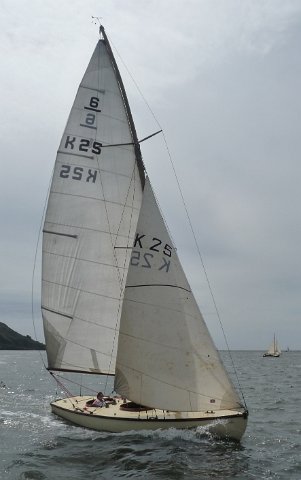
Thanks to a sharp-eyed contributor to this blog, Allen Clarke of Dartmouth, the mystery yacht has been spotted in the South of England, where she is evidently all shipshape and Bristol fashion, in more ways than one, having been launched in Bristol Rhode Island in 1921 as design no 861 of the Herreshoff Manufacturing Company.

She was the first boat built by the company that they hadn't designed in-house, being from the pen of W Starling Burgess, whose assistant and no doubt partner in the drawing work was the thirty year old L Francis.

Sheila was commissioned by her first owner Paul Hammond to compete in the inaugural British America Cup Races and was shipped along with two other six metres from the Seawanhaka Corinthian Yacht Club to the Isle of Wight in the Summer of 1921.

It seems the American's weren't too successful in the first series, something they rectified later.

I don't know who bought the Sheila from Mr Hammond, but in 1933 she was acquired by Iain W Rutherford, who converted her for cruising by closing in the forward hatch, adding a mizzen and the huge windlass I noted in my last post. He also renamed her Suilven, after the famous Scottish mountain, although she has now reverted to Sheila and carries sail number K25.

Mr Rutherford and (I guess) his wife are probably the cosy couple in my original pictures. They cruised in Suilven extensively around the North west of Scotland, also managing a trip to Norway and a circumnavigation of Ireland, until 1938 when he bought the eight metre Pleiades of Rhu. He wrote about his trips, and his wartime experiences, in his book "At the Tiller".

I reckon that conditions in a converted racing yacht must have been pretty extreme, compared to those in something designed for the job. Nearly forty years ago I nearly bought the six-metre Nada, a William Fife III design, when she was lying at Dumbarton in terrible condition. Her cockpits had been covered over to keep the seas out leaving a couple of small hatches for access and the helmsman with a shallow fibreglass tray to sit in, there being a pair of steel lugs to which he could attach himself. Down below presented a long, narrow, dark, dank space equipped with a row of pipe-cots, although on a long beat across the North Sea I imagine you would probably be sleeping more on the side of the hull than in your berth. She had apparently made several long sea voyages in this configuration.

Periods spent in cruising rig have of course enabled many of these old treasures to survive, Nada included, as she's now again in fine racing trim.

Sheila is a lot less extreme than Nada and her principal dimensions are interesting, considering her year of design. They are:-

LOA, 27' 0"; LWL, 23' 6"; beam, 7' 0"; draft, 5' 2"

Very similar to my own Scottish Islander of 1928, which has been compared to a sawn-off six, but Sheila has a longer waterline in an even shorter hull.

She's much shorter than Fife designs of the same period and I guess that W Starling Burgess and L Francis were expecting rough conditions in England and designed a powerful short hull rather than a long slender one that would be better in light airs. In any event she's incredibly modern for her year and it's a pity she didn't do better. It would be interesting to find a report of the racing, which no doubt will be somewhere within the Seawanhaka archives.

I'm going to give Allen ten out of ten for spotting Sheila and myself five for getting some of my guesses right in the last post. She was a much earlier design than I thought, although the photos were from the thirties and she doesn't have a fin keel, see here:-


The mast had been built curved, Swedish square-metre fashion, to improve the aerofoil shape (although it added weight aloft in pre-carbon fibre days).

And of course she has a wee tiller below the deck, in common with most sixes of the time.

I hope that our American friends are pleased to find that the product of two of their best-loved masters of design survives after ninetyone years.

Friday, 9 March 2012

Another Mystery Yacht


The first scottishboating mystery yacht remains unidentified after more than a year, so let's have another go with a new one. Peter has sent in the images above, which show a yacht with a number of interesting and puzzling features.

The photos were all taken by the famous Scottish photographer Ian G Gilchrist, who published a couple of fine books of images, Call of the Wind and Scenes and Sails on the Firth of Clyde under his Windward Publications imprint. From the general style I guess that the pictures above are pre-War, when Ian was in his prime.

The pictures show a hull form that would have been unusual in the 1930s with short ends and what appears to be a flat run aft, possibly suggesting a fin keel.

Image one shows a fractional sloop rig and a mast that has suffered a bit through backstay tensioning, whereas in the other images she has sprouted a mizzen.

Was she designed as a racing yacht, perhaps by her owner anxious to prove a theory and later converted for cruising? There is a clue suggesting that this might be the case in that she seems to have had originally two circular cockpits for safety reasons in the style of many of the early extreme racers, the foredeck hand nipping out of the forward one when required while the helmsman aft concentrated on cerebral work unhindered.

The pictures of her in cruising set-up suggest a very cosy cockpit arrangement, particularly if you invited any guests along.

It's difficult to imagine what life would have been like down below, rather claustrophobic I guess.

An anchor windlass worthy of a Titan appears in all the pictures, suggesting that the owner was a cautious chap. It certainly wouldn't have helped while racing.

And how on Earth was she steered? There's no sign on deck of a tiller, or indeed a rudder.

I'm also intrigued about the locations.

Picture 1 with rhododendrons and a big hoose in the background suggests the Kyles of Bute.

Pictures 2 and 3 again too civilised for the West coast with houses along the shore and cultivated fields, so probably the Firth of Clyde again?

For my money picture 4 is outside Crinan.

Finally a few words about the photographer. Ian Gilchrist was married to Gladys Murison Coulson, who had acquired the lovely Mylne yacht Maid of Lorn as a twenty-first birthday present in 1933 and they lived at Kilcreggan, where he established his Windward Publications imprint. Many of the photographs in his books were taken from the Maid or feature her. She was built by McKellar's slip at Kilcreggan in 1908 with a transom stern and lengthened a year later. She's still going strong and won the beauty prize at the last Mylne Regatta. Here's an image of her, courtesy of the lovely blog lochielbute


I would love to know more about the Gilchrists and maybe someone reading this will have known them. They retired to St Andrews, where Ian died in 1974 followed by Gladys in 1988. It would be good to know that Ian's photographic archive has been preserved.

Thursday, 1 March 2012

A Scottish Gem from Don Roberto


Better known in Argentina than in his native Scotland, Robert Bontine Cunninghame-Graham defies categorisation. Politician, adventurer, explorer, entrepreneur, horseman, humanitarian and survivor all apply to him, as well as an acute observer of life and  brilliant writer. He enjoyed a long and exciting life in Spain, South America and Africa but was also deeply involved in Scottish affairs and the first president of the Nationalist Party of Scotland. Friend of and respected by, among others, Hugh MacDiarmid, Compton Mackenzie and Joseph Conrad, he deserves greater recognition in his native land. As a small contribution to this I offer one of his tales from 1905.


McKECHNIE V SCARAMANGA

" MAN, an awfu'-like thing yon law o' general average. Dod aye, I mind aince being the matter of a hundred pound oot by it."

He paused, and spat reflectively into what he, having traded in his youth to Portland Maine, St. John's, and Halifax, knew as a cuspidor. His whole appearance showed him at first sight a man who for the most part of his life had sailed out of Aberdeen or Peterhead.

His iron-grey hair was thin upon his head, and made a halo round his brick-dust face, on which the sun, the storm, and whisky of full fifty years had done their worst. His beard was stiff and bristly, and grew high upon his cheek, and underneath the chin, looked like the back of a wild boar or porcupine. His upper lip was shaved and blue, his teeth stained yellow with tobacco juice. Thick tufts of bristles overhung his eyes and sprang from out his ears, and his enormous hands, once muscular and hard with hauling upon ropes, although immense, were soft and flabby, though still freckled by the sun which tanned them in his youth. Upon his middle finger was tattooed a ring, and round his wrist a bracelet which he tried hard to hide by pulling down his cuff. Not that he was ashamed of it, or ever for an instant posed for anything but what he was, but, as he would explain,

" Mistress M'Kechnie thocht it didna' look genteel. A woman's clavers, aye ou aye ; but then, ye see, Mistress M'K. raises a wild-like turley-wurley whiles, aboot a feck o' things that dinna matter, for I say when a man has got the siller that is the principal." And certainly he had the siller, for from a mere tin-kettle of a tramp, bought upon credit and in which the saying was if you should drop a marlin-spike it would go through her plates, he had attained to the possession of a fleet which peopled every sea.

But though good luck, which he referred to as the " act of Providence," had thus befriended him and seated him in his own private room in the great office, which he once likened to a liner's cabin, the highest praise in his vocabulary, he yet remained at heart the self-same pawky, pious, superstitious, and hard - fisted sailor man that he was when he first sailed in a whaler to the Arctic seas from Peterhead. His friends and his contemporaries knew him as Andrew Granite, whether because of his resemblance to the stone, his character, or simply from his birthplace, or from all combined, no one was sure. But from the Clyde to Timor- Laut, whenever any of his ships was spoken and ran up her number, a smile went round extending from the forecastle to the bridge, and some old shell-back was pretty safe to say, " One of old Andrew's coffins, damn them, a Granite liner ; yes, by God ; sink like a stone in some place some day, or run upon a shoal marked in no blooming chart ; Andrew will grab the insurance money, and then go off to kirk."

Withal he was a genial, simple, whisky-drinking, pious, and not unkindly man, with all the low-class Scotsman's love for law and pride in never being over-reached, and with a gift of story -telling which a long life at sea had sharpened and improved.

His conversation ran on bottomry, on jettison, demurrage, barratry ("a grand word yon," he would explain), and barnacles. Much had he got to say about Restraint of Princes and the like, of berth notes, back freights, charterparty, cessio clause, frustration of adventure, and as to whether frost and rats fell under act of God, or might be held as perils of the sea. Much did he like to dwell upon "diceesions o' the Coorts," quoting with unction Stamforth v. Wells, Hadley v. Baxendale, and Vogeman v. Parkenthorpe, with comments of his own upon the judges, with much about the lunar and the calendar in the vexed question of the " Charter " month, much of the usages of trades and ports, all which he held " redeeklous," deeming them part and parcel of a scheme against the Granite Line.

An elder of the kirk " outby Bearsden," where, as he said, "he stopped," he yet believed that Providence was a malicious demon on the watch to do him damage, sending foul winds and snapping shafts of screws, blowing off heads of cylinders and heating brasses in an arbitrary way, as if the power referred to had nothing else to do but to watch him and his affairs through a celestial magnifying glass which he kept screwed into his eye after the fashion of a watchmaker when looking at a watch.

The house " outby " where Andrew Granite " stopped " was built of such well-hewn and finely pointed stone as to resemble plaster, so neat were all the joints, so sharp the edges, and though substantial, did not seem designed to live in, but rather as a model from some exhibition of what no house should be. Roofed with dark blue metallic-looking slates, it stood in its own carriage-sweep, which, laid with furnace slag in lieu of gravel, formed as it were a yellow ochre river flowing between the bulwarks of green grass which bounded it, and which, as the possessor said, were " trimmed square by the lifts and braces and ran down sheer into the tide." He used to add that "in a ship, ye ken, ye canna let minavellings lay aboot, an' for a gairdner ye couldna' get a better man nor steadier than an auld sailor, if ye can keep him frae the drink."

Laurels and rhododendrons, the latter "bonny heebrids," as the seafaring " gairdner" called them, stunted and withered by the wind, stood ranged beside the avenue in rows, each with its Latin nickname dangling from a wire upon a piece of tin, as if it was convicted of some crime against its fellows and was doing penance for its sins. Cast-iron hoops contrived to look like withies bordered the road ; and to make all things sure, enamelled plates with the inscription " Parties are requested to keep off the grass " reminded people to be cautious how they walked. A battlemented lodge and wrought-iron gate with a huge gilt monogram upon the top stood sentinels at the edge of the domain. Clumps of young spruce trees were disposed at intervals to break the wind, which bent them over opposite the side it blew, and stripped them bare where they caught all the fury of the blast.

The inside of the villa was suitable to its exterior grace. Plate-glass and varnished yellow pine gave it a sort of likeness to a ship. White fluffy mats lay on the floors, and on the walls were water-colours, so well finished and so smooth that they could easily have been mistaken for the best kind of chromo-lithographs. Wax fruit and feather flowers, and hummingbirds, looking distorted ghosts of their bright selves, were stuck about upon the mantelpieces, covered with glass shades. A banner-screen with a ship worked in crewels stood before the fire, which in a bright steel grate burned till the twelfth of May, and then until October was replaced by coloured paper shavings so contrived as to present the appearance of a waterfall.

Mistress M'Kechnie, a large, high-coloured lady, dressed in black silk and girt about the neck with a gold chain from which a watch was hung which dangled loose or else was stuck into the waistband of her gown, sat in her " droring-room " in state. A large medallion of her lord, with a stout wisp of his stiff hair fashioned into a cable round the edge, was pinned upon her breast. It showed him at the age of thirty, grim and ill-favoured, and had been taken in the port that he called "Ryo" by an artist who he said had been " an awfu' clever chiel," and certainly should have been heard of in the world of art for his stout realism and adherence to the truth.

The owner of the house sat in his sanctum, which, like the cabin of a ship, had small round windows, and was adorned with books, bound in morocco bindings, which he never read, and with a coloured photograph of her he always called "Mistress M'K." and stood in awe of; for she came of " weel-kenned folk," and had some tocher and a temper which was not always safe "to lippen to."

With cigars lighted, his friends about him and their glasses filled, Mr. M'Kechnie used to give full play to his imaginative mind on many subjects which had appealed to him during the course of his career as law pleas about ships, soundings in various ports, the absence of all lights on certain coasts, the charms of ladies he had known about the world and his success with them, and other things of a like nature which he discussed more freely when certain that his wife had gone to bed. One tale led to another, but the tale that his friends all loved the best was one he never failed to tell after his second tumbler of stiff toddy, when, with his feet in carpet slippers worked in yellow beads, and with a fox's head in blue in high relief upon the instep, he would light a Trichinopoly cigar, and after, with the story-teller's instinct, having forced his friends to press him, take up his parable.

" Hae ye all got your glasses filled ? Weel aye I am a sort o' temperate man masel', but speerits, ye ken, are a fair panawcea, that is when taken moderately." To such a proposition no self-respecting Scotsman has an objection, and they all used to fill, and, "paidlin' " with their ladles, inhale the fumes of the hot spirit, puff their cigars, and wait expectantly.

"Ye see, ma freens, law is a kittle sort o' gear, especially sea law, as mony o' ye ken I know fu' feel. But the maist awfu' thing is what they ca' yon general average ay juist fair redeeklous. Ye ken what Mr. Scrutton says he's an M.A. and LL.B. and has juist written the maist compendious work on contrack of affreightment as expressed in charterparties a pairfeck vawdy-mecum. Ane ye ca' Mackinnon helpit him, and between the twa they lay ye aff a'maist a'thing that can arise between a charterer and a shipowner upon the sea.

" Charter-party, sort o' dog Lay tin, carta partita they ca't. In the auld days they juist wrote it in duplicate on a single sheet o' paper, and then divided it by indented edges, each part fitted to the other. That's hoo they got the name, indenture.

" A feck o' things ye'll find in Scrutton's book, ma freens, sort o' auncient like. Whiles when I havna' much to do I tak' it doon and lauch, man I lauch ower it till ma heid juist whummles like a sturdy sheep. Oo aye ye're richt I'm sort o' wandered.

" Weel aweel, I'll tell ye now about a wild-like tulzie I had aince with a lash o' Dawgos a' aboot yon cursed general average. Man, it was this wey, ye ken whiles I juist wonder that a man like Scrutton Mackinnon is na blate either does na' dae something to get the law changed. Na, na, ye could na' richtly look for it ; it's the man's bread, ye ken. Aye, I'll heave roond, I'm subject to thae digressions; so was Sir Walter Scott and others I could mention. Ye mind aboot the seventy-twa, or it may be the seventy-five, freights were fairly high and shipowners were ettlin' to mak' some siller. Bad times we are havin' noo yon cuttin' prices, I juist ca' it cuttin' throats but in the seventy-five that's it I had a boat was gaein' oot to Smyrny wi' a feck o' cotton goods. Somehow or other she just snappit her screw shaft, and if she had na' just by a special providence come across a tramp out o' the Hartlepools she micht have wandered aboot yon islands just like Ulysses him thae raise sic' a dirl aboot in Homer ; for, ye ken, I ha'e a sort o' tincture o' the humanities.

" The tramp just gi'ed her a tow in to Saloneeky. Losh me, then there cam' the salvage racket, the maist infernal intrikit affair ye ever saw. A man juist has to go to the slauchter like a lamb, if aiver a ship makes fast a cable to any o' his boats. Scrutton has it textually, that unless the charter amounts to a demise but I'll no deave ye wi' technicalities. Ye'll get it in Sepia v. Rogers, or Hubbertey v. Holts, and when ye hae it, mickle wiser may ye be.

" Fill up, men, it winna' hurt ye, and there's plenty mair . . . ah yes, yon maitter o' the salvage was sort o' seekenin'."

" The worst thing, though, was that the freighters were a' upon me for demurrage. Sirs me, I was fair gyte, and I juist yokit on Scrutton (the vawdy-mecum, ye mind) as if it had been the Holy Scriptures. Ma heid fair dirled wi' Sangivetti v. Postlethwaite and a heap o' cases very much resembling mine. I thocht I had a bit issue anent the cesser clause, and awa' I went to my awgents in West George Street. I laid my case before them, and they lauch't at me fair lauch't. They told me the point was clear that I stood liable. Man, I whiles think the very elements are a' against the shipowner. What wi' they cursed strikes drawin' awa' the trade, the employers' liabeelity, and the infernal intrikitness o' the law, a body hasna' got a chance.

"Ye'll mind, Geordie, when we went tae sea thegither, sax-and-forty years ago it was maist a' wind jammers in thae days ? "

The crony thus interpolated took his black oily Burmah cigar out of his mouth and grunted, " I mind weel. A man juist signed for his salt horse and his salt pork, nane o' your tin-bag then," and, after looking at the ceiling, spat into the fire.

" Aye, that's so, a sailor man was a richt felly then. Nane o' yer comin' aboard withoot an airticle o' kit except a knife and a pair o' sea-boots, and slingin' the latter doon the forepeak and fa'ing drunk upon them.

" Na, na, we a' had oor bit kists wi' plenty dunnage in them and as for your employers' liabeelity set them up a sailor man juist took his ain life in his hand."

Geordie having grunted something about a long yarn and a rope-maker, Andra' came, as he said, back to his course, and once again took up his tale.

" I juist cabled oot orders to my awgent in Awthens to proceed to Saloneeky to arrange for chartering a vessel to tak' the stuff on to Smyrny ; the body juist agreed wi' the captain o' a Greek schooner, ane they ca'ed Scaramangy, heard you ever sic' a name ?

"His craft was ane o' they Levantyne-built bits o' things, awfu' gay wi' paint, a kind o' gin-palace afloat, ye ken the things, Geordie ? She lookit weel, and my awgent cabled me that, wi' God's blessing, he hoped she would do the trip to Smyrny in aboot three days. I couldna' thole yon ' God's blessing ' in the cablegram. A man has his ain releegious opinions ye mind I'm an elder in the U.P. kirk outby Milngavie (ye canna' get the richt doctrine here in Bearsden, a mere puir imitation o' the Episcopawlians, a sort o' strivin' after being genteel, I ca' it) ; but business, ye see, is business. Besides, thae things are better understood, taken for read, as they ca' it up at Westminister.

" Yon blessing in the cablegram cost me a maitter o' some saxteen shillin' the rates were awfu' high in thae times, ye mind. Saxteen shillin' just expended in a manner I ca' redeek-lous, for the Almighty must ha' kent that I was putting up ma ain bit supplication when the cash was at stake.

" Yon Scaramangy had a wild-like crew on board ; man, they Greeks dinna sail short-handed, I'se warrant them. Thirteen Dawgos forby himsel', and the bit schooner not above three hundred tons. Heard ye the like ?

" I canna' bide a superstitious man, for I aye haud nae ane should stand between a man and Him ; if a man wants Him, let him gang straucht, I say through the Auld Book. Anyhow, Scaramangy had his Madoney a sort o' shrine, ye see aft o' the mainmast, and a bit licht burnin' awa' before it nicht an' day ; an' awfu' waste o' can'le. Weel aweel anither Trichinopoly ye'll na aiblins anither tot. What ! yer done ? Geordie, rax me the ginger snaps. Scaramangy I didna' see him ; but I hae seen his like a thoosand times, maist-like dressed in longshore togs, wi' ane o' thae Maneely straws, an' alpacy jacket, an' white canvas shoes ye'll mind the rig. Maist o' them has a watch-gaird on them like the cable o' a battleship ; ye canna' tell a gentleman nooadays, wi' everybody wearin' their bloody Alberts. No a'thegither bad-like sailors are they Greeks ; sort o' conceity whiles the way they paint their bits o' schooners and their barquentines ; maist o' them yallow, wi' a bit pink streak, whiles a blue ane, and sure to hae a figure-head, some o' they Greek goddesses. No, Geordie, Sapho was no' a goddess she was a poetess, a queer-like ane tae, just went fair demented ower a felly they ca'ed But I'm havering the humanities, ye ken, tak' an awfu' grip on a man.

" Scaramangy was most certain to hae had a wee bit curly Maltese dog on board I canna' bide them, rinnin' aboot yap, yappin' and film' the decks. Set them up ; for ma ain pairt, I like a cat, or maybe a mongoose na, na, man, no a monkey dirty brutes, the hale rick ma tick o' them ; seem to gae into a decline tae soon as ye pass the forties. Man, I mind ane, I traded a coat and a bit Bible for him wi' a missionary in the Cameroons. Puir brute, we had na' sighted the Rock of Lisbon, comin' hame, afore he started hostin'. I had him in the cuddy, and ettled to mak' him tak' some Scott's Emulsion. It would na' dae, and we had juist to commit his bit body to the deep, the same as a Christian, just off the Wolf Rock. I dinna' care to mind it. I lost my ain Johnny the same way. Man, I felt it sae, I should hae liked to hae the wee deevil stufft, but his mother said it would be heathenish.

" Nae doot o' it, yon Scaramangy would foul some other body's cable when he lifted anchor, and find his throat halliards unrove they're apt to use them for a warp, ye ken, or some other kind o' deevilment ; but, anyhow, to sea he went in half a gale o' wind.

" There must hae been an awfu' haggersnash o' tongues, bad as the Tower o' Babel, on board the Aidonia ; that's what they ca'ed her thae Levantynes canna' dae a thing withoot a noise.

" Set o' curly-heided Dawgos, with their silver earrings and sashes rowld round their hurdies I canna' stan' a sailor man wi' a sash on him, it looks sae theatrical.

" What happened only the Lord Himself and Scaramangy really ken. The Lord, for a' He kens, never lets on He hears, and Scaramangy was a naitural accomplished liar frae his birth.

" What he said was, that a pairfect hurricane burst on him, soon as he'd pit to sea. He couldna' get the topsails aff o' her, as nane o his dodderin' deevils daur to gae aloft. So he juist watched them blow clean oot o' the bolt-ropes, and shortened the lave o' his sails the best he could by a special interposeetion o' Providence he didna' lose ony o' his heidsails, though nae doots but he deserved tae.

"He says he and his cattle were in the awfu'ist peril that they ever experienced in their lives, the schooner almost on her beam ends, and the seas fair like to smother her.

"In the nick o' time, what think ye he did, man?

" ' Ran for some harbour,' ' lie to a bittie' ; na, na, nae frichts o' him. He juist pit up a bit sipplication to his Madoney in the companion, and promised her (as if the painted bitch could hear him) that if she took him safe to Smyrny, that he would sacrifice something valuable as a sign o' gratitude. Heard ye the like o' that?

" God's truth, it mak's me mad to think aboot it the folly o' the thing and the gratuitous waste o' valuable property.

" Anyhow, he doddered in to Smyrny some gait or ither, and what d'ye think he done ? He an' his men aye, Geordie, nae doots he had the dawg along wi' them went barefit oot to a shrine they had, and returned thanks to Him who stills the waves that is, when He has a fancy tae.

" I dinna altogether disapprove o' that, for, prayer, ye ken, is usefu' whiles. Samuel pit up his sipplication to the Lord before he hewit yon Agag, and Joshua when he smote thae Canaanites, and even Paul a gran' man Paul, sort o' pawky too lifted a prayer when he was in juist sich a situation as was yon Scaramangy.

" Scaramangy and his Dawgos, when they had done their prayer, went aboard again, un-bent their mainsail, and took it ashore and burnt it on the beach. Mad, ye say, Geordie mad, aye, mad enough, but no on business matters.

" Ye can't think what they did then ?

" They gaed awa' up to the British Consulate, and tabulated their claim, under the law o' general average, for the value o' the mainsail ; for the deevils said, had they no made their vow, the Madoney wouldna' have interfeired, and the vessel would maist certainly hae been lost. No blate, yon Scaramangy but mercy me, whatna' a conception o' natural laws he must have had ! Fancy the Madoney expawtiating in the heavens, watching a storm like a fisherwife watching for her man when an easterly gale springs up, and no to be propeetiated without the promise o' an offerin' !

" After I got the cable, I fair sprang oot o' the hoose, and awa' to West George Street, to my awgents, and they tel't me Scaramangy was domiciled furth o' Scotland, and the case would have to be heard at Smyrny.

" It was juist held that whereas Captain Scaramangy, bein' in peril on the deep, and havin' done everything within his power and in the compass o' good seamanship to save his ship ma God ! and being at the point o' daith, had recourse to prayer. Furthermore, the Coort bein' o' opinion that the vessel must have foondered had there not been an interposeetion o' a Higher Power, decides that Captain Scaramangy took the proper course, and that his prayer and his vow being both heard and considered favourably by the Madoney, that she thocht fit to save the vessel and the crew.

" Therefore, the Coort held that the vow was instrumental in the first degree, and that the jettison o' the mainsail which of course wasna' a richt jettison at all was necessary, and that the shippers were all bound to bear their due proportion o' the loss.

" Appeal nae frichts o' me. It cost me, one way and another, mair than a hundred pound. Appeal na, better to lose than to lose mair ; that's a Greek proverb at least I think so, and no a bad yin.

" Yer gauntin', men; weel, weel, good nicht to ye Geordie, rax me doon Scrutton fae aff the top shelf there's juist a pint or twa anent yon cursed general aiverage I should like to look at before I turn in for the nicht."

From Progress, 1905


Monday, 13 February 2012

The oldest One Design in the World (and a chance to buy her)


Avid readers of this blog (you know who you are, I don’t) know how I love a good mystery. If you guddle through my earlier posts from 2010 onwards you’ll find my attempts to trace the histories of long-disappeared yachts and their owners, which have resulted in occasional successes and one or two tales of maritime adventure and even espionage. On reflection it’s actually quite surprising that so many old craft, built as they were in an impermanent medium and often used hard in rough conditions actually survived, the more so when one reflects on the habits of the early owners of racing craft who cannibalised an older boat for rig and fittings for the new one.

Occasionally the hours spent originally in libraries when I started out in a pre-internet age and now done online from a remote corner of Scotland produced real and very satisfying results. Earliest was the discovery that the Scottie survived as she approached her first century, still making ripples on the Wansee.Read that post here:- Scottie, a tale of espionage

More recently I posted on the one-designs of George Lennox Watson here:- The Clyde 17/19 foot Class 

The Master in his prime

I suggested that his nineteen foot lugsail boats created for the Clyde Canoe Club in 1886 were possibly the oldest one-design class in the World. I had to be tentative, as I knew that the Dublin Waterwags of the same year make this claim, supported by the advertisement placed in the Irish Times of 18 September 1886 by their founder Thomas B Middleton, which started off

“It is proposed to establish in Kingstown a class of sailing punts, with centreboards all built and rigged the same, so that an even harbour race may be had with a light rowing and generally useful boat…..” 

Waterwag at Dalkey
At that time I didn’t have a precise date for the Watson boats and also didn’t want to upset the Irish friends whom I meet mostly in cyberspace but sometimes also along our shores, but help has now arrived in the form of Martin Black’s masterpiece “The Art and Science of Yacht Design” which arrived here recently and has put paid to all work around the house for the time being and coincidentally published by some of those Irish friends. Martin records the Dumbarton Herald of 18 August 1886 reporting 

“Early in the present season the Clyde Canoe Club ….. resolved to add to their fleet of lugsail craft, three lugsail boats…. and on Saturday last, 14 August, the three left the Leven for Gareloch…”

The first boats of both classes were built by R McAlister & Son of Dumbarton. It would be fascinating to read any surviving correspondence among the promoters of the two, as we know there were very close family and sporting connections across the Irish Sea at that time.

So there we have it, nearly a dead heat and certainly a victory for the Celts, as both classes beat the Solent by a couple of years.

In my original post I recorded three more boats built in 1887 and a final one in 1888. Martin reports a total of nine, the first three named Red, White and Blue, three more built by McAlisters in 1887 for the Royal Clyde YC, which he doesn’t name and a final three in 1891 by Paul Jones of Gourock, also unnamed.

So what about my 1888 boat? I was thinking about the Banshee, which the Watson design list published in Martin’s book describes (design no 149) as a “Clyde 17/19 ft”, 2.5 tons and built by A McLaren at Kilcreggan. Incidentally Martin also lists the Nell (design no 156) as a “Clyde 19ft”, also 2.5 tons and built by J Adam of Gourock.

Confusion is caused by the emergence of another class hot on the heals of the first one, the 17/19s, about which we know quite a bit. To which class did Banshee and Nell belong?

In my post I wrote that we didn’t have photographs of the earlier boats and posted the lines and sailplans, copied here:-


  Here is a half model of Red, which is just a wee bit clearer than the above.


But I have now learned that one of them, Banshee, still exists. Not only that, she’s for sale, via Gareth Worters of the Dauntless boatyard. Contact details are posted below.  To me she looks like one of the original boats and not a 17/19, which generally weighed in at 3 tons and seem to have much deeper keels.

She’s had a very thorough professional restoration, including making and fitting a new stem, stern post, lots of planking repairs and reframing and an entire new deck structure. From the photos below it seems she’ll need very little, apart from a final coat of paint, to get her sailing again. Gareth tells me that there’s a good set of spars, finished to a high standard and a suit of sails.


As visitors will know this blog is unmonetised and totally non-commercial and I want to keep it that way, but I am happy to help friends in the world of old boats. If you want to pursue the Banshee further you can find Gareth on garethdauntless (at) aol.co.uk.

And if you miss out on the Banshee, don’t forget that Hubert Stagnol is building and has maybe finished (I haven’t heard from him for a while) another of the original design in France, about which I posted here:- Red lives again


Saturday, 4 February 2012

Cool Colonsay


I'm just back from an interesting trip to Colonsay. Over the years I've often had a glimpse of this island, visible far out to sea from the pre-historic lookout post of Dun Fada round the corner from Degnish Point, but thoughts of the great Atlantic swells always put me off visiting by boat. Better to travel on board the good ship Isle of Mull, above, where good conversation and fine strong coffee can be found.

An invitation  to take part in a discussion about the proposed fish farm stirred me from winter lethargy into three days on this magical island on the edge of the world. 

What follows is a little photo-essay of my visit, without the polemic, which I will save for a more political forum.


Well, maybe not entirely politics-free, because what on earth is the Icebeam doing in Oban? She's been here for months, a Swedish research ship equipped with state of the art under-water survey equipment. She's been seen as far afield as Ardnamurchan, as reported by the Kilchoan Blogger.

McCaig's Folly
And I can't resist a poke at the PC Brigade, who insist on calling it a tower, when everyone knows its real name. Here goes with the essay.

Leaving the Sound of Kerrera, Mull in the distance.
On arriving there was time for  quick drive round the island before dark.

The Strand, between Colonsay and Oronsay
It has to be called Hangman's Rock

Loch Fada
First view of Traigh Ban

Day Two dawned cold and bright and I decided to do a gentle stroll from Scalasaig to the north of the island.

Scalasaig

Leaving Scalasaig one soon comes to an interesting wee haven.


After a little while I came to the Colonsay House estate and took a detour through.


A case for the WD40
Traigh Ban again, from under Carnan Eoin
Raised beach


The Old Man of Balnahard

The way back is always longer  


On Day Three I had time to explore south from Scalasaig and walked over towards Queens Bay, where there are signs of old cultivation.


From the high ground one gets a good view of the Scalasaig Kirk.


And finally a view of the route home, with Jura stretching north on the left and Scarba just visible beyond.

The Wherrymen

The Wherrymen
Two old friends on the water